Up date : Mars 2026
LES MARQUES PRÉSENTÉES SUR CE SITE
The brands on this website - Die Marken auf dieser Website
A - B - C - D - E - F - G - H - I - J - K - L - M - N -
O - P - Q - R - S - T - U - V - W - X - Y - Z 0 - 3
(Voir aussi note sur le Zamac, métal utilisé dans l’industrie du jouet, bas de page)
(See also note on the Zamac, metal used in toy industry, end page)
0 Scale Models : voir (see) OSM
3D Laser Craft :
Socité pratiquant la découpe au laser, située à Donegal en Irlande, produisant entre autres des wagons,
voitures
et locomotives en contreplaqué de bouleau.
Laser cutting company producing, among other things, wagons, coache and a locomotives in birch plywood,
located in Donegal, Ireland
Société américaine créée en 1995 en Californie (USA) à Mountain View et regroupe un certain nombre de marques
spécialisée dans le train de jardin (échelle 1:20.3 - 45mm) et la reproduction de modèles anciens au 1:32 et On30.
Ces modèles sont de très grande qualité dans les détails et la finition.
Trois divisions produisent des locomotives, du
matériel roulant dans les échelles 1.20.3 et 1:32, et des rails en code 250 et 232
ou en On30 (du gros matériel de taille
O mais pouvant circuler sur des voies HO de 16,5 mm) :
- AMS : Américan Model Supply (On30)
- Accucraft Custom Line et Accucraft Train pour les trains de jardin.
A noter que Accucraft Compagny UK existe depuis 2004 en Grande
Bretagne. Fondée par Ian et Sandy Pearse cette
société est également spécialisée dans les trains de jardin et la
vapeur vive. C'est l'importateur exclusif de Accucraft US
Us company created in 1995 at Mountain View in California
(USA), and groups a number of brands specialized
in the garden trains
(scale 1:20.3 - 45mm) and the
reproduction of old models in the 1:32 and On30.
These models are of very high
quality in the details and finish.
Three divisions produce engines and rolling
stock in scales 1.20.3 and 1:32, and of the rails codes 250 and 232
or in On30 (of the large equipment of size O but
being able to
circulate on tracks HO of 16.5 mm):
- AMS : Américan Model Supply (On30)
- Accucraft
Custom Line and Accucraft Train for the garden trains.
It
should be noted that Accucraft
Company U.K. exists since 2004 in the United
Kingdom. Founded by Ian and Sandy
Pearse this
company is also specialized in the garden
trains and the live steam. It is the
exclusive importer of US Accucraft
ACE : "O"
Entreprise britannique ACE Electric Train Company Ltd. de Londres
a été créée en 1995 sous la forme d'un partenariat
entre Andries Grabowsky et Alan Levy dans le but de distribuer les trains en
"O" fabriqués par Andries Grabowsky et sa
société ACE Far East basée en Thaïlande.
sur la recommandation de A. Levy.
Ce nom est une anagramme des initiales d'Allen, Charlotte et Emily Levy.
Charlotte et Emily étant respectivement sa femme et sa plus
jeune fille.
La production d'ACE à l'origine
fabriquée à Taïwan a été transférée, en 1996, à Madras, en Inde, puis en
janvier 2000 l'ensemble
de la fabrication a été déplacé à Bangkok, en Thaïlande.
En 2008, le partenariat Allen Levy/Andries
Grabowsky a été rompu, suite à des visions différentes sur l'évolution
a donner aux trains ACE,
Alan Levy conservant ACE
Trains et Andries
Grabowsky se concentrant sur la marque Darstaed.
Les deux entreprises sont toujours en activité (2019).
Logos ACE utilisés par Andries Grabowsky et par Alan Levy:
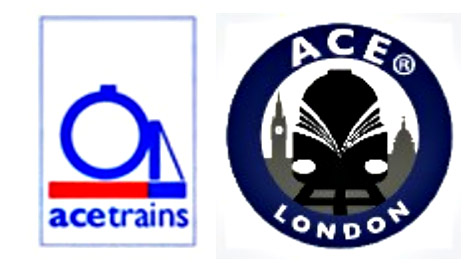
Above logos ACE used by Andries Grabowsky and Alan Levy
UK company ACE Electric Train Company Ltd. of London was established in 1995 as a partnership between Andries Grabowsky
and Alan Levy with the aim of distributing the "O" trains manufactured by Andries Grabowsky and his company ACE Far East
based in Thailand.
The company, originally called Allchem Trains Ltd, then became ACE, on the recommendation of A. Levy.
This name is an anagram of the initials of Allen, Charlotte and Emily Levy. Charlotte and Emily being his wife and youngest
daughter respectively.
The production of ACE originally made in Taiwan was transferred, in 1996, to Madras, India, then in January 2000 the assembly
of manufacturing was moved to Bangkok, Thailand.
In 2008, the Allen Levy / Andries Grabowsky partnership was severed, following differing views on how ACE trains are expected to evolve,
with Alan Levy retaining ACE Trains and Andries Grabowsky focusing on the Darstaed brand.
Both companies are still in operation (2019).
(American Hobby Manufacturers) marque d'un importateur/distributeur américain. Cette société,
fondée au début des années 1960 par
Paul Bernie, fait suite à une autre société
importatrice déjà créée par Bernie à Philadelphie (USA) dans les années 1950 :
la GHC-HO TrainCompany (General Hobbies Corporation) qui importait des trains
japonais et Italiens.
AHM
étroitement liée à Rivarossi était son importateur
exclusif pour les USA et distribuait également du matériel Liliput,
Pocher,
Roco ou Mehanotehnika.
A fait faillite en 1981, la marque
disparait en 1985.
Paul Bernie a alors créé, vers 1982, la marque IHC diffusant alors surtout du matériel Méhano.
(American Hobby Manufacturers )
- Brand of an American
importer/ distributor. This company,
founded at the beginning of the years 1960 by Paul
Bernie,
fact following another importing company,already rested by Bernie in Philadelphia (the USA)in the years
1950: the GHC-HO Company Train (General Hobbies Corporation) which imported
Japanese and Italian trains.
Closely dependent with Rivarossi its was
exclusive importer for the USA and also
distributed equipment To Pocher,
Roco or
Mehanotehnika.
With fact bankruptcy in 1981, the brand
disappears in 1985.
Paul Bernie then created, around 1982, the IHC brand mainly distributing, at this time, Méhano equipment.
Airfix Railway system
: "HO"
A
commencé par produire, en Angleterre, des kits en OO en 1957. En 1960
Airfix produit du matériel roulant
sous forme de kits de construction, dans des boites de couleur bleu clair.
A partir de 1976 du matériel "Ready to run" a été proposé dans un
nouveau catalogue et, partir de 1979, cette production est
commercialisée sous la marque GMR. (Great Model Railways), avec de nouveaux accouplements.
En 1981 la gamme a été vendue à Palitoy, intégrée dans sa série "Mainline".
Cette production cessa en 1984, les moules Airfix/GMR ont été vendus à Dapol qui les a revendus à Hornby par ma suite.
Began producing OO kits in England in 1957. By 1960, Airfix was
producing rolling stock in the form of construction kits,
in light blue boxes.
From 1976,
"Ready to run" equipment was offered in a new catalog and, from 1979,
this production was marketed under
the GMR. (Great Model Railways) brand, with new couplings.
In 1981 the range was sold to Palitoy, integrated into its "Mainline" series.
This production ceased in 1984, and the Airfix/GMR molds were sold to Dapol, who in turn sold them to Hornby.
Allard, Jacques René :
A ouvert le magasin parisien "Au Pullman" (70 rue d'Amsterdam - Paris 9ème) en 1946, consacré aux trains jouets.
It opened the Parisian store “Au Pullman” in 1946, dedicated to the train toys.
Alpin Line : "Om"
Société
Suisse, créée à Bâle en 2004 et fermée en 2016, commercialisait du
matériel en Om - Avait repris la ligne "AlpineLine"
de la marque
Roco, qui avait elle-même repris les activités de Fama/Utz.
line of the Roco brand, which had itself taken over the activities of Fama /Utz.
American Flyer : HO - O et S
USA
–
D'abord une marque de l'entreprise Edmond Metzel MFG à Chicago
(illinois), petite entreprise de quincaillerie, American Flyer
pris
rapidement la première place dans la production de l'entreprise et devint en 1910 la "Américan Flyer Manufacturing Company"
produisant
des trains mécaniques en "0" et en "S" (wide gauge) et l'usine s'installe à Pilsen (quartier de Chicago).
En 1938, a été
racheté
par AC Gilbert, produisant toujours du matériel en "0" jusque vers 1940, qui ferme l'usine de Pilsen.
Vers 1947, reprise de la production mais en écartement "S" (22,5 mm)
en deux rails, le "0" étant abandonné.
La production Gilbert s'arrête en 1966
En 1967, suite à la faillite de AC Gilbert la marque est reprise par Lionel et existe
toujours.
Il y a donc trois types de matériel : celui d'origine puis celui de la période Gilbert et enfin celui de Lionel
American Flyer took first place in the production of the company and in 1910 became the "American Flyer Manufacturing Company"
Producing mechanical trains in "0" and "S" (Wide Gauge) and the factory moved to Pilsen (Chicago district).
In 1938, was bought by AC Gilbert, still producing "0" equipment until around 1940, which closed the Pilsen factory.
Around 1947, taken again production but gauge “S” (22.5 mm) in two rails, the 0 being abandoned.
The production Gilbert stops in 1966.
In 1967 the brand, with the bankrupt of AC Gilbert, is taken again by Lionel and always exists.
There are thus three types of material: that of origin, that of the Gilbert period and finally that of Lionnel
One of the brand of distribution of Accucraf Company specialized in equipment in On30 ( "O" on bogies HO)
Entreprise Suisse, créée dans les années 1970, qui produit et commercialise, entre autres, des copies de matériel ancien
comme Hag, Micro-Maag ou Buco (gamme Amiba-Antique)
Possède un magasin et un musée du jouet à Wetzikon, canton de Zurich.
Swiss company, founded in the 1970s, which produces and markets, among
others, copies of old equipment such as
Hag, Micro-Maag or Buco (Amiba-Antique range)
Has a shop and a toy museum in Wetzikon, (Zurich).
Arnold : "N"
Créée à
Nuremberg en 1906 par Karl Arnold la firme vend des jouets bon marché en fer blanc.
Ce n'est qu'en 1960 qu'est lancée la production de trains en "N"
(9mm) .
De
1960 à 1962 production de la série Rapido 200 (train jouet au 1/200)
puis, à partir de 1963 une production de modèle à l'échelle 1/160
qui
s'impose rapidement comme une référence du modélisme en N. L'attelage
Rapido devient le standard Européen de cette échelle.
La
marque passe sous le contrôle de Rivarossi en 1996 et fabrique l’ensemble de la
production en N du groupe.
Après la disparition de Rivarossi, en 2004, Hornby Railways
(groupe Bachmann) reprend la marque qui est toujours
utilisée mais fabriquée en
Chine.
Karl Arnold created this firm in Nuremberg in 1906, the firm sells tin cheap toys.
It is only in 1960 that the production of trains in“N" is launched (9mm).
From 1960 to 1962 series production Pronto 200 (train toy to the 1/200) then, from 1963 a production of scale model 1/160
which is essential quickly as a reference of model making in N. the couplin Rapido is essential like the standard European of this scale.
The brand passes under the control of Rivarossi in 1996 and manufactures the whole of the production in N of the group.
After the disappearance of Rivarossi, in 2004, Hornby Railways (Bachmann group) takes again the brand which is always
used but manufactured in China.
Aristo-craft : "HO" et "O"
La société Les trains Aristo-Craft a été fondée en 1935 par Nathan et Irwin Polk.
Ils ont ouvert en 1946 le célèbre magasin de loisirs "Hobby Shop", sur 5 étage, à Manhattan (fermé en 1991).
Ils proposaient des modèles et des kits à construire en HO et O. Certains produits étaient de provenance Pocher ou Faller.
De 1948 à 1950 ils étaient aussi importateur exclusif de Rivarossi aux USA.
Mais c'est la distribution de nombreux matériels roulants de l'échelle proche du "G" qui a fait leur célébrité.
Ce matériel était une adaptation de l'échelle "1" au 1/32 (3/8 de pouce) sur voies de 45mm (1.772 in).
En 1985 lancement d'une production de bâtiments en "G"
En 1988 Aristo-Craft a créé une nouvelle gamme au 1/29, en partenariat ave REA et toujours sur voie de 45mm, le "G45" destinée à être
compatible avec le matériel LGB.
En 2006 production d'une locomotive à vapeur vive, la 2-8-2 Mikado.
En décembre 2013 Aristo-Craft Trains a cessé ses activités.
En 2014 une tentative de relancer la production en "G" a été faite par Scott Polket mais a pris fin en 2016.
The trains Aristo-Craft founded in 1935 by Nathan and Irwin Polk.
They opened in 1946 the famous leisure store "Hobby Shop", on 5 floors, in Manhattan (closed in 1991).
They offered models and kits to build in HO and O. Some products were from Pocher or Faller.
From 1948 to 1950 they were also exclusive imporator of Rivarossi in the USA.
But it is the distribution of many rolling stock of the scale close to the "G" which made their celebrity.
This material was an adaptation of the scale "1" to 1/32 (3/8 of an inch) on tracks of 45mm (1,772 in).
In 1985 launch of a production of buildings in "G"
Aristo-Craft has created a new range at 1/29, in partnership with REA always on track of 45mm the "G45" intended to be compatible
with the LGB material.
In 2006 production of a steam locomotive, the 2-8-2 Mikado.
In December 2013 Aristo-Craft Trains ceased these activities.
In 2014, an attempt was made to relocate the "G" activity by Scott Polket but ended in 2016.
AS - Voir Schuhmann
Athearn : HO
C'est
en 1938 à Hawthorne (Los Angeles), en Californie, que Irv Athearn a commencé à fabriquer des modèles en
"0" dans le garage de sa
mère puis,
en 1943 crée "Athearn Trains in Miniature" et vend des fournitures de chemin de fer miniature pour se lancer dans le HO en 1948.
La production en "0" est arrêtée au début des années 1950.
L'usine s'installe à Compton, californie et cette extension permet de
fabriquer des modèles spéciaux pour d'autres marques comme Lionel,
Cox, Atlas, Penn Line ou Walters.
La production se fait sous forme de kit à monter ou de "prêt à rouler", en métal, jusqu'à la fin des années 50 puis en plastique.
En 1951 Athearn rachète la marque Globe Models et utilise le nom de "Globe" pour lancer ces premiers kits en matière plastique.
Après le décès de son fondateur, en 1991, la firme commence à produire du "N".
La
marque rachetée en 2004 par Horizon Hobby Inc qui rachète également à
Model Die Casting sa ligne de trains miniatures "Roudhouse"
(marque créée en 1938) et son outillage.
L'usine de Compton est fermée
En 2008 la marque Tower 55 d’Overland Model a été acquise en 2008 et intégrée à la gamme Athearn Genesis.
La
série "Blue Kit", kit à construire en boite bleue, a été arrêtée en
2009, pour manque de rentabilité, et toute la fabrication est transférée
en
Chine.
son siège social à Champaign (Illinois)
Il y a 4 lignes de producrtions (2011) : Genesis qui est la marque haut de gamme d'Athearn, Athearn Ready To Roll en HO et en N,
Athearn "Precision"
qui propose des répliques en métal moulé sous licence et "Roundhouse" qui met l'accent sur les premières années du chemin de fer de
l'ère de la vapeur
A remarquer que par la suite la référence "Roudhotuse" à été utilisée par Athearn sur du matériel HO en plastique.
in 1943 created "Athearn Trains in Miniature" and sold supplies of miniature railway. to get into the HO in 1948.
The production in "0" is stopped at the beginning of the years 1950.
The factory is set up in Compton, California and this extension makes it possible to manufacture special models for other brands such as
Lionel, Cox, Atlas, Penn Line or Walters.
The production is done in the form of kit to assemble or "ready to roll", in metal, until the end of the 50s then in plastic.
In 1951 Athearn bought the Globe Models brand and used the name "Globe" to launch these first plastic kits.
After the death of its founder in 1991, the firm began to produce "N".
The brand was bought in 2004 by Horizon Hobby Inc which also bought from Model Die Casting its line of model trains "Roudhouse"
(brand created in 1938) and its tools. The Compton plant is closed.
In 2008 the Tower 55 brand of Overland Model was acquired in 2008 and incorporated into the Athearn Genesis range.
The "Blue Kit" series, a buildable kit in a blue box, was discontinued in 2009 for lack of profitability, and all manufacturing is
transferred to China.
The company continues to operate from an office in Long Beach, California, while warehousing is managed by Horizon Hobby from its
headquarters in Champaign, Illinois.
There are 4 production lines (2011): Genesis which is Athearn's premium brand, Athearn Ready To Roll in HO and N, Athearn
"Precision" which offers licensed cast metal replicas and "Roundhouse" which focuses on the early years of the Steam Age railway.
Note that subsequently the reference "Roudhouse" was used by Athearn on HO plastic material.
Atlas : HO - N - O
Fondée
par Stephan Schaffan père, en 1924, la Compagnie d'Instruments Atlas a commencé
dans un petit garage de Newark (New Jersey).
S. Schaffan était originaire de Tchécoslovaquie, arrivé aux USA vers 1900 avec
son matériel de mécanique de précision et son savoir-faire.
En 1933 son fils Stephan Schaffan junior rejoint son père et se lance dans le
modélisme ferroviaire en produisant des éléments de voies,
des voies flexibles et des aiguillage préassemblés.
L'usine s'installe à Hillside (toujours dans le New Jersey) et l'Atlas Tool
Company est créé le 30/09/1949 et a créé, entre antres, la "Super Flex Track".
En 1968 Atlas demande à Rivarossi de lui fabriquer des modèles en N. Les deux premiers catalogues Atlas/Rivarossi paraissent
en 1968 et 1970, uniquement matériel N.
Atlas a ensuite fait fabriquer du N par Trix (Autriche).
Vers 1990 la Atlas Tool Company devient la Atlas Model Rairoad Company.inc
Au début des années 2000 Atlas a racheté la production "0" d'InterMountain.
Cette entreprise est toujours en activité.
S. Schaffan originating in Czechoslovakia, had arrived at the USA around 1900 with its equipment of precision mechanics and
its know-how.
In 1933 his son Stephan Schaffan junior joined his father and embarked on model railroading by producing track elements, flexible
tracks and pre-assembled turnouts.
The factory moved to Hillside (still in New Jersey) and the Atlas Tool Company was created on 09/30/1949 and created, among others,
the "Super Flex Track".
In 1968 Atlas requires of Rivarossi to manufacture models in N to him. the first two catalogues Atlas/Rivarossi appear
in 1968 and 1970, only material N.
Atlas then made manufacture N by Trix (Austria).
In the early 1990s the Atlas Tool Company changed to Atlas Model Railroad Company.inc
At the beginning of the 2000s Atlas bought the product "0" from InterMountain .
The company is always in activity.
ATT - American train & Track Corp : "HO"
Entreprise américaine importatrice de modèles réduits à l'échelle HO entre 1966 et 1970
Crée par Matthew Tager,qui travaillait jusqu'alors pour beaucoup de marques comme A1tlas, ATI, Athearn etc...et rejoint dès 1967
par Hugh Stephens, ATT faisait venir la majorité de ses modèles d'Autriche (Roco) pour le matériel roulant et de Yougoslavie
(Mehanotehnika) pour le matrériel moteur.
Ce matériel était proposé en boîtes complètes ou en éléments séparés et le premier catalogue a été édité en 1967.
En 1970 devant le peu de succès d'ATT, M. Tager abandonne la marque ATT pour créer une nouvelle société : Model Power
en reprenant le matériel en réserve.
American company importing electric trains on the HO scale between 1966 and 1970
Created by MatthewTager, who hitherto worked for Atlas and joined in 1967
by Hugh Stephens, ATT brought in the majority of his models
from Austria (Roco) for rolling stock and Yugoslavia (Mehanotehnika) for the engine material.
This equipment was offered in complete boxes or separate elements and the first catalog was published in 1967.
In 1970 in front of the ATT's little success, M. Tager abandoned the ATT brand to create a new company: Model Power by taking up
the equipment in reserve
Aurora : "N"
Aurora Plastics Corporation : Société
américaine qui fabriquait et revendait des modèles réduits en plastique.
Créée dans les années 1950 elle est
restée en activité jusqu’en 1973.
Elle commercialisa sous le nom "Postage Stamp Trains" du matériel en "N" vers 1967, principalement du matériel
Roco (importé
aux USA par Minitrix) et quelques trains de
moindre qualité fabriqués au Mexique.
En 1969 édition d'un catalogue sous le nom de "Postage Stamp Trains" (du matériel Minitrix) qui a la particularité
de présenter du matériel roulant qui n'a pas été fabriqué......
Reprise par Nabisco en 1970 la marque cesse toute production en 1977 puis disparait vers 1980.
Aurora Plastics Corporation: American company that manufactured and sold plastic scale models.
Created in the 1950s, it remained in operation until 1973.
It marketed under the name "Postage Stamp Trains" "N" material around 1967,
mainly Roco material (imported into the USA by Minitrix)
and some lesser trains made in Mexico.
In 1969 edition of a catalog under the name of "Postage Stamp Trains" (Minitrix material) which has the particularity
to present rolling
stock that has not been manufactured......
Taken over by Nabisco in 1970, the brand ceased all production in 1977 and then disappeared around 1980.
Bachmann : HO
et N
A Philadelphie, en 1833, Henry Carlisle produisait des objets en écailles de tortue ou en ivoire (peignes).....
Il
s'associe en 1889 avec une société concurrente tenue par un
sculpteur Henry G. Bachmann et son fils Walter J. Bachmann.
Passant au celluloïd pour fabriquer des montures de lunettes, ils se spécialisent en moulage par injection de plastique;
En 1914 cette société prend le nom de Bachmann Brothers.
Aprés la guerre ils se diversifient et fabriquent avec succès des bâtiments à monter pour les trains miniature : la gamme Plasticville.
Immense
succès et Plasticville USA est toujours l'une des lignes de Bachmann.
C'est
à la fin des années 60 que Bachmann Brothers se rapproche de Kader
Industrie (fondée à Hong Kong en 1948) pour soutenir sa
production.
Les premiers modèles de trains Bachmann (matériel roulant), produits par Kader, sont commercialisés dès 1952 en "O" et "HO".
Vers 1965/1970 Bachmann a utilisé la marque Bronco pour diffuser du matériel HO et N
C'est en 1968 que Bachmann commence à commercialiser du "N"
Les premières locomotives Bachmann ont été produites en 1970.
En 1981 Kader rachète Bachmann et rebaptise la marque Bachmann Industries.
En 1988 Bachmann lance sa gamme Spectrum et en 1990 la gamme BIG Haulers (en G de 1:20 à 1:32)
En 1989,
Kader s'installe en Grande Bretagne sous le nom de Bachmann Industries (Europe) et produit une gamme appelée Branchline
en utilisant les moules de Palitov Mainline..
En 1992 Bachmann Industries(Europe) absorbe l'allemand Liliput
et en 2000 l'anglais Graham-Farish (échelle
N). Les marques sont
conservées, réunies dans la société Bachmann Europe Pic qui continue leur production.
En
1998, pour les 50 ans de la société Kader, lancement de la gamme "Blue
Riband", destinée au modélisme haut de gamme du matériel
anglais.
Kader est un des gros producteurs de trains jouets au monde et toutes
ses usines sont installées en Chine du Sud.
Aux USA Bachmann Industries (Philadelphie) a absorbé en
octobre 2007 la marque Williams et conserve cette marque sous le nom de
"Williams by Bachmann" et continue à commercialiser du matériel Bachmann (Spectrum)
avec des références différentes de celles utilisées
par Bachmann UK.
It joins in 1889 a concurrent company held by a sculptor Henry G. Bachmann and his son Walter J. Bachmann.
Passing to the celluloid, to manufacture eyeglass frames, they specialize in moulding by plastic injection;
In 1914 this company takes the name of Bachmann Brothers.
After the war they diversify and manufacture buildings successfully to be assembled for the miniature trains: the Plasticville range.
Immense success and Plasticville USA is always one of the lines of Bachmann.
It is at the end of the Sixties that Bachmann Brothers approaches Kader Industrie (foundedin Hong Kong in 1948) to support his production.
The first models of Bachmann trains (rolling stock), produced by Kader, were marketed in 1952 in "O" and "HO".
Around 1965/1970 Bachmann used the Bronco brand to distribute HO and N equipment
It was in 1968 that Bachmann began to market "N" The first Bachmann locomotives were produced in 1970
In 1981 Kader repurchases Bachmann and renames the brand Bachmann Industrie
In 1988 Bachmann launches its range Spectrum and in 1990 range BIG Haulers (in G 1:20 to 1:32)
In 1989, Kader settles in the UK under the name of Bachmann Industries(Europe) and produces a range called Branchline using the
Palitov Mainline molding equipment.
In 1992 Bachmann Industries(Europe) absorbs German Liliput and in 2000 English Graham-Farish (scaleN). The brands are preserved, joined
together in the company Bachmann Europe Peak which continues their production.
In 1998, for the 50 years of the Kader company, launching the range “Blue Riband”, intended for the top-of-the-range model making
of English equipment.
Kader is one of the large producers of trains toys in the world and all its factories are installed in south China.
In the USA Bachmann Industries (Philadelphia) absorbed, in October 2007, the brand Williams and preserves this brand under the
name of "Williams by Bachmann" and continuous to market equipment Bachmann (Spectrum) with references different from those used by
Bachmann the U.K.
le célèbre Tamagotchi)
A fusionnée avec la société Vidéo Namco, en 2005, pour donner
Dans les années 1950/1960 des jouets en tôle
 Logo de 1959 à 1975
Japanese company created in 1950 by Naoharu Yamashima in Tokyo, now the 3rd world producer of toys in the world (amongst other
things the famous Tamagotchi)
With amalgamated with the Video Namco company, in 2005, to give the “Namco Bandaged Games”.
In years 1950/1960 sheet toys, some trains inter alia, were manufactured and diffused by Bandai.
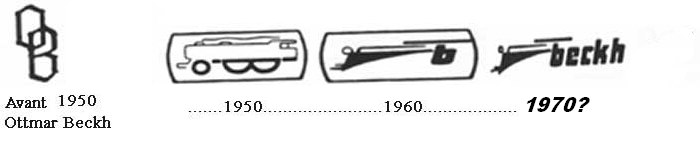
BECKH : O et HO
Firme créée à Nuremberg en 1939
par Ottmar Beckh qui a repris le matériel du fabriquant de jouet en tôle
Adolph Schuhmann.
Après la guerre, Beckh relance la production du train jouet en O en 28mm et en 32mm.
Le premier catalogue (4 pages) a été publié en 1949 et ne proposait que du marériel déja fabriqué en 1939..
A partir de 1960 production de matériel HO avec un train
à piles, matériel simplifié pour les grands magasins.
La production en "O"aurait été stoppée en 1969 et toute la production HO aurait cessée en 1973.
Company founded in Nuremberg in 1939 by Ottmar Beckh who took over the equipment of sheet metal toy manufacturer
Adolph Schuhmann.
After the war, Beckh relaunched the production of the toy train in O in 28mm and 32mm.
The first catalog (4 pages) was published in 1949 and only offered equipment already manufactured in 1939.
From 1960 production of HO equipment with a battery train, simplified equipment for department stores.
Production in "O" would have been stopped in 1969 and all HO production would have ceased in 1973.
Berliner TT Bahnen : (BTTB) "TT"
Berliner TT Bahnen a été créée en 1972 quand le
gouvernement de la DDR a repris le contrôle de Zeuke.
La production a été axée sur la quantité pour faire rentrer des devises en RDA.
Ce dernier reprend BTTB Zeuke GmbH et lance sa nouvelle société Berliner TT Bahnen Pilz GmbH & Co. KG toujours installée à Berlin.
À la fin de 1993 ce nom devient Tillig Modellbahnen Gmbh & Co.KG et la société est transférée à Sebnitz en Saxe.
Berliner TT Bahnen was created in 1972 when the government of GDR took back the control of Zeuke.
The production was centered on the quantity to make return currencies to GDR.
In 1990, after the reunification, it takes the name of BTTB Zeuke, but gone bankrupt and in 1993 was taken again by Hans-Jürgen Tillig.
This last takes again BTTB Zeuke GMBH and launches its new company Berliner TT BahnenPilz GMBH & Co. KG always
installed in Berlin.
At the end of 1993 this name becomes Tillig Modellbahnen GMBH & Co.KG and the company is transferred to Sebnitz in Saxony.
Billerbahn : "HO"
Société
Allemande, créée en 1935 à Nuremberg par Hans Biller (ex employé de Bing) à
produit des trains jouets vers 1949,
uniquement du matériel, jusqu'à sa fermeture pour faillite en 1977.
En
réalité il y a eu deux sociétés déclarées à Nuremberg, l'une en 1947
par Biller Hans comme "Fabrication de jouets" et l'autre en
1942 par
Biller Joahan pour une "Usine de jouets en métal".
Il faut noter que Johann se dit Hans en Bavarois.....
Des
trains ont été présentés en 1950 en une échelle Oe (1/45) roulant
sur une voie de 16.5mm et présenté comme du HO.
Les locomotives ont été équipées soit d'un moteur à ressort soit à partir de 1962 d'un moteur électrique à piles.
exclusively in, until it closed for bankruptcy in 1977.
In reality there have been two companies set up in Nuremberg, one in 1947 by Biller Hans as "Manufacture of toys" and
the other in 1942 by Biller Joahan for a "Joann factory in metal".
It should be noted that Johann calls himself Hans in Bavarian .....
Trains were introduced in 1950 on Oe scale (1/45) on track 16.5mm presented as HO.
The locomotives were fitted either with a spring motor or from 1962 with a battery-powered electric motor.
BILOfix :
En 1959 Lego avait séparé ses activités "non-briques" en créant la marque Fix BILO (usine à Billund) mais, en 1960, après un
nouvel incendie de la division "Bois" (pour la 3ème fois), Lego ne remet pas en service cette division.
La société BILOfix a été créée en février 1962 par Gerhardt Christiansen à Kolding - Danemark.
Il vient de quitter, avec son frère Kirk, la société Lego où il dirigeait la division bois.
BILOfix fabriquait de nombreux jouets entièrement en bois principalement des jouets de construction (du type "Meccano") et d'autres
comme des train
(locomotive, voitures et wagons) ou du matériel roulant routier.
A partir de 1969 et jusqu'en 1972, Revell a l'exclusivité de la distribution des produits BILOfix sous le signe "Revell-BILOtoy"
Vers 1973 la marque Bilofix à été renomée Hanse Tec.
La société a été absorbée par KE Mathiasen A/S, gros distributeur de jouets en bois, société basée à Aarthus (DK)
In 1959 Lego separated his "no-brick" business by creating the BILOfix brand (in Billund) and in 1960, after the fire of the "Wood" division
(for the 3rd time), Lego does not put this division back into service.
BILOfix was founded in February 1962 by Gerhardt Christiansen in Kolding - Denmark.
He has just left, with his brother Kirk, the Lego company where he headed the wood division.
Bilofix made many toys entirely made of wood mainly in construction toys (of the "Meccano" type) and others such as trains (locomotive,
cars and wagons) or.road rolling stock.
In 1967 the brand was distributed in Great Britain under the name of BILOToy
From 1969 until 1972, Revell has exclusive distribution of BILOfix products under the sign "Revell-BILOtoy"
Around 1973 the Bilofix brand was renamed Hanse Tec.
The company was absorbed by KE Mathiasen A / S, a large wooden toys distributor based in Aarthus (DK)
BING : "OO" - "0" - "1"
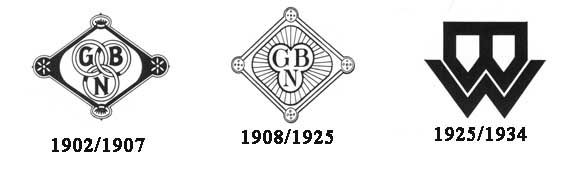
Ignace et Adolphe Bing - Les
deux frères fondent la Gebrüder Bing (matériel de cuisine) en
1863 à Nuremberg puis, en 1879,
se lancent dans la production
de jouets.
Ils fabriquaient des trains en écartement III ou IV (75 mm) et en "O".
A la mort de Ignace son fils Stephan prend la direction de l'entreprise et la rebaptise Bing Werke.
Au
début des années 1900 Bing produit des trains pour le marché anglais
par l'intermédiaire de Bassett Lowke qui repeignait le matériel aux
couleurs britanniques.
Il s'installe également sur le marché américain, la division John Bing de New York, en copiant le matériel Ives.
Vers 1921 Bing tente de s'installer au Canada.
En 1920 bing commence à produire du matériel en "OO".
A partir de 1927 Bing connait de graves difficultés financières et
les banques lui refusent des prêts (la famille Bing est juive) et la
Bing Werke est liquidée en 1932. Le matériel et l'outillage sont alors repris :
- Le matériel lié à la vapeur par Falk.
- Les trains par Bub
- L'outillage et les machines par Fleischmann.
L'usine est abandonnée en 1933.
Stephan Bing et son fils ont quitté l'entreprise et ont acheté la firme de Fortner & Haffner à Nüremberg pour développe une ligne en "OO" plus compète.
En 1935 les premiers trains Trix Express sont présentés à Liepzig.
Entre temps, pour fuir les persécutions, la famille Bing s'installe au Royaume Uni en 1930.
En association avec Bassett Lowell ils commercialisent le matériel Trix
Express puis fondent la marque anglaise Trix, à Northampton en
1932, qui
produira les Trix Twin Train
Les enfants de Stephan Bing, Frantz et sa sœur Lilli, prennent sa suite jusqu'en 1657.
began producing toys.
They manufactured trains in gauge III or IV (75 mm) and in "O".
At the death of Ignace his son Stephan takes over the management of the company and renames it Bing Werke.
In the early 1900s Bing produced trains for the English market through Bassett Lowke who repainted the British-colored material.
He also moved to the US market, John Bing New York division, copying the Ives material.
Around 1921 Bing tries to settle in Canada.
In 1920 bing began to produce material in "OO".
From 1927 on, Bing suffered serious financial difficulties and the banks refused him loans (the Bing family was Jewish) and
Bing Werke was liquidated in 1932. The equipment and tools are then taken back:
- The material related to steam by Falk.
- Trains by Bub
- Tooling and machinery by Fleischmann.
The factory is abandoned in 1933.
Stephan Bing and his son left the company and bought the Fortner & Haffner firm in Nuremberg to develop a more complete "OO" line.
In 1935 the first Trix Express trains were presented in Liepzig.
Meanwhile, to escape persecution, the Bing family moved to the United Kingdom in 1930.
In association with Bassett Lowell they commercialize the equipment Trix Express then founded the English brand Trix,
in Northampton in 1932 which will produce the Trix Twin.
The children of Stephan Bing: Frantz and his sister Lilli take his suite until 1657
BLUE BOX Toys :
Cette société a été créée en 1952 à Hong Kong par Peter Chan Pui avec des usines à Hong Kong et à Singapour qui ont été délocalisées
en Chine dans les années 80.
Il existe aujourd'hui (2016) une société basée à Hong Kong nommée "Bluebox" qui fabrique des jouets, entre autre un train "fantaisy"
circulant également sur une voie en creux.
This company created by Peter Chan Pui in 1952 in Hong Kong and established factories in both Hong Kong and Singapore.
In the 80's the manufacturing were moved to China
There exists today (2016) a society based in Hong Kong named “Bluebox” who manufactures toys, amongst other things a train “fantaisy”
with tracks also in hollow.
BLZ : "O"
Créée par MM. Bourdeaux, L'Heure et Zedda - Marque Française fondée en 1943, à Paris. Locomotives type électrique, quelques wagons
(foudres, citernes, plateaux). Lance une gamme en "OO" destinée aux grands magasins (les trains Scellé Bell) puis disparaît en 1951.
Created per Messrs Bourdeaux,
L'Heure and Zedda - French Brand founded in
1943, in Paris. Engines model electric, some wagons
(tanks, wine
cisterns, plates). Launch a range in “OO”,
intended for the chain store (trains Scellé Bell),
then disappears in 1951.
Bowman : "O"
Fabrique de jouets en bois, la Hobbies Ltd, crée en 1891 à Dereham (Norfolk - UK)
La Bowman Models a été créée en 1926 par Geoffrey Bowman Jenkins
C'est en 1928 que Bowman fabrique et commercialise sa première locomotive
à vapeur vive, de taille 1 sur un écartement 0 (la 234).
La gamme s'étoffe avec des locos vapeur vive et quelques wagons et voitures
mais la production de trains se termine en 1935.
Vers 1945 le nom Bowman Models et sa marque "Archer" ont
été rachetés à la famille Jenkin par "Piece and Parts and Assemblies
Ltd
of Luton" (Bedfordshire - UK) la pour crééer la "Bowman of Luton" qui a repris la production de machines à vapeur statiques ou pour
animer des maquettes de bateau
Factory of wooden toys, la Hobbies Ltd creates in 1891 in Dereham (Norfolk - U.K.)
The Bowman Models was founded in 1926 by Geoffrey Bowman Jenkins.
It is in
1928 that Bowman manufactures andmarkets his first engine with live
steam, of size 1 on a gauge 0 (the 234).
The range is
packed with steam locos and some wagons and coaches
but the production of trains finishes in
1935
Around
1945 the name Bowman Models and its brand "Archer" were bought from the
Jenkin family by "Piece and Parts and Assemblies
Ltd of Luton" (Bedfordshire - UK) to create the "Bowman of Luton" which resume the production of machines static steam or to animate boat models
BRAWA : O, HO et N
Marque
Allemande. Artur Braun a créé un magasin, en 1948, vendant des trains
électriques et des tramways. Le premier matériel, en HO,
produit par A. Braun a
été un tramway reproduisant celui d'Oberstdorf en 1955.
En 1963, création de la marque Brawa, (contraction de Braun et Waiblingen)
La marque produit quelques 800 articles pour le HO, N, TT, Z et création de la
société Braunkabel qui fabrique toutes sortes de fils
électriques pour le modélisme.
La marque est toujours en activité.
German brand. Artur
Braun created a store, in
1948, reselling electric
trains and trams. The first equipment, in HO,
produced by A. Braun was a tram reproducing that of Oberstdorf in 1955.
In 1963, creation of the Brawa brand, (contractionof Braun and Waiblingen)
The brand produces some 800 articles for HO,N
, TT, Z and creation of the
Braunkabel company which manufactures all kinds
of electric
wires for model making.
The brand is always in activity.
BRIO :
Entreprise Suédoise fondée en 1884 par Ivar Bengtsson, près d'Osby dans le sud de la Suède, qui fabriquait des paniers en lamelles de bois
de bouleaux.
En
1907, avec ses trois fils, Ivar se lance dans la création/fabrication de jouets
en bois (BRIO = Bröderna ("frères") Ivarsson [à] Osby).
Fabrique
des jouets en bois dont des trains circulant sur une voie "rails à empreintes", créé en 1958,
creusée dans du bois de hêtre.
Le
jouet le plus célèbre a été son cheval à bascule.
A fait partie du groupe suédois d'investissement Proventus depuis 2004.
A été repris par l'allemand Ravensburger en 2015 - Toujours
en activité.
Swedish company Founded in 1884 by Ivar Bengtsson, near to Osby in the south of Sweden, which manufactured shopping
cart in wood strips birches.
In 1907, with his three sons, Ivar launches out in creation/manufacturing of wooden toys (BRIO = Bröderna (“brothers”) Ivarsson
[in] Osby).
Factory of the toys out of wooden of which trains circulating on a track “hollow impression rails”, from 1958, cutting in wood of beech.
The most famous toy was its rocking horse.
Fact part of the group of Swedish Proventus investment since 2004.
Was taken up by the German Ravensburger in 2015 - Always in activity.
BRIMTOY (voir
aussi WELLS) : "O"
La
BMTM (British Metal and Toy Manufacturers) a été fondée en Angleterre
en 1914 à Hackney (Londres). Cette entreprise fabriquait
des
jouets en fer blanc, y compris des trains, jusqu'à sa liquidation en 1921. C'est à partir de là qu'est
créé, en 1923 la "Brimtoy Ltd".
En 1931 cette dernière fabrique et commercialise du matériel en O, en particulier des trains, en partenariat avec Gebruder Bing.
En 1932 elle est absorbée par Wells et en 1949 est fondée la "Wells Brimtoy Distributor" société chargée de commercialiser les produits.
The BMTM (British Metal and Toy Manufacturers) was founded in England in 1914 in Hackney (London). This company manufactured
tin plate toys, including train set, until its liquidation in 1921. It is from there that Brmtoy Ltd. was created in 1923.
In 1931 the latter manufactures and markets O-shaped equipment, in particular trains in partnership with Gebruder Bing.
In 1932 it was absorbed by Wells and in 1949 the Wells Brimtoy Distributor was founded, the company responsible for marketing
the products.
Brit-Line (Comercial Brit-Line, SL) : "N"
Société Espagnole d'importation et de distribution (pour l'Espagne et
le Portugal) de produits spécialisés dans
le modélisme ferroviaire, créée en 1979 par Magda Sebastián et Bartomeu Boada, à Olesa de Montserrat (Barcelone). .
Spanish import and distribution company (for Spain and Portugal) of products specializing in railway modelism,
created in 1979 by Magda Sebastián and Bartomeu Boada, in Olesa de Montserrat (Barcelona).
Trademark used by Bachmann in years 1965/1970
BUB
: O , S et HO
Fondée
en 1825, à Nuremberg par Kark Bub, cette marque commence par produire
des trains en tôle étamée dès 1851 puis des trains
à traîner dès 1903. Les premiers trains sur rails sont fabriqués,
atelier situé à Nurembert 48 Hauptstrasse, à partir de 1905 en
"0" et "1",
d'abord à ressort puis électrique en 1914.
Bub absorbe Carette en 1917 puis Bing en1931.
Dès
1925 BUB se lance dans le 00, la gamme "Tischbahn" (16,5mm), surtout
des objets de décor et à partir de 1930 produit du matériel
roulant puis en 1961 une série "Populaire" en HO, la série H, reprenant les modèles sur des châssis simplifiés.
En
1945 production de matériel en "S" mais sur voies de 24mm (erreur de
conversion pouce/mm ?) donc incompatible avec le matériel US
de 22,5mm. Cette production est arrêtée en 1958.
Tout
le matériel a toujours été fabriqué en tôle sauf des axes/roues en
plastique (HO) et des flancs de bogies en métal moulé.
C'est
probablement la raison qui a conduit la marque à disparaitre en
1966
A noter que depuis 2002 une société du nom de BUB commercialise du matériel fabriqué en chine. Bien que basée à Nuremberg et
faisant référence à l'année 1851, cette nouvelle société n'a rien à voir avec l'ancienne marque BUB.
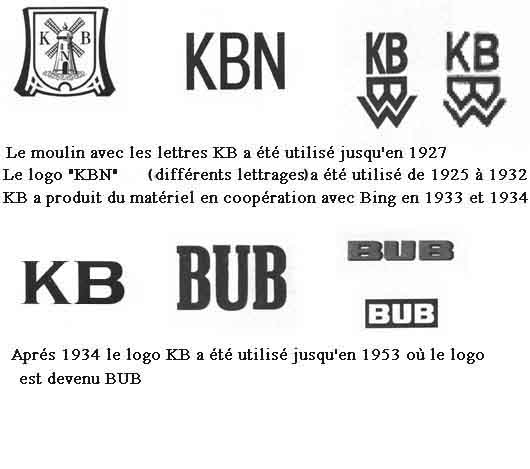
Le logo de la marque était KB ou KBN puis BUB :
Created in 1825, in Nuremberg by Kark Bub, this brand began by producing stable sheet trains in 1851 then trains to be dragged
in 1903.
The first trains on rails were made, workshop located in Nurembert 48 HauptStrasse, from 1905 in "0" and "1", first to spring
then electric in 1914.
Bub absorbs Carette in 1917 then Bing in 1931.
As
early as 1925 Bub launched in the 00, the series "Tischbahn" (16.5mm),
especially decor objects and from 1930 produced rolling
stock and then in 1961 a "popular" series in HO, the H series, resuming Models on simplified chassis.
In 1945 production of "S" equipment but on 24mm tracks (inches/mm conversion error?) so incompatible with 22.5mm US equipment.
This production was arrested in 1958.
All the equipment has always been made of sheet metal except plastic axes/wheels (HO) and flanks of molded metal bogies.
This is probably the reason that led the brand to disappear in 1966
It should be
noted that since 2002 a company with
the name of BUB markets
equipment made in China. Although based in
Nuremberg and referring at the year 1851, this new company has
nothing to do with old brand BUB.
The logo of the brand was KB or KBN then BUB (see up)
BUCO : O et HO
Buco est la contraction de
"Bucherer & Co" société créée en 1919 par August Bucherer à
Amriswil en Suisse.
Elle commence à produire des jouets en bois vers 1923 puis déménage à
Diepoldsau dans le canton de Saint-Gall
La production de trains jouets
en échelle 0 commence en 1944 et celle en HO en 1954.
Le dernier catalogue BUCO est
publié en 1956 et la production s’arrête définitivement en 1958.
En 1962 les stocks (produits
finis, pièces détachées) sont repris par B. Stauffer et du matériel est mis sur
le marché toujours sous
le nom de BUCO.
Pendant les années 1970 à 1990
du matériel BUCO a été proposé venant de sources diverses, toujours reconstitué
à l’aide
d’anciennes pièces.
En 1975 un catalogue est même édité par Stauffer reprenant pratiquement
l’intégralité de l’ancien catalogue BUCO.
Dans les années 1990 Fritz
Krähenbühl achète l’ancien outillage utilisé à Diepoldsau et vers 2005/2006 le
magasin Amiba à
proposé des répliques BUCO en 0 et HO réalisées avec cet ancien
outillage.
En 2011 est créée, à Bauma
canton de Zurich, une nouvelle société, la
"BUCO Spur 0 GmbH",
qui acquiert les droits de marque
BUCO,
l'arbalète avec l'inscription BUCO superposée, auprès de l'Institut de la
propriété intellectuelle de la Confédération suisse.
Elle récupère le reste du stock en 0 et l’ensemble de l’outillage détenu par F. Krähenbühl.
It started producing wooden toys around 1923 and then moved to Diepoldsau in the canton of St Gallen
The production of toy trains in scale 0 began in 1944 and that in HO in 1954.
The last BUCO catalogue was published in 1956 and production stopped definitively in 1958.
In 1962 the stocks (finished products, spare parts) are taken over by B. Stauffer and equipment is put on the market still under the name
of BUCO.
During the years 1970 to 1990 BUCO material was proposed from various sources, always reconstituted with the help of old parts.
In 1975 a catalogue was even published by Stauffer, taking almost the entire old BUCO catalogue.
In the 1990s Fritz Krähenbühl bought the old tools used in Diepoldsau and around 2005/2006 the Amiba store offers BUCO 0 and HO
replicas made with this old tools.
In 2011 a new company, "BUCO Spur 0 GmbH", was created in Bauma, near Zurich, which acquired the trademark rights BUCO, the
crossbow with the inscription BUCO superimposed, from the Institute of Intellectual Property of the Swiss Confederation.
It recovers the rest of the stock in 0 and all the tools held by F. Krähenbühl.
BUSCH : "TT"
Entreprise allemande située - 1955 - à Viernheim (Allemagne - Saxe) spécialisée dans le décor pour le modélisme ferroviaire, les autos
miniatures au 1/87 et la fabrication de matériel électronique pour les enfants.
Elle propose du matériel MTH en 0.
En 2016 à la faillite de P. Lorenz la société Busch a repris la fabrication de ce matériel dans son usine de Schöenheide, avec l'ancien
personnel de Lorenz.
Toujours en activité (2024)
German company located (1955) in Viernheim - Germany - Saxony, specialized in modeling for railway modeling, miniature cars
at 1/87 and manufacture of electronic equipment for children.
It offers MTH material in 0.
In 2016, at the failure of P. Lorenz, Busch took over the manufacture of this equipment at its factory in Schöenheide, with the
former staff of Lorenz.
Still active (2024)
Chad Valley :
Une fabrique de
reliure, basée à Birmingham, Grande Bretagne, (crée en 1860) s'est installée à
Harborne en 1897, le long du
ruisseau "Tchad".
Cette société a pris comme nom Tchad Valley Works avec comme marque
enregistrée "Chad Valley".
Surtout connue pour ses peluches, la Chad Valley se lance dans la création de jouets en tôle vers
1920.
En 1978 la société est reprise par Palitoy et la marque Chad Valley
par Woolworth's qui fit faillite en 2008.
the brook “Chad”.
This company took as name Tchad Valley Works with marks recorded “Chad Valley”.
Especially known for his cuddly toys, Chad Valley launches out in the creation of sheet toys around 1920.
In 1978 the company is taken again by Palitoy and the brand Chad Valley by Woolworth' S which went bankrupt in 2008.
Conti (Co Mo Ge): "HO"
En 1946, en Italie, la marque et le
brevet CO.MO.GE (COnstruzione MOtori Giocattolo Electtrici) sont
déposés par les Parretti,
trois cousins passionnés de trains qui travaillaient pour les Chemins de fer Italiens (FS=Ferrovie dello Stato italiane).
En 1947 les trois hommes s'associent avec
l'entreprise Giuseppe Conti & C, de Bollate usine Boroni, près de Milan, qui produisait,
depuis
1889 des jouets en bois et en papier mâché.
Ils avaient déjà produit, à Milan, un autorail de type Ale 880 sous leur marque Co Mo Ge.
Le matériel Conti est commercialisé sous la marque "Train Conti brev.CoMoGe".
Les trains Conti étaient construits "pour durer" entièrement en métal moulé, aluminium et peinture épaisse.
Cette production n'a que rarement dépassé les frontières de l'Italie.
Mis en faillite en 1960, Conti est repris par Oreste & C. Cicchetti et la marque va finalement disparaitre en 1966.
Cicchetti à produit durant quelques années un train "économique" de qualité très médiocre baptisé "Jolly"
In 1946, in Italy, the mark and the CO.MO.GE patent were registered by the Parretti, three cousins, passionate about trains,
who worked for the Italian Railways (FS = Ferrovia dello Stato italiane).
In
1947 the three men team up with the company Conti,factory
Boroni, Milano, which produced, since 1892, wooden toys
and chewed paper toys
They had already produced, in Milan, a railcar type Ale 880 under their brand Co Mo Ge.
The Conti equipment is marketed under the brand name "Train Conti brev.CoMoGe".
Conti trains were built "to last" entirely in molded metal, aluminum and thick paint.
This production has rarely gone beyond the borders of Italy.
Cicchetti produced for a few years an "economic" train of bad quality called "Jolly".
Con-Cor : "N"
Société Américaine basée à
Bensenville (Illinois) commercialise des modèles réduits en HO puis en N à
partir de 1962.
Elle est actuellement basée à Tucson (Arizona) et commercialise, sous son nom, beaucoup de matériel importé (voir Kato).
It is currently based in Tucson (Arizona) and markets, under its name, much of imported equipment (see Kato)
Société
américaine crée à Placenta (Californie) en 1945, connue pour ses
modeles réduits d'avion, a commencé à difuser du matériel
en HO au début des années 1970. Ce matériel était produit par Athearn et fabriqué pour la Cox international à Hong Kong.
En
1977 parution du dernier catalogue Cox repris par la société "Leisure Dynamics"
Le matériel en HO a conservé le nom de Cox jusqu'en 1983 où cette société à fait faillite et l'ensemble de la ligne HO
de Cox à été repri par Model Power
Par la suite d'anciens modèles Cox ont été distribués par Model Power et AHM.
in the early 1970s.
This material was produced by Athearn and manufactured for the international COX in Hong Kong.
In 1977 published the last COX catalog taken up by the company "Leisure Dynamics" HO material has kept the name of Cox until 1983
when this company went bankrupt and the entire HO de Cox line was taken up by Model Power
Thereafter of old Cox models were distributed by Model Power and AHM
Cragstan : Voir Yonezawa
Créée en 1954 à New York par Frank Stanton, l'entreprise américaine Craig-Stanton Sales Crop, devenue Cragstan Industries en
1956, importait et commercialisait des jouets fabriqués au Japon de fin des années 1950 à vers 1970.
Les trains à l'échelle "S" étaient mécaniques
ou électriques alimentés par batteries.
manufactured in Japan from the end 1950's to about 1970.
The trains on the scale “S” mechanical or electric were supplied by batteries.
Crown Products : "HO"
Sous marque de Mantua créée en 1964 pour diffuser du matériel roulant fabriqué à Hong Kong par Kader et vendu à bas prix, en fait des
copies du matériel de marques diverses.
A Mantua sub -brand created in 1964 to sell rolling stock manufactured in Hong Kong and sold at low prices, in fact copies of
various brands equipment
Note : Le wagon citerne HO "Crown" de ma collection était vendu aux USA par, entre autres, les supermarchés Grand-Way.
Note: The Ho "Crown" tank car from my collection was sold in the USA by, among other things, Grand-Way supermarkets.
Ne pas confondre avec la société Crown Model Products ci-dessous
Do not confuse with the company Crown Model Products below
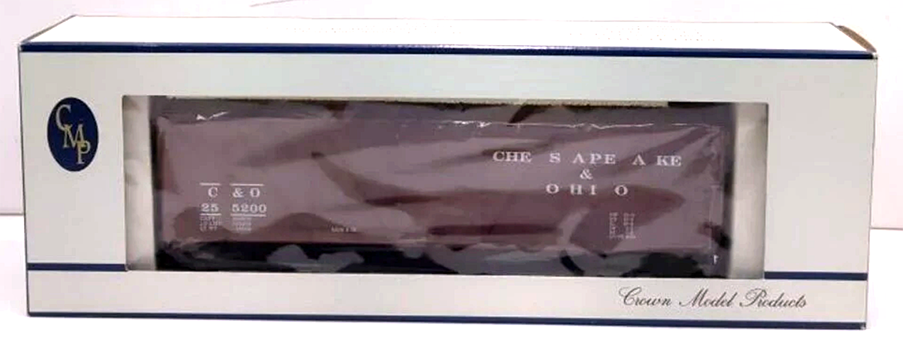
Crown : (Crown Model Products)
Entreprise américaine Crown Model Products a été fondée en 1993 par Don Stubbs, propriétaire du magasin Northeast Trains à
Peabodi (Massachusetts), pour produire, dans un atelier situé à Waltham, uniquement des wagons frigorifiques à bogies (bogies et
accouplement d'origine Weaver) à l'échelle "0".
Dans les années 1990 CMP à proposé une série de wagons, toujours frigorifiques, à l'échelle "S".
En 2000 Weaver à racheté l'ensemble de matériel de prduction puis, à la disparition de Weaver, les moules ont été repris par Lionel qui
proposait dans son catalogue de 2017 des wagons frigorifiques fabriqués à partir des moules originaux de Crown.
Peabodi (Massachusetts)
to produce, in a workshop located in Waltham, only refrigeration wagons with truck (bogies and coupling Weaver) scale "0".
In the 1990s CMP offered a series of wagons, still refrigerated, on a "S" scale.
In 2000 Weaver bought all production equipment and then, at the disappearance of Weaver, the molds were taken up by Lionel which
offered in its 2017 catalog of refrigerated wagons made from the original Crown molds.
Dapol : HO - O
Actuellement
situé à Chirk, au Pays de Galles - GB, Dapol a été créé en 1983 par David et Pauline Boyle et
produisait du matériel
en OO dans son usine de Winsford (Cheshire) bien qu'une bonne partie de sa
production était réalisée à Hong Kong et en Extrème Orient.
En 1985 Dapol rachète, à Pallitoy, l'outillage de Mainline et de Airfix puis rachète la marque et le matériel de Wrenn en 1993
En 1994 l'entreprise déménage pour Llangollen (Pays de Galles) mais au cours de cette opération un très grave incendie détruit
une bonne partie de la production et tout le matériel l'outillage d'origine de Wrenn.
En 1994 Dapol vend à Hornby le matériel de production des diverses marques acquises au fil du temps.
En 2001 Dapol arrète la production, peu importante, de Wrenn.
En 2002 Dapol commence à produire du N.
En 2003 nouveau déménagement pour Chirk.
En 2011 retour du OO (arrêté depuis 12 ans) par la mise sur le marché d'une locomotive Class 22 puis d'une Class 52 Western.
En 2015 Dapol commence à produire du matériel en 0.
although much of its production was carried out in Hong Kong and the Far East.
In 1985, Dapol bought out Mainline and Airfix tools from Pallitoy and then bought the brand and equipment from
Wrenn in 1993
In 1994 the company moved to Llangollen (Wales) but during this operation a very serious fire destroyed
much of the production and all the original Wrenn tooling equipment.
In 1994 Dapol sold to Hornby the production equipment of various brands acquired over time.
In 2001 Dapol stops production of Wrenn.
In 2002 Dapol started producing gauge N.
In 2003 new relocation for Chirk.
In 2011 return of the gauge OO (stopped since 12 years) by the placing on the market of "a locomotive Class 22 then a Class 52 Western.
By 2015 Dapol begins to produce material in gauge 0
Darstaed: "O"
Entreprise Suisse fondée à Zoug en 1966 par Marcel R.
Dauphin et Twerenbolt qui produisait du matériel en "O".
La marque et tous les outils ont été acquis par Andries
Gabowsky en 1993, modéliste expérimenté qui a joué un rôle clé
dans la renaissance du "O" en Grande Bretagne.
Andries Grabowsky, un Néerlandais basé à l'origine à Taiwan, travaillait
depuis 1991 dans la fabrication de trains miniatures en HO.
En 1995 il fusionne avec la "Allchem Trains" de M. Levy pour créer une
marque de distribution en Angleterre: la "ACE Trains".
Depuis Gabowsky et Levy se sont séparés et en 2008 la marque Darstaed
est relancée, produite en Chine à Xiamen (province de Fujiam).
On considère que Andries Grabowsky est à la base de la
renaissance du "Tin Plate" à l'échelle "O" en Grande
Bretagne, en particulier grâce
à ses premières répliques
modernisées et électrifiées du matériel Hornby des années 1930, comme
les locomotives
4-4-4-4 ou la 4-4-4-2.
Cette marque existe toujours (2020) : la société Darstaed Vintage
Ltd, tout comme ACE.
The brand and all tools were acquired by Andries Gabowsky in 1993, an experienced model maker who played a key role in the
revival of the "O" in Great Britain.
Andries Grabowsky, a Dutchman originally based in Taiwan, had been working since 1991 in the manufacture of model trains in HO.
In 1995 he merged with Mr. Levy's "Allchem Trains" to create a distribution brand in England: the "ACE Trains".
Since Gabowsky and Levy have separated and in 2008 the Darstaed brand is relaunched, produced in China in Xiamen (Fujiam province).
Andries Grabowsky is considered to be at the root of the revival of the "O" scale "Tin Plate" in Great Britain, in particular thanks
to its early modernized and electrified replicas of Hornby equipment from the 1930s, such as the 4-4-4-4 locomotives or the 4-4-4-2.
This brand still exists (2020): the company Darstaed Vintage Ltd, just like ACE.
Commercialise du matériel axé sur le modélisme ferroviaire, matériel en kit ou assemblé, fabriqué en Chine.
Toujours en activité (2023)
Store of toys/leisures open beginning of the years1980 to Plains, not far
from Chicago (Illinois, USA) -
Marketing equipment focused on railway modelism, kit equipment or assembled, manufactured in China.
Still in activity (2023)
Dinky toys :
Cette
marque anglaise, spécialisée dans des "véhicules de poche", a
été créée par Frank Hornby (des trains Hornby) en 1933 : la "Modelled
Miniature"qui pris le nom de Dinky Toys en 1934.
Sa production est entièrement moulée par injection de Zamac, mélange de zinc et de magnésium.
Il existait, vers 1935, deux trains en catalogue : Deux "marchandises" avec
respectivement 3 ou 4 wagons et un "voyageurs" de 3 voitures.
1933: the “Miniature Modelled”
who taken the name of Dinky Toys in 1934.
Its production is entirely moulded by injection of Zamac, mixture of zinc and magnesium.
There existed, around 1935, two trains in catalogue: Two “goods” with respectively 3 or 4 wagons and a “travellers” of 3 cars.
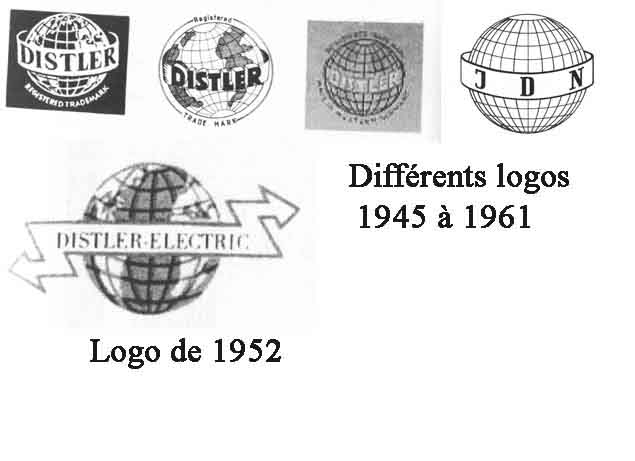
DISTLER :
Société créée en 1895 à Nuremberg
(Allemagne) qui fabriquait des jouets en tôle lithographiée puis à partir de 1920 des trains en O de 35mm,puis du 28mm et du 16,5mm.
Après la mort de son fondateur Johan Distler, la Société passe sous
le contrôle d'Ernst Volk, en 1936, puis devient en 1938 la sous-marque
de Trix après le rachat d'une partie des outils de Schuhmann et de Doll.
En
1952 Distler se lance dans le chemin de fer électrique alimenté en
"triphasé" (en fait diphasé grace à un condensateur) en 3x14 volts
alternatifs par un transformateur Siemens branché sur le secteur
biphasé ordinaire. La voie était en 3 rails où les deux rails
extérieurs étaient isolés.
En 1957 la production du 0 est stoppée pour produire du matériel en
HO jusqu'en 1960/1962.
L'entreprise est alors vendue, en 1962, en Belgique et devient la Distler Toys SA basée à
Nivelles qui produit très peu de wagons et de trains en HO.
La production s'arrête en 1968.
35mm, then the 28mm and the 16,5mm.
After the death of its founder Johan Distler, the Company passes under the control of Ernst Voelk, in 1936, then becomes in 1938 the
secondary brand of Trix after the repurchase part of the tools of Schuhmann and Doll.
In 1952 Distler embarked on the electric railroad fed in "three -phase" (in fact diphasé by dint of a capacitor) in 3x14 alternative volts by a Siemens transformer connected to the ordinary two -phase sector.
The track was in 3 rails where the two external rails were isolated.
In 1957 the 0 production is stopped to produce HO equipment until 1960 /1962.
The company is then sold in Belgium and becomes Distler Toys SA based in Nivelles which produces very few coaches and trains out of HO.
The production stops in 1968
Doll :
Cette entreprise Allemande a été fondée en 1898 par Peter Doll et Isaak Sondheim.Elle fabriquait des machines à vapeur et a fourni des produits semi-finis à des entreprises produisant des trains jouets.
C'est en 1927 que Doll a commencé à vendre son propre matériel en 0 (une locomotive à deux essieux n°420).
Des locomotives électriques (en 14-20 volts et 4-6 volts) ont été produites dès 1928.
Afin d'échapper aux menaces d'expropriation par les nazis en 1938 Doll passe un accord avec Fleischmann
pour la reprise de son catalogue. Une petite partie de l'outillage a été repris par Distler toujours en 1938.
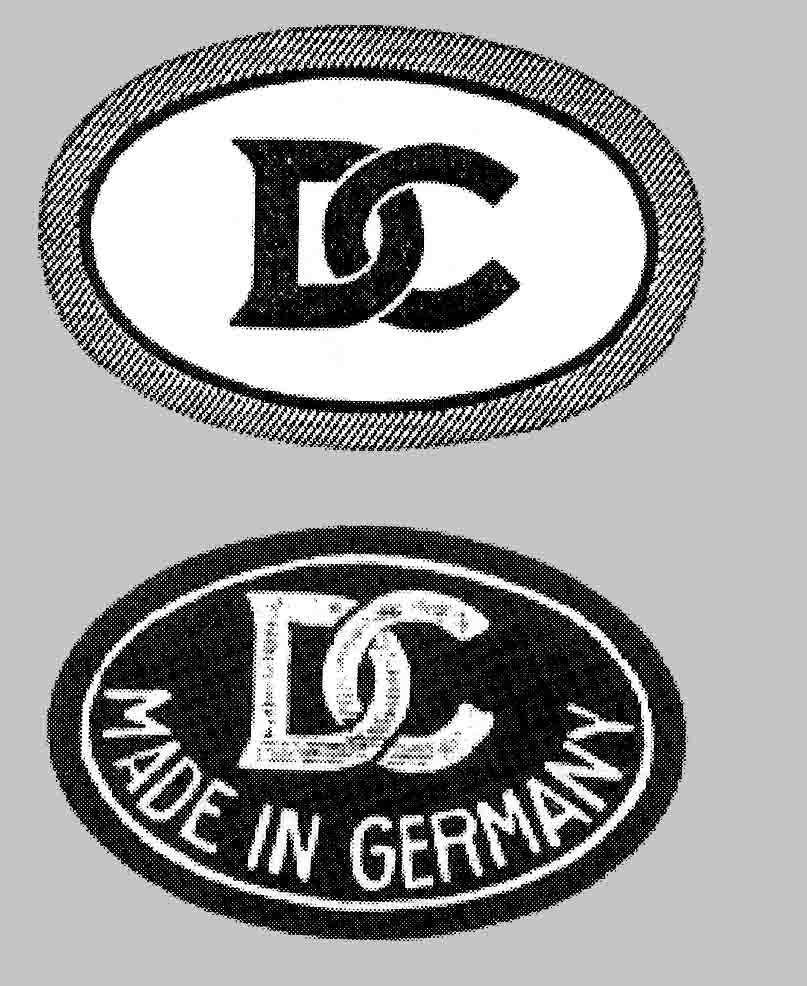 Logos Doll
This German company was founded in 1898 by Peter Doll and Isaak Sondheim.
It manufactured steam engines and provided semi-finished products to companies producing on the trains toys.
It is in 1927 that Fraud started to sell its own equipment into 0 (an engine with two axles n°420).
In order to escape the threats from expropriation by the Nazis in 1938 Doll makes an agreement with Fleischmann
for the resumption of itscatalogue. A few Doll tools were taken over by the Distler company (also in 1938)
Dregeno :
Allemagne - Coopérative d'artisans du bois de la région de Seiffen (Saxe), tout près de la frontière Tchèque, (ex République Démocratique Allemande).
Seiffen est surnommé "Le village des jouets".
Cette région à une longue tradition de fabrication de jouets en bois
tourné, remontant au 16ème siècle.
La production de jouets en bois est toujours très active, surtout axée
sur la fabrication de figurines et décorations pour Noël.
Seiffen is called “the village of the toys”.
This area with a long tradition of manufacturing of turned wooden toys, going back to the 16th century.
The production of wooden toys, always very active, is especially centered on the manufacturing of figurines and decorations for Christmas.
Voir, see, Konrad Dressler (KD)
Edobaud : "O"
Créée
par M. Edouard Baud - Marque Française fondée en 1928 sous le nom des
"Ets Baud" à Villerbanne dans le Rhône
puis s'installe à Oyonnax, dans l'Ain, en 1930 en prenant le nom de "Edobaud".
Production type "jouet
scientifique" très lourd et entièrement boulonné qui commence par un
train jouet de chantier, fonctionnel en 1930,
puis en 1931 elle se lance dans une série sur
voie "O" mais avec une échelle faisant penser à du "1".
Très peu de matériel disponible : 2 locomotives (2B2 et 2C2), un
locotracteur chantier, 2 automotrices, 8 voitures, 9 wagons de
marchandises
et 7 wagonnets de chantier.
La voie, était montée sur des traverses en bois ce qui isolait parfaitement les 3 rails.
La marque disparaît en 1938.
then moved to Oyonnax, in the Ain, in 1930 by taking the name of "Edobaud" type "toy scientist"very heavy and fully bolted, begins with
a construction toy train, functional in 1930, then in 1931 embarks on a series on" O "track but with a scale reminiscent of" 1 ".
Very little material available: 2 locomotives (2B2 and 2C2), a construction site locomotive, 2 railcars, 8 cars, 9 freight cars and
7 construction cars.
The track was mounted on wooden sleepers which perfectly insulated the 3 rails. The brand disappeared in 1938.
EFSI :
Production
de modèles réduits routiers au 1/90 puis au 1/87, cette société Néerlandaise
fondée en 1959 à Heerlen sous le nom de Bestbox en
par le gouvernement pour employer des
personnes handicapées.
Le
nom de EFSI a été donné à cette société en 1971.
Les activités de Efsi ont cessé en 1988, les moules étant repris par
V. Nies sous le nom de Holland-Oto
handicapped people. The name of EFSI was given to this company in 1971.
The activities of Efsi ceased in 1988, the moulds being taken over by V. Nies with the name of Holland-Oto.
Ehlcke :
Cette
entreprise située à Dresde (RDA) a été créée en 1949 par Wemer Ehlcke a fabriqué
du matériel HO d'abord rue Bärensteiner puis en
1960 rue Berthener.
A fait faillite en 1969 et l'actif a été repris par l'état et intégré dans le conglomérat VEB Modellbahnwagen Dresden (ex Schicht - voir aussi
VEB Dresden).
Les brevets ont été repris par Piko puis, après 1991, par Sachsenmodelle.
then street Berthener
With fact bankruptcy in 1969 and the credit was taken again by the state and integrate in the conglomerate VEB Modellbahnwagen
Dresden (ex Schicht) (see also VEB Dresden).
The patents were then taken again by Piko then, after 1991, by Sachsenmodelle.
Electrotren : "HO"
A
Barcelone, en Espagne, la marque JOS-FEL (1940-1951), qui porte le nom de son
créateur : Josep Feliu, fabriquait des trains à
l'échelle "O", avec un
type de fabrication simple mais très robuste.
En 1951 cette marque reprise par la famille Gonzales change de nom et devient Electrotren ("train électrique" en Français),
L'entreprise s'installe à Alcatla de Henares (Madrid) en 1956.
L’entreprise a tout d’abord fabriqué des trains
en métal à l’échelle S et O avant, en 1954, d’entamer la production de
modèles à l’échelle
HO et de passer au plastique injecté en 1960.
Electrotren appartient au groupe Hornby depuis le 1er avril 2004 sous la marque Hornby España, S.A. à Alcalá de Henares,
exploitant depuis lors la marque Electrotren et distribuant également, en Espagne, les produits Superlots.
Toujours en production.
scale, with a simple but very robust manufacturing type.
In 1951 this brand taken up by the Gonzales family changed its name and became Electrotren ("Electric train" in English), the company
moved to Alcatla de Henares (Madrid) in 1956.
The company first made metal trains in S and O scale, in 1954, to start the production of models at the HO scale and to go to the plastic
injected in 1960..
Electrotren belongs to the Hornby Group since April 1, 2004 under the brand name Hornby España, S.A. in Alcalá de Henares,
since then operating the Electrotren brand, which also distributes Superlots products in Spain.
Still in production.
ELME:
Autriche - Voir (see) Löma
ESM - Eastern Seaboard Models : "N"
Société installée à Waldwicks, New Jersey - USA est toujours en activité (2020).
Fondée en 1987 cette société a pour but de commercialiser du matériel "N" et "Z" sous forme de séries limitées.
Elle repeint et redécore des modèles existants produits, entre autres, par Microtrain ou Rivarossi.
Company based in Waldwicks, New Jersey - USA is still in business (2020).
Founded in 1987, this company aims to market "N" and "Z" equipment in the form of limited series. She repaints and redecorates
existing models produced, among others, by Microtrain or Rivarossi.
ETS: "N"
Electric Train System – Firme crée
en 1991 à Prague (République Tchèque) par Gustav Taus, spécialisée dans les
modèles en tôle
lithographiée en écartement "O".
En production .
in spacing “O”.
In production.
ESU (Pullman) :
Société Allemande à Ulm, créée en 1996 ESU
Electronic produit des modules électroniques pour sonoriser des modèles
réduits de bateaux et
de voitures à partir de sons réels.
En 2006 elle propose des télécommandes pour les
modèles réduits, en particulier pour trains (locomotives et
appareils de voie).
En 2012 ESU se lance dans le matériel roulant et propose un locotracteur allemand V60.
En 2015 création d'une gamme en G et I, puis en HO, sous la marque Pullman.
German company in Ulm, created in 1996 ESU Electronic produces
electronic modules to sound models of boats and
of cars from real sounds.
In 2006, it offers remote controls for model cars, in particular for trains (locomotives and switches).
In 2012 ESU launches rolling stock and proposes a German locomotive V60. In 2015 creation of a range in G and I, then in HO,
under the brand Pullman.
Fabbri : "O"
Filiale de
l'Italien FCS Libri, cette société Française est spécialisée dans la
diffusion de collections encyclopédiques thématiques vendues par
voie de presse ou par correspondance (abonnements).
sees of press or by correspondence (subscriptions).
Faller : O - HO
Société allemande créée en 1946 dans
la forêt noire.
Peu de temps après la guerre, deux frères, Edwin et
Hermann Faller voulaient faire des jouets en bois. En
1946, à Stuttgart, les frères
fondèrent la "Société Hermann Faller".
Rapidement les frères ont déménagé leur entreprise
dans leur ville natale, Gütenbach, dans la Forêt-Noire (Schwarzwald).
Ils ont renommé leur entreprise en
"Gebrüder Faller" et ont commencé à fabriquer des kits de construction
en
bois, des briques en bois
et, à partir de 1950
des accessoires pour trains miniatures H0 sous le nom
de marque "Marathon".
Et en 1970, Faller publie son "HiT Train": un train jouet
en plastique coloré alimenté par une batterie sur des rails en plastique très
robustes
de 32mm (en 0).
En 1972, une loco-citerne noire
d'aspect un peu plus sérieux a été produite, suivie d'une loco diesel Henschel
et d'une loco tender.
Dans les années 1970 Faller a lancé une petite production en HO.
Les
locomotives et les voitures "Play train" étaient deux fois plus grandes que
celles du "train HiT".
Un geste intelligent car le
train fonctionne maintenant parfaitement avec les figurines Playmobil.
Sur la base de "Play train", Faller sort le
"E-Train" en 1980, contrôlé par un transformateur 12V DC.
Les voies E-Train sont également
appropriées pour Play Train.
Le catalogue Faller 1985 a été le dernier catalogue
avec une vaste gamme de jouets.
La production des trains jouets a été vendue par Faller à Eco-Spielwaren en 1986 et le e.Train de faller est devenu le PlayTrain de Eco-
En 1997, Faller a repris son concurrent Pola. Depuis
le rachat Pola se consacre désomais uniquement aux produits à l'échelle G.
La gamme de produits actuelle de Faller comprend des
structures de chemin de fer, des maisons et des bâtiments commerciaux, des
ponts, le
système "Car", toutes sortes d'accessoires, d'aménagements
paysagers à l'échelle H0, N, TT et Z, ainsi que les thèmes
spéciaux Zoo, Ferme,
Camping, Carnaval et Foire.
German company founded in 1946 in the Black Forest.
Shortly after the war, two brothers, Edwin and Hermann Faller wanted to make wooden toys. In 1946, in Stuttgart, the brothers founded
the "Hermann Faller Society".
Soon the brothers moved their business to their hometown, Gütenbach, in the Black Forest ("Schwarzwald"). They renamed their company
"Faller Brothers" ("Gebrüder Faller") and began manufacturing wooden building kits, wooden bricks and, starting in 1950, accessories for
model trains H0 under the brand name "Marathon".
And in 1970, Faller publishes its "HiT Train" : a colorful plastic toy train powered by a battery on very robust plastic rails of 32 mm
(in 0). In 1972,
a loco tanker
A slightly more serious looking black was produced, followed by a Henschel diesel locomotive and a soft loco.
In 1977, the "PlayTrain" was launched as the big brother of the HiT train with the same size of rail and the same technology as the
HiT train.
Locomotives and Play Train Cars were twice as large as those of the HiT train. A smart move because the train now works perfectly with
Playmobil action figures.
On the basis of "Play Train", Faller released the "E-Train" in 1980, controlled by a 12V DC transformer. The E-Train tracks are also
suitable for Play train.
In the 1970s a small production of rolling stock in HO was realized.
The 1985 Faller catalog was the last catalog with a wide range of toys.
The production of toy trains was sold by Faller at Eco-Spielwaren in 1986 and the E.Train de Faller became the Playtrain de Eco-
In 1997, Faller took over competitor Pola. Since the takeover, Pola is now focusing exclusively on G-scale products.
Faller's current product line includes railway structures, homes and commercial buildings, bridges, the Car system and all kinds of
accessories and landscaping on the scale H0, N, TT and Z, as well as the special themes Zoo, Farm, Camping, Carnival and Fair.
Heinrich FISCHER : "O"
La société Heinrich Fischer Co à Nuremberg était certainement la plus petite fabrique de jouets de la région et la moins
connue.
Elle aurait été crée vers 1890 et produisait des jouets en étain puis, vers 1925, des jouets en tôle en particulier des gares et
quelques matériels en 1 et 0, mais rien ne confirme réellement ces suppositions.
La marque a été abandonnée en 1931 ou 1932.
The Heinrich Fischer CO company in Nuremberg was certainly the smallest toy factory in the region and the least known.
It would have been created around 1890 and produced tin toys then,
around 1925, sheet metal toys in particular stations, tunnels
and some materials in 1 and 0, but nothing really confirms these assumptions.
The brand was abandoned in 1931 or 1932.
FischerTechnik:
Le système fischertechnik été créé en 1964 par le professeur Artur Fischer. Le système Fischer est basé sur un bloc de construction type,
avec un assemblage possible sur les six faces. Cette "multiple
formes" est le bloc de base pour tous les jeux de construction Fischertechnik
qui
sont proposés en fonction de l'âge et les capacités de l'utilisateur.
Ces ensembles permettent à
l'utilisateur de connaître et comprendre le monde de la technologie, si
l'intention est d'apprendre, ou tout
simplement pour jouer.
Toujours en activité.
The system fischertechnik created in 1964 by
professor Artur Fischer. The system Fischer is
based on a standard block of construction,
with a possible assembly on the six faces. This“multiple forms”
is the basic block for all
games of Fischertechnik construction which are
proposed according
to the age and the capacities
of the user.
These units make it
possible to the user to
know and understand the world of technology, if the intention is to learn, or quite
simply to play.
Always in activity
Fleischmann : N ,
O, Oe
et HO
Jean
Fleischmann - Créé en 1887 à Nuremberg, cette entreprise fournissait
les fabricants de jouets de la région en pièces en laiton,
moulées à
la cire ou au plâtre.
Elle commença à produire des jouets en fer blanc puis, en 1938, elle reprend les activités de la société Doll : sa production de machine
à vapeur et de matériel en 0.
Le dernier catalogue Doll est repris, à l'identique, sous le sigle Gebr Fleischmann.
En 1949 lancement d'une nouvelle gamme en 0 en 2 rails et courant continu.
Fleischmann est le premier à proposer une voie en 0 à deux rails.
Le 0 est proposé jusqu'en 1959.
Lancement
de la gamme HO en 1952
Lancement de la gamme en N (Picolo) en 1969
En 1992 lancement de la gamme Magic Train, à l'échelle "Oe" ces trains de taille "0" roulaient sur des voies HO.
Cette production a été abandonnée en 2009.
Le 21 mars 2008 Fleischmann a été racheté par Modelleisenbahn Roco.
Depuis 2017 le matériel est fabriqué au Vietnam.
Fleischmann ne produira plus que du "N".
Depuis le 1er janvier
2019 le matériel Fleischmann est distribué sous la marque Roco, les
boîtes transparentes en plastique sont
réutilisées mais l'insert en carton porte la marque Roco......
Fin 2023 Roco propose un train échelle "Oe" du type Magic Train.....
Used by Fleischmann on Doll stock after 1938
Jean
Fleischmann - Created in 1887 in
Nuremberg, this company provided the toys manufacturer
of the area in brass parts,
moulded
with wax or plaster.
It started to
produce toys then, in 1938, it takes
over the activities of the socity
Doll: its production of steam
engine and equipment in 0.
The last catalogue Fraud is
taken again, with identical, under the set of initials Gebr Fleischmann.
In 1949 launching of a new range in 0, D.C.current.
Fleischmann is the first to propose a way into 0 with two rails.
The 0 are proposed until 1959.
Launching the range HO in 1952
Launching the range in N (Picolo) in 1969
In 1992 launch of the Magic Train range, on the "Oe" scale, these "0" size trains ran on HO tracks. This production was discontinued in 2009.
On March 21, 2008 Fleischmann was acquired by Roco Modelleisenbahn.
Since 2017 the material is manufactured in Vietnam. Fleischmann will only produce "N".
Since 1 January 2019 the Fleischmann equipment has been distributed under the Roco brand, the transparent plastic boxes have been reused but the cardboard insert bears the Roco mark.At the end of 2023 Roco offered a train on "Oe" scale like the Magic Train type .....
Fletcher-Barnhardt &
White.inc : "HO"
Petite société située à Charlotte (Caroline du Nord – USA)
Fait partie du groupe "Ha-Lo
Industries (USA)" spécialisé dans les objets publicitaires.
Small firm located at Charlotte (North Carolina – USA)
Fact part of the group """Ha-lo
Industries (USA)" specialized in the advertising objects.
En
1980, Jacques Barret, ancien directeur des ventes de Jouef, a fondé la société Tredi qui a produit des
trains jouets de bas de
gamme sous la marque Fobbi.
Ce matériel destiné à la grande distribution visait un marché autre que celui
de Jouef ou Lima.
Mais
petit à petit il en arrive à concurrencer ces marques et pour finir, à
la mise
en faillite de CEJI en 1985, c'est Jacques Barret
qui rachète Jouef et
concentre l'activité de fabrication autour de Champagnol en y
créant
"Jouef Industrie".
Cette société fait fabriquer des coffrets pour les supermarchés sous la marque
"Jouef par Fobbi" jusqu'au début des années 1990.
Un seul bogie était utilisé pour toutes les motrices, avec une vis sans fin entrainant un engrenage en laiton.
In 1980, Jacques Barret, former sales manager of Jouef, founded Tredi, which produced low-end toy trains under the Fobbi brand.
This material intended for mass distribution targeted a market other than that
of Jouef or Lima.
But gradually he came to compete with these brands and finally, when
CEJI went
bankrupt in 1985, it was Jacques Barret who bought
Jouef and
concentrates the manufacturing activity around Champagnol by creating
"Jouef Industrie".
This company has manufactured boxes for supermarkets under the brand
"Jouef by Fobbi" until the early 1990s.
A single bogie was used for all the motives, with a worm screw driving a brass gear.
Reunidas
Frateschi LTDA" fabriquant exclusivement du matériel pour le modélisme ferroviaire en HO.
sous lees références 3000 et 3001.
Brazilian company of toys
created in 1958 by "Galiléo Frateschi: Frateschi Toy
Factory", become in
1967
"Industrias Reunidas Frateschi LTDA" manufacturing exclusively equipment for railway HO model making.
In
1969 the company markets its first rolling
stock: a coach ref.: 2001, then in
1975 an engine G-12 type under references 3000 and 3001
The first rails leave in
1977 (right and curved) and
the first catalogue goes back to 1973.
Company always in activity (2018)in Ribeirao Preto (Säo Paulo) Brasil.
Gégé : "HO"
Marque Française, créée en 1934 par Germain GIROUD, produit du matériel ferroviaire à partir de 1962. La marque disparaît en 1977.
GEM :
Il y a plusieurs entreprises qui ont
utilisé la marque "GEM" pour leurs trains miniatures :
- GEM (Georges et Ernest Merli) Marseille France
- GEM (Electric Mechanical Toys) Milan Italie
- GEM Models (vers 1958/1960) nom d'un importateur américain de modèles en laiton
fabriqués en très petite série au Japon
- GEM a aussi été utilisée par un fabriquant anglais de superstructures pour
locomotives en voie étroite.
There are several companies that have used the "GEM" brand for their miniature trains:
- GEM (Georges and Ernest Merli) in Marseille France
- GEM (Electric Mechanical Toys) in Milan Italy
- GEM Models (around 1958/1960) Name of an American importer of brass models made in very small series in Japan
- GEM was also used by an English manufacturer of narrow gauge locomotive superstructures
La société
Française GEM, créée à Marseille en 1945 par Georges et Ernest Merli. Elle a
commencé par produire des jouets
en bois puis des jouets mécaniques en tôle (sous licence Konrad Dressler).
En 1957 la marque est rachetée par "France-Jouets", autre entreprise
Marseillaise créée en 1946 par J.M. Moheng et H. Fauvel, mettant
un terme à la coopération avec KD bien que la production à base des modèles KD ait continuée jusqu'au milieu des années 60.
"France Jouets" disparaît en 1972.
In 1957 the brand was bought by "France
Jouets" créated, also in Marseille, in 1946 by J.M. Moheng and H.
Fauvel, putting an
end to the cooperation with KD althought based on KD models continued until the mid-1960s.
France-Jouets desppears in 1972.
matériel en HO.
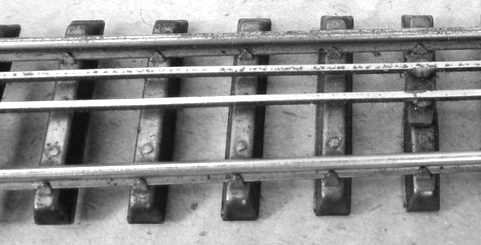
Italian brand created in 1945 in Milan by Fancesco Biaggi to be started
by producing equipment in O and 1 then, in 1947, in HO.
At
the beginning, the track was very specific "the biaggi system" with 4
rails: two interior insulated rails which fed, by
alternating current,
the engine induction coils, the return being made by
the two external rails connected to each other (rails of rolling).
This system was quickly abandoned for a classic three rails route.
The GEM brand disappeared in 1955
Geyper :
Firme Espagnole fondée à Valence en 1945 par Antonio Pérez Sánchez.
Ce n'est qu'en 1950 que Geyper commence à se faire connaitre dans la production de jouets.
A cessé ses activités en 1987.
Spanish firm founded in Valencia in 1945 by Antonio Pérez Sánchez.
It was not until 1950 that Geyper began to make a name for itself in the production of toys.
Ceased operations in 1987.
Gilbert :
"HO" - "O"
"A.C. Gilbert Company", fondée en 1909 à Westville dans le Connecticut (USA) pour fabriquer des produits destinés à la magie, cette entreprise
s'est lancé dans le jouet avec son Erector, jeu de construction semblable au Meccano. Gilbert commercialise une ligne en HO sous le nom
de Gilbert HO à partir de 1938.
Dans les années 1950 Gilbert est l'un des plus grands producteurs de jouets
américains.
Vers 1955 et pendant 4 ans Gilbert a commercialisé du matériel fabriqué par la société Varney.
En 1967 en faillite la maque disparaît.
launched out in the toy with its Erector, building set similar to Meccano. Gilbert also markets a HO line under the name
of Gilbert HO from 1938.
In the years 1950 Gilbert is one of the largest producers of American toys.
Around 1955 and during 4 years Gilbert marketed equipment manufactured by the Varney company.
In 1967 bankrupt, the brand disappears.
Globe : "HO"
Entreprise créée à Milwaukee (Wisconsin -USA) en 1943.
Les premiers modèles à construire ont été mis sur le marché en 1948.
C'étaient des wagons tout métal, la citerne en tôle et
toutes les autre pièces en métal moulé,
y compris les extrémités de la citerne et le dôme.
Les bogies étaient
équipés, de chaque côté, de deux ressorts métalliques.
Cette société a été
rachetée par Athearn en 1951. Le nom de Globe a alors été utilisé par
Athearn pour diffuser ses premiers
kits.....en plastique, en complément de ses propres kits métal.
Le nom de Globe disparait en fin des années 1950.
Company created in Milwaukee (Wisconsin - USA) in 1943.
The first models to be built were put on the market in 1948. They was metal wagons, the cistern in sheet and all the others parts
moulded metal , including the ends of the cistern and the dome. The bogies were equipped, on each side, with two metal springs.
This company was repurchased by Athearn in 1951. The name of Globe was then used by Athearn to diffuse its first plastic kits .....,
in complement of its own kits metal.
The name of Globe disappears in the end of 1950.
GMP:
"O"
Fondée par Mrs. Gilardi, Moureaux, Pottier - Marque Française, créée en 1955 à Paris. Cesse ses activités quatre ans après en 1959.
Created in 1955 in Paris, by Messrs Gilardi, Moureaux, Pottier this brand closed fours years later, in 1959.
GMR : "HO"
Marque commerciale "Great Model Railways", utilisée par Airfix (maruqe anglaise) de 1979 à 1981 (rachat
par Palitoy),
pour différentier le matériel "Ready to Run" du matériel Airfix "kit à construire".
"Great Model Railways" used by Airfix, (England) From 1979 to 1981 (purchase by Palitoy), to differentiate the "ready to run"
material from the airfix "Kit to build".
Graham Farish : "N"
Société
anglaise qui commercialise des trains en OO à partir de 1950 avec des locomotives propulsées par des moteurs 2 pôles. "N
Une grosse partie de la production a été moulée en Mazac (similaire au Zamac) et a été détruite par la "peste du zinc".
En 1970 la société commence à produire du matériel à l'échelle N, sous le label GRAFAR et abandonne définitivement le OO.
Dès 1980 Grafar devient le principal fournisseur de matériel britannique en N.
A ce moment une partie de la production est commercialisée sous le nom de GRAFAR qui la re-commercialise sous Graham Farish,
mais la dénomination sociale reste Grafar Limited…..it’s
clear no !
La marque est achetée par Bachmann Europe en 2001 et la production est immédiatement délocalisée en Chine, la marque
existe toujours.
Many of its products were moulded in Mazac (similar to Zamac) and were destroyed by the“plague of zinc”.
In 1970 the company starts to produce equipment on the scale N, under label GRAFAR and leave the OO definitively.
By 1980 Grafar becomes the British leading vendor for equipment in N.
At this time part of the production is marketed under the name of GRAFAR which Re-markets it under Graham Farish,
but the company name remains Grafar Limited..... C'est simple non ?
The brand is bought by Bachmann Europe in 2001 and the production is immediately delocalized in China, the brand always exists.
Grötsch fournissait aussi des modèles pour les
marques HWN, Dressler ou BUB.
son propre nom ou sous le sigle "GGF" (Georg Grötsch Fürth) puis s'installe à Nuremberg, vers 1970, devenant la société
"Georg Grötsch KG", qui fabrique et distribue des trains jouets, jusqu'en 1978.
Georg Grötsch produed HO equipment, lithographed sheet, as far as back 1949 for the Beckh brand in Nuremberg.
Grötsch provided also models for brands HWN, Dressler or BUB.
Around 1956 creation of Georg Grötsch KG Spie in Fürth which starts to manufacture plastic equipment HO
and it markets under its own name or under initials "GGF" (Georg Grötsch Fürth) then settles, around 1970, in Nuremberg, company
Georg Grötsch KG,which manufactures and distributes trains toys,until 1978.
HAG :
O - HO
Fondée à St Gallen, en Suisse, par les frères Hugo et Alwin Gahler, le 1er avril 1944, cette société s'est spécialisée dans le "0".
Suite au déclin du "0" au profit du HO, Hag a lancé une production HO en 1954 avec arrêt de la production "0" en 1957.
HAG est devenu une société
anonyme en 1979 -
En 2012 la société change de main devenant la HAG Modellbahnen. GmbH, l'usine de Mörschwil est fermée et la production transférée
à Stansstad et la poduction "de nouveau modèles" continue sous le nom de HAG et propose le même matériel "amélioré".
En 2018 la société Amiba reprend le matériel des "anciens modèles" de "l'ancienne HAG" et vend ce matériel jusqu'à l'épuisement
du stock existant.
La marque HAG existe toujours (2024).
Founded in St Gallen, Switzerland, by the Brothers Hugo and Alwin Gahler, on April 1, 1944, this company specialized in "0".
Following the decline of the "0" for the benefit of the HO, Hag launched a HO production in 1954 with the stop of production
"0" in 1957.
Hag became an anonymous company in 1979 -
In 2012 the company changed hands became the Hag Modelbahnen. GMBH, the Mörschwil factory is closed and the production
transferred In Stansstad and the "new models" continues under the name of Hag and offers the same equipment "improved" .
In 2018 the Amiba company takes up the equipment of the "old models" of "the old Hag" and sells this equipment until exhaustion
existing stock.
The Hag brand still exists (2024).
.
Haji :
Société fondée en 1951 à Tokyo,
Haji était un fabriquant de jouets ,également connu sous le nom de "Mansei Toy Co Ltd"
Haji était spécialisé dans la production de jouets liés au
transport avec une série de trains en "S" (tout en tôle puis citerne tôle sur
chassis plastique) et en HO (tôle et plastique)
Haji
n'est pas connu pour avoir produit des jouets après les années 1969/70.
Company
created in
1951 in Tokyo, Hadji wasone manufacturing of toys of the area of Tokyo,
also known under the name of "Mansei Toy Co Ltd"
Hadji was
specialized in the production of toys
related to transport with a lot of sets "freight train" in
gauge "S" (first all sheet metal
then tank metal on plastic frame) and in HO (tank sheet metal on plastic frame)
Hadji is not known to have produced toys after the years 1969/1970.
HANSE :
Entreprise créée en 1930 par Holger Hansen à Tranbjerg (Danemark) qui
fabriquait des malles de voyages en bois.
En 1934, début d'une production de jouets en bois
En 1973 la fabrique déménage à Braband.
Ne pas confondre avec la société "Hanse Tec" ci-dessous .
Company created in 1930 by Holger Hansenwith in Tranbjerg (Denmark) which manufactured wooden trunks for travel.
In 1934, beginning a production of wooden toys
In 1973 the factory moves in Braband.
Not to confuse with the company below :
Marque Danoise de jouets en bois, c'est en fait le nouveau nom de BILOfix dans les années 1973.
Ne pas confondre avec l'entreprise Hanse ci-dessus.
Danish wooden toys brand, is actually the new name of Bilofix in the years 1973.
Do not confuse with the Hanse company above.
Herkat
Modellbahn est une société allemande (Nuremberg) spécialisée dans le nettoyage
des voies HO et N.
Produit, entre autres, des wagons citernes nettoyeurs dans ces échelles.
Herkat Modellbahn is a German company (Nuremberg) specialized in the cleaning of the ways HO and N.
Product, inter alia, tankers rails cleaners int hese scales.
Heros :
Située
au cœur de la forêt Bavaroise, cette entreprise Allemande aurait plus de 100
ans d'existence dans la production de jouets en bois.
Heros fait partie de la société Rossberg basée à Lam (D)
-
Toujours en activité.
Located in the middle of the Bavarian forest, this German company would have more than 100 years of existing in the production
of wooden toys.
Hero belongs to the Rossberg company basedin Lam (D) -
Always in activity.
Hobby Line : "HO"
Deux origines (Two origins) :
HO bbyline (HO bbykit) : Voir (see) John A. English
Hobbyline : Voir (see) Roco
Holz Kunts/Kaden :
Entreprise
artisanale familiale de la région de Seiffen (Allemagne- Saxe), fondée par Richter/kaden à la fin du 19ème siècle,
a
commencé à produire des trains en bois vers 1955.
Toujours en activité (voir aussi Dregeno)
Family craft business in the area of Seiffen
(Germany - Saxony), founded by Richter/kaden at the
end of the 19th century,
started to
producerafts around 1955.
Always in activity (see also Dregeno)
Hornby
: O
et HO
Cette marque a pour origine la société Meccano Ltd (voir ce nom) fondée en 1908 par Frank Hornby à Liverpool.
La marque Hornby a été créée pour concevoir et fabriquer les trains jouets de la société Meccano Ltd.
Dès 1920 la production
de train mécaniques en "0" commence dans l'usine de Binn's
road sous le nom de "Hornby Train",
la production des "Hornby Series" est lancée.
Les premières publicités sont publiées dans les revues "Meccano Magazine" édition anglaise 1920, 1921 et française de 1921
En 1930 le catalogue
est très important avec une multitude de wagons et comporte des
locomotives réalistes et des voitures de luxe
comme les "Pullmann".
Le
premier modèle électrique est lancé dès 1925, alimenté directement sur le
secteur 110 volts au travers d'une simple lampe incandescente
(à filament) qui jouait le rôle de ballast....En 1929 on passe en 6 volts continus.
En 1938 la société lance du "OO" sous l'appellation "Hornby Dublo".
D'abord avec des machines à ressort, la production devient entièrement électrique en 1941.
Le matériel roulant était fabriqué en métal (tôle lithographiée), les premiers wagons en plastique apparaissent en 1958
Les moteurs étaient alimentés par un système 3 rails jusqu'en 1959 puis en 2 rails.
la marque Française SMCF.
En 1921 la firme Meccano s'installe à Paris, rue de Rébéval dans le 9ème, sous le nom de Meccano France, où les ateliers occupent
4 étages de l'immeuble pour dans un premier temps gérer les importations du matériel fabriqué à Liverpool. Rapidement Meccano
France récupère l'outillage anglais et devient autonome.
Au début des années 1920 production des trains mécaniques "Zulu"qui étaient moins couteux que le matériel Hornby.
Construction de l'usine de Bobigny en 1929, copie conforme de l'usine de Liverpool.
En 1951 l'entreprise déménage à Belleville, dans le 19ème, en utilisant l'outillage anglais et en repeignant les modèles aux
couleurs françaises.
Rapidement la production s'oriente sur du matériel purement français et les ateliers de belleville sont remplacés, en 1931
par une nouvelle usine située à Bobigny (région parisienne) où sont fabriqués les populaires modèles type "M" ainsi que les luxueux
"Train bleu" et "Flèche d'or", les plus beaux modèles de Hornby.
A partir de 1934/1935 de nouveaux modèles sont produits (série 1) qui vont remplacer le matériel anglais avec une nouvelle décoration.
La production s'arrête en 1941 pour reprendre en 1946, la marque
"Hornby Train" devient simplement "Hornby", la "M series" revient
sur le marché en 1952 et la série "N° 50" apparait en 1957.
En 1958 l'usine de Bobigny est agrandie et commence à produire des
locomotives moulées en zamac avec une nouvelle génération de
matériel
roulant.
C'est en 1960 qu'est créée la société Hornby France pour
produire du matériel en HO, le Hornby acHO, destiné à remplacer le Hornby
Dublo
(OO) anglais.
Cette production vient en complément du jeu de construction
"Mecanno" et des automobiles Dinky Toys produits par l'usine de Bobigny.
Cette même année Meccano France a racheté la marque SMCF (moules inclus).
En 1962 la production en tôle lithographiée est arrêtée et le "Hornby 0" est abandonné en 1964.
En 1970 l'usine de Bobigny est démolie.
Suite à la concurrence de Jouef, le Hornby AcHO disparait en 1973
La production du Dublo a cessé en 1965 (après la fusion avec Tri-Ang, filiale de Rovex, qui a pour société mère Lines Bros)
et le matériel de production a été vendu à une autre société de Bros lines : la G&R Wrenn
La marque devient, en 1965, la Tri-Ang Hornby Ltd jusqu'en 1972 où, après la disparition de Lines Bros, elle est rachetée par
Dunbee-Combex-Marx et prend le nom de Hornby Railways Ltd.
En
1980 D.C.M. fait également faillite et Hornby Railways devient
une société indépendante sous le nom de Hornby Hobbies Ltd
et s'ouvre au
public en 1986.
En 1985 de nouvelles séries sont lancées comme "Thomas the tank engine" et la gamme "Amis"
La concurrence devenant dure avec les nouveaux acteurs comme Dapol, Hornby se rapproche de Lima (Italie) et toute la production
est décentralisée en Chine (Sandra Kan, usines dans la région de Canton) ) dès 1995.
En 2004 rachat de la marque Espagnoles Electrotren et création du groupe Hornby Spain SA.
En 2005 Hornby Railways reprend les actifs de Rivarossi et continue la production des marques Arnold, Jouef, Lima
En 2006 Hornby prend le contrôle de Airfix et des peintures Humbrol puis, en 2008, de Corgi.
A noter qu'en 2008 Kader (Bachmann Industrie), le principal concurent d'Hornby, rachète Sandra Kan.
En 2015 le contrat avec Sandra Kan est dénoncé et le matériel de fabrication rapatrié en UK.
En 1964 Lines Bros (propriétaire de la marque Triang) rachète Hornby et produira du HO et du TT jusqu'en 1973 sous l'appellation
Meccano-Triang (mélange de Hornby et de VB, marque française reprise précédemment par Triang)
Voir aussi Meccano
The Hornby brand was created to design and manufacture toy trains for the company Meccano Ltd.
From 1920 the production of mechanical trains in "0" begins in the factory of Binn's road under the name of "Hornby Train",
the production of "Hornby Series" is launched.
The first advertisements were published in the English edition of "Meccano Magazine" (1920, 1921) and the French edition (1921).
In 1930 the catalog is very important with a multitude of wagons and includes realistic locomotives and luxury cars like the "Pullmann".
The first electric model was launched in 1925, supplied directly from the 110-volt sector through a simple incandescent lamp (filament)
which acted as a ballast .... In 1929, we switched to 6 continuous volts.
The M series appeared in 1926, the automatic coupling system in 1931.
In 1927 a "Hornby Lines" workshop was set up in the USA to be sold the following year to AC Gilbert.
In 1938 the company launched "OO" under the name "Hornby Dublo". First with spring machines, production became entirely electric
in 1941.
The rolling stock was made of metal (lithographed sheet metal), the first plastic wagons appeared in 1958 The engines were powered by
a 3 rail system until 1959 then by 2 rails.
It was in 1960 that the "HO" appeared under the name of "Hornby ACHO" in 12 continuous volts, absorbing the French brand SMCF.
Meccano France (Hornby acHO)
In 1921 the Meccano firm moved to Paris, rue de Rébéval in the 9th, under the name of Meccano France, where the workshops occupied
4 floors of the building to initially manage the imports of the material manufactured in Liverpool.
Quickly Meccano France recovers English tools and becomes independent.
From 1923 production of "Zulu" mechanical trains, which quickly became Hornby with electrifies equipement.
Construction of the Bobigny factory in 1929, compliant copy of the Liverpool factory.
In 1951 the company moved to Belleville, in the 19th, using the English tools and repainting the models in French colors.
Quickly production is oriented on purely French equipment and Belleville workshops were replaced, in 1931, by a new factory located
in Bobigny (Paris region) where are manufactured the popular "M" models as well as the luxurious "train Bleu" and "Flèche d'or",
the most beautiful models of Hornby.
From 1934/1935 new models were produced (series 1) which will replace the redecorated English equipment. Meccano France (Hornby)
The production stopped in 1941 to leave in 1946, the brand "Hornby Train" simply became "Hornby", the "M Series" returned to
the market in 1952 and the series "N ° 50" appeared in 1957.
In 1958 the Bobigny factory was enlarged and began to produce locomotives molded in Zamac with a new generation of rolling stock.
It was in 1960 that Hornby France was created to produce HO equipment, the Hornby acHO, intended to replace the English
Hornby Dublo (OO).
This production complements the "Mecanno" construction game and Dinky Toys cars produced by the Bobigny factory.
That same year Meccano France bought the SMCF brand (molds included).
In 1962 production in lithographed sheet metal was arrested and the Hornby "0" was abandoned in 1964.
In 1970 the Bobigny factory was demolished.
Following Jouef competition, the Hornby acHO disappeared in 1973
Production of Dublo
ceased in 1965 (after
fusion with Tri-Ang subsidiary of Rovex which
has Lines Bros as head office)
and the equipment of production was sold to another company of lines Broe: the G&R Wrenn.
The brand becomes, in
1965, the Tri-Ang Hornby Ltd until
1972 when, after the
disappearance of Lines Bros it is repurchased
by
Dunbee-Combex-Marx and takes the name of Hornby Railways Ltd.
In
1980 D.C.M also goes bankrupt and
Hornby Railways becomes an independent
company under the name
of Hornby HobbiesLtd and opens
with the public in 1986.
In 1985 new series are launched like“Thomas the tank engine” and the range "Amis".
Competition becoming hard with the new actors
like Dapol, Hornby approaches Lima (Italy) and all the production decentralized in China (Factories Sandra Kan near Canton) by 1995.
In 2004 acquisition of the brand Spanish Electrotren and creation of the group Hornby Spain SA.
In
2005 Hornby Railways takes again the credits
of Rivarossi and continues the
production of the brands Arnold, Jouef, Lima.
In
2006 Hornby gains control of Airfix and
Humbrol paintings then, in
2008, of Corgi.
Note that in 2008 Kader (Bachmann Industrie), the main competitor of Hornby, bought Sandra Kan.
In 2015 the contract with Sandra Kan was denounced and the manufacturing equipment repatriated to UK.
In
1964 Lines Bros (producing the Triang
brand) repurchases Hornby which will
produce HO and TT until 1973 under name of
Meccano-Triang (mixture of Hornby and VB, French brand recovery previously by Triang)
See also Meccano
Hot Wheels :
Fondée en 1968, cette marque du groupe Mattel
qui a commercialisé des trains jouets à traîner (fabriqué à Hong-Kong) de 1983
à 1985,
locomotives
et wagons de marchandises. Il existe un dépôt marchandises avec des voies en
creux.
Cette marque existe toujours mais ne produit plus que des voitures miniatures - Elle a en particulier racheté Tyco, propriétaire de la marque
Matchbox, en 1997.
Founded in
1968, this brand of the Mattel group
which marketed trains toys to
trail (manufacturedin Hong-Kong) from1983 to 1985,
engines and freight cars.
There exists a deposit goods with tracks in hollow.
This brand
always exists but does not produce any
more that miniature cars - It in
particular repurchased Tyco, owner
of the
Matchbox brand , in 1997.
HWN (Heinrich Wimmer Blechspielwarenfabrik) :
O et HO
Allemagne - Heinrich Wimmer a fondé en 1920, à Nuremberg, une entreprise qui fabriquait des jouets en tôle.
Elle a pris le nom de HWN en 1928.
La production, vendue dans les grands magasins, de trains bon marché en tôle, O et HO (trains complets avec machines à moteur mécanique
puis électrique, des gares et autres accessoires) a commencé après la guerre.
Vers la fin des années 1960 le plastique a remplacé la tôle.
A la
mort d'Heinrich, en 1969, son fils Ernest repris l'affaire jusqu'en 1976, et
disparition de la marque.
HWN a également travaillé en partenariat avec Karl Bub.
It took the name of HWN in 1928.
The production of cheap sheet trains, O and HO (complete trains mechanical then electric, stations and others
accessories) started after the war.
Towards the end of 1960 the plastic replaced sheet metal.
With the death of Heinrich, in 1969, his son Ernest taken again the business until 1976, and disappearance of the brand .
HWN also worked in partnership with Karl Bub.
Ibertren
: HO
et N
Marque Espagnole qui a été créée en 1973 à Barcelone (Espagne).
Elle commence par fabriquer un moteur électrique pour modèle réduit
équipant une locomotive diésel SNCF 61001.
Elle commercialisa du N (1:160) avec un 3ème rail
(courant continu) baptisé 3N, qui est donc incompatible avec le matériel N
couramment utilisé.
La production en HO commence en 1980.
La société mère "Model Iber Sa" fait faillite en
1992 et est reprise par Exin qui a produit du matériel très simple,
jouets pour les plus jeunes.
La marque Ibertren disparait alors.
En 2004 création d'une société "Ibertren Modelismo SL", toujours à
Barcelone relance la marque Ibertren avec un catalogue en HO.
En 2008 Ibertren propose des modèles en N.
Toujours en activité Ibertren propose quelques modèles en N et de très
rares pièces en HO.
It starts by manufacturing an electrical motor for scale model equipping a Diesel loco SNCF 61001. Henrich Wimmer Blechspielwarenfabrik
It marketed N with one 3rd rail (D.C. current) baptized 3N, which is thus incompatible with equipment N usually used.
The production HO starts in 1980.
The parent company “Model Iber Sa" fact bankruptcy in 1992 and is taken again by Exin which produced very simple equipment,
toys for young people.
The Ibertren brand disappears then.
In 2004 creation of a company “IbertrenModelismo SL", always in Barcelona starts again the Ibertren brand with a HO catalogue.
In 2008 Ibertren proposes models in N.
Always in activity Ibertren proposes some models in N and very rare HO parts.
Petite entreprise d'importation et diffusion de jouets créée à Philadelphie (USA) en 1982 par Bernard Pau.
Elle fait suite à AHM en difficulté à l'époque.
Actuellement
basée à Humble Texas elle diffuse via Internet,du matériel pour train
jouets principalement en HO et N
et a vendu du matériel roulant sous ce nom.
Small company of importation and diffusion of toys created in Philadelphia (USA) in 1982.
She follows AHM in difficulty at the time
Currently based in Humble Texas it diffuses, on the Web, equipment for train toys HO and N, sold rolling stock under
this name.
IRC - InterMountain Railway Co: HO - N - 0
Entreprise Américaine crée en 1986, située dans le Colorado à Longmont, qui fabrique et commercialise du matériel roulant et
des
locomotives en HO, N et Z soit en kit soit assemblé.
Toujours en activité,
mais les modèles sont maintenant fabriqués en Chine.
L'entreprise a également fabriqué, à Longmont, des kits en "0". Cette production a été vendue à Atlas dans les années 2000.
American company creates in
1986, located in
Colorado at Longmont, which manufactures and
markets rolling stock and
engines HO, N
and Z either in kit or
assembled.
Always in activity but the models are now
manufactured in China.
The company has also manufactured "0" kits in Longmont. This production was sold to Atlas in 2000's.
JEP : "HO"
Marque
Française issue d'un regroupement d'artisans regroupés à la fin du 19ème
sous l'appellation "Jouet de Paris".
En 1909, une société de ferblanterie, la "SIF UNIS FRANCE", qui produisait déjà des jouets en fer blanc, rachète
"Jouet de Paris".
La marque devient progressivement "JdeP"
puis "JEP" vers 1930.
Sutout présente sur le marché du "O", JEP a produit dès 1925 un matériel en "OO" : le train Mignon, mais ce n'est
qu'en en 1949 qu'une production en HO a été lancée.
Vers 1950 une production à l'échelle "S" (25mm) a été mise sur le marché mais sans aucun succès et très rapidement abandonnée.
La production en "O" est arrétée en 1963, celle du "HO" en 1965 et la marque "JEP" disparait en 1965.
A noter que la marque "SIF UNIS FRANCE" existe toujours (2022) à Iwuy près de Cambrai et produit par emboutissage des
moules pour la patisserie.
French brand resulting from a regrouping of
craftsmen gathered at the end
of the 19th pennies name “Jouet de Paris”.
In
1909, a company of tinplate
industry, the "SIF UNIS FRANCE", which produced already
tin toys, repurchases “Jouet de
Paris”.
The brand
becomes gradually “JdeP” then “JEP” around
1930.
Especially present on the market of the "O", JEP produced in 1925 a material in "OO": the train Mignon, but it is not
only in 1949 that HO production was launched.
Around 1950 a "S" scale production (25mm) was put on the market but
without any success and very quickly abandoned.
Production in "O" is stopped in 1963, that of the "HO" in 1965 and the mark "JEP" disappears in 1965.
Note that the brand "SIF UNIS FRANCE" still exists (2022) in Iwuy near
Cambrai (France) and produced by stamping
pastry moulds.
JL - Jean Laffont : "HO"
Entreprise française créée par Jean Laffont en 1949 située rue de Rivoli à Paris (1er).
Elle produisait du matériel en HO (voitures et wagons) à construire, en
carton et bois sur chassis en métal moulé.
Le montage était assez difficile et la peinture, comme la décoration,
devait être réalisée par l'acheteur.....
La marque a disparu en 1972 après le décès de son créateur.
She produced equipment HO: cars and wagons to build, in cardboard and wood on molded metal chassis.
The assembly was quite difficult and the painting, like the decoration, had to be carried out by the buyer .....
The brand disappeared in 1972 after the death of its creator
 Publicité dans Loco Revue 281 du 02/1968
John A. English : "HO"
Vers la fin des années 40,
à Morrisville - Pa - USA, J.A. English s’est lancé dans la fabrication de kits métal de locomotives
vapeurs puis
d’une diesel.
Ce matériel était vendu sous son propre nom puis, vers 1955, sous la marque Hobby Line Products en ajoutant à son offre quelques
wagons en plastique, pour finalement abandonner le métal y compris pour les
locomotives.
Cette marque a disparu vers 1963.
Towards the end of the Forties, in Morrisville - Pa - USA, J.A.English launched
in the manufacturing of vapor
kits metal locomotive then
a diesel, sold under its own name then,around
1955, under the Hobby Line
Products brand which added to his offer some plastic
wagons, for finally giving up metal including for the engines.
This brand disappeared around 1963.
JOUEF : "HO"
Marque
française, fondée en 1944 dans le Jura, produit des trains jouets en HO.
Elle
passe au modélisme en 1963 tout en restant "à bas prix".
De 1961 à 1969 Jouef a fabriqué du matériel pour l'Angleterre. Ce matériel était
distribué par Playcraft. Certains wagons étaient
modifiés
(plaque d'informations) pour correspondre au matériel anglais.
Vers 1974/1976 Jouef a égalment produit du matériel pour un distributeur Allemand "Trim Toy's". Ce matériel était vendu dasn des
boites spécifiques, aux couleurs Trim Toy's et marquées Jouef.
Jouef a fait également fabriquer, pour le marché de Grande Bretagne, du matériel roulant en Irlande sous la marque "HDI".
HDI = Hobby Developments Ireland; Cette production a été très brève : Une année entre 1979 et 1980.
Vendue en 1972 la firme dépose le bilan en 1980, est reprise par Joustra du
groupe "CEJI" qui dépose son bilan en 1985, puis est reprise
par le fondateur de
FOBBI qui regroupe toutes les fabrications de jouets autours de Champagnol.
Enfin en 1995 Jouef est racheté par le groupe italien Rivarossi et l'usine ferme ses portes en 2001.
Après le rachat des actifs de Rivarossi par Hornby
Railways, en 2004, la marque continue d’exister, mais avec du matériel
fabriqué en
Chine, avec des références du type HJ1234.
French brand, founded in
1944 in the Jura,focus on the train toy
HO, it passes to model making in
1963 while remaining “at low prices”.
From 1961 to 1969 Jouef manufactured
equipment for England. This equipment was
distributed by Playcraft. Some wagons were modified
(plate of information) for England.
Around 1974/1976 Jouef also produced equipment for a German distributor "Trim Toy's". This material was sold in specific boxes,
in Trim Toy's colors and marked Jouef.
Jouef also made manufacture, for the United Kingdom market, rolling stock in Ireland under brand HDI –
HDI = Hobby Developments Ireland; This production was very brief : One year between 1979 and 1980.
Sold in
1972 the firm files for bankruptcy in 1980, is
taken again by Joustra of the group
CEJI going bankrupt in 1985,
then bought
back by the founder of FOBBI which regroups all the manufactures around Champagnol.
Finally in
1995 Jouef is
repurchased by the Italian group Rivarossi and
the factory closes down in 2001.
After the credits of Rivarossi repurchased
by Hornby Railways, in 2004, the brand
continues to
exist, but with equipment made in
China,with references like HJ1234.
Junior (Micro Maag) : "HO"
Secondary brand used by Micro Maag AG to distribute boxed trains (1945/1949)
Jyesa (Juguetes Y Estuches Sociedad Anônima) : "HO"
Marque
Espagnole crée en 1936 à Ibi (Alicante) elle produisait des étuits pour seringues (d'où le nom), des lampes de poche et
quelques jouets.
Ce n'est qu'après la guerre civil que la production de jouets est devenue importante.
Cette marque disparait vers 1980..
It was only after civil war that toys production has become important.
This brand disappeared about in 1980
K - Line (MDK) : "O"
K-line a tout d'abord été une sous-marque de l'entreprise "MDK",
entreprise fondée en 1975 par Maury D. Klien, en Caroline du Nord.
Cette entreprise commercialisait du matériel Lionel.
Quand la compagnie "Louis Marx" a disparue en 1948, "MDK" a sauvegardé des
moules et des accessoires "Marx",
allant jusqu'à les récupérer dans les
usines désaffectées.
Les moules ont été réutilisés par K-Line pour
créer sa propre ligne de produits.
Le matériel a été adapté pour être
compatible avec le matériel Lionel et vendu moins cher, au grand dépit de Lionel.
L'entreprise "MKD" se lance
dans les trains écartement "0" et "S" matériel et voies en 22,5 mm, en 1985.
Une procédure, engagée par Lionel, va conduire K-Line à la faillite.
Une grosse partie du matériel roulant devait être remis sur le marché sous la marque RMT (Ready Made Toys)
Lionel est autorisé à utiliser la marque sous le nom de "K-Line by Lionel".
K-line was initially a sub-brand of the MDK company, founded in 1975 by
Maury D. Klien, North Carolina.
This company marketed Lionel equipment.
When
the Louis Marx Company disappeared in 1948, MDK secured Marx molds and
accessories, going as far as recovering
them in the disused factories.
The molds were reused by K-Line to create their own line of products.
The material was adapted to be compatible with Lionel material and sold cheaper, to the great defiance of Lionel.
The MKD company launches in trains spacing "0" and "S" material and tracks in 22.5 mm, in 1985 ..
A lawsuit, initiated by Lionel will lead K-Line to bankruptcy.
A large part of the rolling stock had to put back on the market under the brand RMT (Ready Made Toys)
Lionel is authorized to use the mark under the name "K-Line by Lionel".
Kadee : (Micro Trains)®
Entreprise Américaine, fondée en 1940 par deux frères jumeaux: les Edward Dale et Keith à White City (Orégon)
Ils
ont commencé par produire des aiguillages pour trains miniatures HO
puis ont inventé le "Matic Coupler", un attelage
magnétique révolutionnaire à l'époque.
Dès 1972 Kadee commence à produire du matériel roulant pour le "N" et une division spécifique est créée : La Micro-Train®
spécialisée dans le N puis le Nm et le Z
American company, founded in 1940 by two twin brothers Edward: Dale and Keith
They started by producing shuntings for miniature
trains HO then invented the “Matic
Coupler”, a revolutionary magnetic
coupling at the time.
From 1972 Kadee began to produce rolling stock for the "N" and a specific division was created: the Micro-Train®
In 1990 the two brothers got angry, Dale kept Kadee and Keih create the Micro Train Lines in talent (Orégon) specialized
in N then the NM and the Z
Always in activity, specialized in the production of
spare parts for railway model making.
Kader
:
Voir - see Bachmann
Tout commence en 1950 où un jeune pationné de modélisme ferroviare,
Yuji Kato, se spécialise dans la fabrication de boggies HO en
utilisant le matériel d'emboutissage de l'entreprise familiale "Kato Kinzoku".
En 1957, création à Tokyo de la "Sekisui Kinzoku Co.Ltd."Sspécialisée
dans le modélisme ferroviaire en HO.
En 1965 lancement d'une production en "N" qui devient très importante au fil du temps et ouverture en 1981 de l'usine de Saitama
à Tsurugashima et apparition du logo "KATO" :
Elle
possède plusieurs centres de distribution au Japon, les "Hobby Center Kato"
de Tokyo et Osaka
En 1986 création de Kato USA par Hiroshi Kato près de Chicago (Schaumburg,
Illinois)
La fabrication de tous les produits KATO est effectuée au Japon.
using the "kato kinzoku" family business jaming equipment.
In 1957, creation in Tokyo of the "Sekisui Kinzoku Co.LTD" specialized in railway modeling in HO
In 1965 launching a "N" production which became very important over time and opening in 1981 of the Saitama factory in Tsurugashima
and the appearance of the "Kato" logo.
The company has several distribution centers in Japan, the "Hobby Center Kato" in Tokyo and Osaka
In 1986 Creation of Kato USA by Hiroshi Kato near Chicago (Schaumburg, Illinois)
The manufacture of all Kato products is carried out in Japan.
.
KB - KBN :
Keim : "O"
Société Allemande, la Keim & Co (fondée en 1886 à
Nuremberg) produisait des emballages métalliques.
C'est à partir
de 1920 qu'ont été fabriqués des jouets en tôle et des machines à vapeur.
Vers 1938 la production de trains
jouets commence avec la reprise des sociétés Kraus et Kraus-Fandor
(cédées par leurs propriétaires juifs
suite à l'aryanisation de l'Allemagne).
Cette usine à été détruite par des bombardements en 1946 et jamais reconstruite.
Du matériel ex-Krauss a été fabriqué jusqu'en 1962/1963.
En 1955 Keim fabrique ses premiers trains électriques, une
production assez limitée, surtout du matériel de dépannage pour les
locomotives et
matériel Krauss, qui a été arrêtée début des années 1970.
German company, Keim & Co (founded in
1886 in Nuremberg) produced metallic containers.
After 1920 is manufactured the sheet toys and the steam engines.
Around
1938 the production of trains toys
starts with the resumption of the company Kraus and Kraus-Fandor (from its Jewish owners in
the course of the Germany Aryanization).
This factory destroyed by bombardments rebuilt in 1946 and ever rebuilt.
In 1955 Keim manufactures its first electric trains.
Limited production, especialy equipment of breakdown service for Krauss engines and material, who was stopped beginning of the years 1970.
KD
= Konrad Dressler :
HO et O
Entreprise
allemande fondée à Fürth (Bavière) en 1917, qui produisait des articles ménagers.
A commencé de produire des jouets en tôle à partir de 1922 et des trains en 0 (tôle lithographiée) en 1946 et jusqu'en 1962.
Le logo "KD" apparait en 1949
La production en HO a commencé en 1956 et s'est poursuivie jusqu'en 1969 avec des modèles en plastique à partir de 1962.
La production était surtout destinée à la grande distribution qui la
revendait sous leur propre marque.
Dressler était étroitement dépendante des magasins Quelle Gmbh et à fait faillite quand ils ont préféré vendre d'autres marques.
La société est alors dissoute en 1970 et le
matériel de production vendu à Grötsch.
Started to produce sheet metal toys from 1922 and 0 trains (lithographed sheet) in 1946 until 1962.
The "KD" logo appeared in 1949
HO production began in 1956 and continued until 1969 with plastic models from 1962.
Production was mainly intended for mass distribution which often sold it under their own brand.
Dressler was closely dependent on stores Quelle GmbH and went bankrupt when they preferred to sell other brands.
The company is then dissolved in 1970 and the production equipment sold to .Grötsch.
Kleinbahn : "HO"
Firme
autrichienne, la "Kleinbahn Mechanische Werkstätte -
Spielwarenerzeugung Ing." spécialisé dans le jouet en HO a été créée
en
1947 par Erich Klein à Vienne, le premier catalogue parait en 1949.
Cette entreprise était spécialisée dans la production de matériel roulant autrichien, en HO, type de matériel pratiquement ignoré par
les grandes marques allemandes.
La vente est
assurée soit par un petit réseau de boutiques de la marque, soit par la
poste puis Internet.
Oskar Klein, qui était le partenaire de son frère Erich, devient actionnaire en 1952 puis fait éclater leur association
pour fonder sa propre société en 1984 : la Klein Modellbahn, à Vienne.
Erich Klein conserve le nom de Kleinbahn - Fermé en 2021
Austrian Firm, the Kleinbahn Mechanische Werkstätte - Spielwarenerzeugung Ing. Specialized in toy HO. Created in 1947
by Erich Klein in Vienna, the first catalog was published in 1949.
This company was specialized in the production of Austrian rolling stock, in HO, a type of material practically ignored by
the leading German brands.
The sale is ensured either by a small network of shops of the mark, or by the post then the Internet.
Oskar Klein, who was the partner of his brother Erich, became a shareholder in 1952 and then broke up his association
To found his own company in 1984: the Klein Modellbahn in Vienna.
Erich Klein keeps the name of Kleinbahn - Closed in 2021
Klein Modellbahn : "HO"
Entreprise Autrichienne, fondée à Vienne en 1984 par Oskar Klein (frère du fondateur de KleinBahn)
Production entièrement axée sur du HO qualité modélisme : locomotives, voitures et wagons.
Suite à des problèmes financiers, la production a cessé en 2008 et la vente du matériel a été stoppée en 2010.
Austrian company, founded in Vienna in 1984 by Oskar Klein (brother of the founder of KleinBahn)
Production entirely centered on HO fisrt quality, engines, cars and coaches.
Following financial problems, the production ceased in 2008 and the sale of materials was stopped in 2010.
Kraus Fandor : "O"
Firme Allemande, créée en 1910 à
Nuremberg, par Joseph Kraus et ses deux cousins Forcheimer.
"FANDOR" est la contraction des noms des mères des fondateurs Fanny et Dora (deux sœurs).
La société était alors spécialisée dans les rouages de mécanismes d'horlogerie.
C'est vers 1925 que sont fabriqués les premiers trains en "0" (mais proche du 1) et en "1".
A
remarquer la création d'une caténaire fonctionnelle pour le 0 qui
pouvait s'installer sur les voies de n'importe quelle marque permettant
ainsi le fonctionnement indépendant de deux trains, l'un par les 3 rails, l'autre par les 2 rails de roulement et la caténaire.
Les
cousins Forcheimer émigrent aux USA en 1924 ouvre une entreprise qui
fabrique des trains jouets sous la marque "Dorfan" (Fandor à
l'envers), qui travaille en étroite collaboration avec Fandor.
Après la guerre plus aucune production, la société "Joseph Kraus
& Co Milton Forchheimer" de New York existe toujours en 1950 puis
disparait en 1963.
En 1933, le fondateur (d'origine juive) émigre aux USA et un peu avant la
guerre (1937/1938) la société Allemande à été reprise par Keim qui
a
continué la production. Bombardée en 1946 l'usine n'a jamais été reconstruite.
German firm, created in
1910 in Nuremberg, byJoseph
Kraus and his two Forcheimer cousins.
FANDOR is the contraction of the names of the
mothers of both founders Fanny and Dora (two
sisters).
The company was then
specialized in the wheels of mechanisms for clock
industry.
It is around 1925 that the first trains in “0"(but near to the 1) are manufactured” and in “1”.
Note that
the creation of a functional overhead wires
for the 0 which could be installed on
tracks any brand thus allowing
operation independent of two trains, one by the
3 rails, the other by the 2 guide rails and the
overhead wires.
The Forcheimer cousins emigrate in the USA in
1924 opens a company which manufactures
trains toys under the brand Dorfan (Fandor withback),
who works in close collaboration with Fandor.
After the war
any production, the companyJoseph
Kraus & Co Milton Forchheimer of New
York exist always in
1950 then disappears in 1963.
In
1933, the founder (of Jewish origin)emigrates in the USA and alittle before the war(1937/1938) the German company at summertaken
again by Keim which continued
production. Bombarded in 1946 the factory was
never rebuilt.
Karen : Voir Holz Kunst/Karen
LEGO :
En
1916 Ole Kirk Christiansen achète une petite menuiserie à Billund
(Danemark). Détruite par un incendie, en 1924, l'entreprise
est
reconstruite et va produire des articles ménagers en bois (échelles, tabourets...) et des petits jouets.
Cette production de jouets va devenir importante dès 1932 et la société prend le nom de "Lego" en 1935
Nouvel incendie en 1942, l'atelier et
l'entrepôt sont entièrement détruits et reconstruits.
En 1947 premier essais avec une machine à injecter le plastique et première ébauche de ce qui deviendra la brique Lego.
A la mort du fondateur Ole,
quatre frères se partagent les activités de Lego : Godtfred à la
direction, Gerhardt, johanes et Karl Georg
en production.
En
1957 les activités bois et plastique sont séparées, Karl pour le plastique et Gerhard pour
le bois prennent la direction de
ces productions.
En
1960 un 3ème incendie détruit les ateliers des jouets en bois. La
décision est prise d'abandonner cette production et en 1962 les
deux
frères Karl et Gerhardt quittent Lego et partent fonder leur
propre société.
Gerhardt fonde la société Bilofix, à Kolding, Danemark, qui deviendra en 1973 la Hanse Tec.
and will produce domestic articles of wood (scales stools) and small toys.
This production of toys will become important by 1932 and the company takes the name of Lego in 1935
New fire in 1942, the workshop and the warehouse are entirely destroyed and rebuilt.
In 1947 first tests with a machine to inject the plastic and first outline of what will become the Lego brick.
With the death of the Ole founder, four brothers share the activities of Lego: Godtfred as manager, Gerhardt, johanes and Karl Georg.
In 1957 the activities wood and plastic are separated, Karl for the plastic and Gerhard for wood take over the leadership of it.
In 1960 3rd fire destroys the workshops of the wooden toys. The decision is made to abandon this production and in 1962 the two
brothers Karl and Gerhardt leave Lego and to found their own companie.
Gerhardt founds the Bilofix company, in Kolding, Denmark, which will become in 1973 the Hanse TEC.
Has its own brands: Lemke collection, Minis, HobbyTrain
LGB:
La
société, crée en 1968 par Lehmann à Nuremberg, était spécialisée dans la
production de matériel en "G".
"G" pour "Groß", grand en allemand, qui désigne des "trains de jardin" utilisant des voies de 45mm.
Après la faillite de
2006, la marque a été reprise par Marklin et la production à été transférée à Györ, en Hongrie.
Malgré le dépot de bilan de Marklin en 2009, la production continue
toujours sous la marque "LGB".
LGB a produit du matériel pour Playmobil (reconnaissable avec ses deux tampons rouges au lieu du butoir central typique LGB)
ainsi qu'une série simplifiée, distribuée par ToyTrain.
The company, created in 1968 by Lehmann in Nuremberg, specialized in the production of "G" equipment.
"G" for "Groß", big in German, which designates "garden trains" using 45mm tracks.
After the 2006 bankruptcy, the brand was taken over by Marklin and the production was transferred to Györ, Hungary.
Despite Marklin's bankruptcy in 2009, production still continues under the "LGB" brand.
LGB produced equipment for Playmobil (recognizable with its two red pad instead of the typical LGB central stopper)
as well as a simplified series, distributed by Toytrain
Life Like HO et N
Cette
entreprise américaine a été fondée en 1950 par Lou et Sol Kramer et fabriquait.....des
glacières en mousse extrudée.
Pour augmenter sa production elle s'est
intéressée au monde du modèle réduit ferroviaire en fabriquant des tunnels en mousse.
Sa production s'est élargie avec le temps et la production de matériel roulant a commencé vers 1968.
En 1970 LifeLike rachète Inc. Varney et réutilise ses moules en HO.
Début des années 70, lifelike commercialise une ligne en N produite par Méhanotehnika en Yougoslavie.
Dans les années 1980 LifeLike commercialise du matériel HO également produit par Mehano.
Deux
lignes de produits ont été commercialisées par LifeLike : la Proto 1000
(créée pour concurrencer Athearn avec des prix bas) et
Proto 2000 de
qualité supérieure mais fragile dans les pièces de détail.
A partir de 1996 des wagons ont été
commercialisés dans cette game, soit en kit soit "Prêt à rouler".
En
2005 la société, connue alors sous le nom de "Industrie Lifoam", se
reconcentre sur ses produits en mousse extrudée et
la partie modélisme est reprise par Walthers et en 2011 l'esemble des séries Proto ex Life Like est proposé sous le nom de Walthers Proto
Drive puis en 2016 le nom Lif Like n'est plus utilisé.t.
This American company was founded in 1950 by Lou and Sol Kramer and manufactured ..... extruded foam refrigerators.
To increase its production it was interested in the world of the railway scale model by manufacturing foam tunnels.
Its production widened with time and the production of rolling stock started around 1968.
In 1970 LifeLike repurchases Inc. Varney and re-uses its HO moulds.
Beginning of the Seventies, lifelike markets a line in N produced by Méhanotehnika in Yugoslavia.
In the years 1980 LifeLike markets equipment HO also produced by Mehano.
Two lines of products were marketed by LifeLike: Proto 1000 (created to compete with Athearn with low prices) and Proto 2000
of higher but fragile quality in detail parts.
From 1996 cars were sold in this game, either in kit or "ready to roll".
In 2005 the company, known then under the name of Industry Lifoam, reconcentre on its extruded foam products and the model making
part is taken back by Walthers, in 2001 the entire life-Like Proto series was renamed Walthers Proto Drive. In 2016 the LIfe Like name
is retired.
Liliput : HO - N
Firme
autrichienne, fondée à Vienne en 1947 par Walter Bücherl, les premiers trains miniatures étaient en bois et en étain.
En 1949 Liliput absorbe la marque Igri (créée en 1946 à Vienne par Ignaz Richter) qui proposait un train tout métal en 00,
mécanique ou non motorisé (assez semblable à du Trix).
Début des années 1950 Liliput passe au plastique.
En
1966 ouverture d'une nouvelle usine toujours à Vienne, puis d'une autre
en 1977 à Baden-Wien (au SW de Vienne).
Liliput a également proposé des wagons sous forme de kit à construire (Bausatz).
Le matériel fonctionnait en 12
volts continu, puis petit à petit a été proposé en alternatif 3 rails compatible avec le Marklin.
Liliput a également produit du matériel en HOe (9mm) en 2 ou 3 rails courant alternatif,
dans les années 60/70 Liliput a également produit, en commun avec Roco, du matériel exporté aux USA par AHM.
Ces produits étaient souvent confondus.
En 1972 a racheté le matériel britanique de Trix (repris dès 1967 par Trix Allemagne).
En difficultés financières la marque est reprise par "Herpa" en 1988 puis a été rachetée
en 1992 par "Kader" qui possède
le groupe britannique Bachmann Industries depuis 1984.
La marque existe toujours (2014), matériel fabriqué en Chine par Kader pour le compte de Bachmann.
In 1949 Liliput absorbed the Igri brand (created in 1946 in Vienna by Ignaz Richter) which offered an all metal train in 00,
mechanical or without motor (quite similar to Trix).
Beginning of the 1950's Liliput went to plastic.
In 1966 opening of a new factory still in Vienna, then another in 1977 in Baden-Wien (SW of Vienna).
Liliput also offered wagons as a Assembling kit (Bausatz).
The material was operated in 12 volt DC. Over time began to make available in 3 rails AC for compatibility with Marklin.
Liliput also produced equipment in HOe (9mm) in 2 or 3 AC tracks, in the 60s / 70s Liliput also produced, in common with Roco,
material exported to the USA by AHM.
These products were often confused.
In 1972 bought the British equipment Trix (taken again in 1967 by Trix Germany).
In financial problems the brand is taken back by Herpa in 1988 then was repurchased in 1992 by Kader which hold the British group
Bachmann Industries since 1984.
The brand always exists (2014), equipment made in China by Kader on behalf of Bachmann.
LIMA HO, 0 et N
Entreprise
Italienne "Lavorazione Italiana Metalli e Affini" créé à Vicenza en
1946 par le Conte Marzotto qui produisait des pièces en
aluminium moulé
pour la FS, les chemins de fer Italiens.
Lima a commencé à produire des jouets en aluminium en 1948. Ce n'est qu'en 1954 que Lima,
qui vient d'être racheté par O. Bisazza (le
véritable créateur des
trains Lima), se lance dans le train jouet en plastique de grande série, jouets
très simples et uniquement sur le modèle
des trains italiens.
En 1962 la gamme devient Européenne.
Lima commence à commercialiser du N en 1966.
A la fin des années 1980, et pendant environ 2 ans, Lima en
coopération avec Hobbytrain à proposé du matériel "N" sous la marque Minibahn
Lancement d'une production en "0" vers 1977, échelle rapidement abandonnée en 1980.
Lima est racheté, en 1992 par le groupe Rivarossi puis est repris par Hornby International en 2004 avec les actifs de Rivarossi.
Note : A partir de 2002 les références sont précédées de la lettre "L" pour désigner le matériel vendu comme du Lima.
La
marque existe toujours (2014) avec du matériel fabriqué en Chine, depuis 2006, pour le compte de Bachmann..
Company
Italian (Lavorazione Italiana Metalli E Affini) created
in Vicenza in 1946 by the Count Marzotto who produced aluminium
parts moulded for the FS, the Italian railroads.
Lima started to produce
aluminium toys in 1948. It is only in 1954 that Lima, which has
just been repurchased by O. Bisazza (the true one
creator of the Lima trains),
launches out in the train toy out of plastic great series, very simple
toys and only on the model of the Italian trains.
In 1962 the range becomes European.
Lima starts to market N in 1966.
In the late 1980s, and for about two years, Lima, in cooperation with Hobbytrain, offered "N" gauge rolling stock under the Minibahn brand.
Production in "O" gauge began around 1977, but this scale was quickly abandoned in 1980.
Lima is repurchased, in 1992 by the
Rivarossi group then is taken again by Hornby International in
2004 with the credits of Rivarossi.
Note: From 2002 onwards, references are preceded by the letter "L" to designate equipment sold as Lima.
The brand always exists (2014) with equipment made in China, since 2006, on behalf of Bachmann.
LIONEL 00 - 0 et Standard
En
1900 Joshua Lionel Cowen fonde, à New York USA, la société "Lionel Corpoation"
qui commercialise sont premier train : l'Electric Express en
1903.
Production à l'écartement "Standard" de 54 mm (2-7/8 pouce se rapproche du II).
Les premiers trains étaient alimentés par des piles humides (à l'acide) qui furent rapidement remplacées par un transformateur alimenté par le
secteur 110 volts. En 1906 est créée la première voie à trois rails, toujours à l'échelle "Standard".
En
1915 lancement de l'échelle "O" qui va petit à petit supplanter le
"Standard". La production en "Standard" va être arrêtée en 1939
En 1926 Lionel absorbe Ives Trains.
En 1929 ouverture de l'usine de Hillside, dans le New Jersey, qui fonctionnera jusqu'en 1974.
En 1938 Lionel lance une production en 00 (double 0) au 1/76. Cette échelle était très marginale aux USA (Scalecraft ou encore Varney) où
du HO était produit par plusieurs constructeurs comme American
Flyer .
Comme pour le "Standard" (échelle 2" 1/8) Lionel a peut-être
voulu "faire un coup". Le "Standard", qui n'en était pas un puisque
seul Lionel
en produisait, a pris de l'importance puisqu'il figurait sur les catalogues d'une dizaine de fabricants.
Quoiqu'il en soit le 00 fut un
échec et a été abandonné par Lionel en 1942, contrairement à l'Europe
où HO et 00
utilisaient la même voie classique 16,5mm.
La grande période pour Lionel a été dans les années 1950 où il fut un moment le plus grand producteur de jouets du monde.
Mais cette diversification lui a été fatale et dans les années 1960 la qualité de ses productions diminua.
En 1967 Lionel, qui vient d'absorber American Flyers, est déclaré en faillite et la production des trains électriques arrêtée.
La Lionel Toy Corporation (nouveau nom lancé en 1965) donne en 1969 l'autorisation à General Mills de produire du matériel Lionel.
En 1970, le matériel de production "fer blanc" est vendu à Williams qui produit des copies du matériel Lionel et Ives.
En
1973 Lionel est absorbé par la filiale Fundimensions de General Mills
et la production de matériel Lionel se redresse, retrouvant la qualité
"Lionel" du début.
En
1980 General Mills décide de délocaliser sa production au Mexique, à
Mexico, ce qui fut un véritable désastre. La production retourne
dans
le Michigan, à Chesterfield, quatre ans plus tard, en 1984.
En
1985 la marque Lionel est reprise par Kennes Parker puis revendue, en
1986, à Richard Kughn (un passionné de trains qui avait fait
fortune
dans l'immobilier) qui lance la marque "Lionel Trains".
En 1987 Lionel passe un accord avec MTH qui devient sons sous-traitant ce qui permet à MTH d'utiliser le nom de Lionel
pour ces reproductions.
En
1995 la marque change à nouveau de main et de nom devenant la Lionel LLC qui
possède alors toutes les marques et les droits liés à Lionel
Coporation.
En 2009 un nouvel accord permet à MTH d'utiliser les graphismes de Lionel (alors Lionel LLC) pour ces modèles et les boites.
Cet accord a pris fin en 2019
En
2000, après 100 années de production en Amérique, la marque fait
fabriquer son matériel en Corée et en Chine. Question de survie pour la
marque.
A la suite d'un procès, Lionel absorbe K-Line en 2005.
En 2006 Lionel retrouve le HO en lançant une locomotive diésel et quatre locomotives vapeur hautement détaillées.
En 2006, pour des questions juridiques qui finalement se terminent bien, la marque a bien failli disparaitre.
Le siège social retourne à New York, pas loin de l'emplacement d'origine de 1900.
En 2010 déménagement, le siège mondial de Lionel s'installe en Caroline du nord, à Concord.
En 2021 la production s'installe dans une usine au Vietnam.
En
2018 Lionel veut développer son offre HO et achète les licences, et
probablement l'outillage correspondant, du matériel
ModelPower et
Mantua à MRC (groupe ATI), mais en 2021 un litige oppose les deux sociétés.....
In 1900 Joshua Lionel Cowen founds, in New York USA, the
Lionel Company which sells his first train: the Electric Express in 1903.
Production at the "Standard" gauge of 54 mm (2-7/8 inches approaches II)
In 1906 is created the first track with three rails, always on the "Standard" scale.
In 1915 launch of the "O" scale that will step by step supplant the "Standard". Production in "Standard" will be stopped in 1939.
In 1926 Lionel took control of Ives Trains.
In 1929 opening the Hillside factory in New Jersey, which opened until 1974.
In 1938 Lionel launched a production in 00 (double 0) at 1/76. This scale was very marginal in the USA (Scalecraft or Varney) where
HO was produced by several builders like American Flyer.
As for the "Standard" (scale 2 "1/8) Lionel may have wanted to" make a coup "The" Standard ", which was not one since only Lionel in
produced, took on importance since it appeared on the catalogs of a dozen manufacturers.
Anyway the 00 was a failure and was abandoned by Lionel in 1942, unlike Europe where HO and 00 used the same 16.5mm classic track.
The great period for Lionel was in the 1950's when he was for a time the largest toy producer in the world.
But this diversification was fatal and in the 1960's the quality of its productions decreased.
In 1967 Lionel, who just absorbed American Flyers, was declared bankrupt and the production of electric trains stopped.
The Lionel Toy Corporation (new name launched in 1965) gives General Mills permission in 1969 to produce Lionel material.
In 1970, the "tinplate" production equipment was sold to Williams who produced copies of Lionel and Ives material.
In 1973 Lionel is absorbed by the Subsidiary Fundimensions of General Mills and the production of material Lionel is recovering,
finding the quality "Lionel" of the beginning.
In 1980 General Mills decided to relocate production to the Mexique, in Mexico, which was a real disaster. The production returns
to Michigan, in Chesterfield, four years later, in 1984.
In 1985 the Lionel brand was taken over by Kennes Parker and then sold, in 1986, to Richard Kughn (a pationnate trains who had
made a fortune in real estate) which creates the brand Lionel Trains.
In 1987 Lionel made an agreement with MTH which became subcontracting sounds which allows MTH to use the name of Lionel for
these reproductions.
In 1995 the brand changed hand again and became the Lionel LLC which then had all the brands and rights linked to Lionel Coporation.
In 2009 a new agreement allows MTH to use Lionel's graphics (then Lionel LLC) for these models and boxes. This agreement
ended in 2019.
Liliput1953p2.html
In 2000, after 100 years of production in America, the brand has its equipment manufactured in Korea and China. Survival question
for the brand.
Following a lawsuit, Lionel yook control of K-Line in 2005.
In 2006 Lionel found the HO by launching a diesel locomotive and highly detailed steam locomotives.
In 2006, for legal issues that finally ended well, the brand almost disappeared.
The head office returns to New York, not far from the original location of 1900.
In 2010, a new move, Lionel's global headquarters moved to North Carolina, Concord.
In 2021 production moved to a factory in Vietnam.
In 2018 Lionel wants to develop its HO offer and bought the licenses, and probably the corresponding tools, of the ModelPower and
Mantua equipment to the MRC (ATI group), but in 2021 a dispute opposed the two companies .....
Lobaugh : "O"
Artisan
habitant à San Francisco, Roland Lobaugh a fabriqué des wagons à
l'échelle O, en kit ou "pret à rouler", de la fin des années
1930 au début des années 1960.
Ces kits en bronze et en bois étaient de très bonne qualité, les wagons étaient d'un poids respectable.
Living craftsman in San Francisco, Roland Lobaugh manufactured car kits or "ready to run" on the scale O of the end of 1930 to
the beginning of the years 1960.
These kits in bronze and wooden were of very good quality, the wagons were of a sizeable weight.
Cette production a été ensuite commercialisée sous le nom de Elme par Werner Tinkl jusqu'en 1958.
An Austrian company founded in 1946 gy Maria Lôster that manufactured material in O until 1952.
This production was then marketed under the name Elme by Werner Tinkl until 1958.
Lone Star Locos : "N"
C’est sous la marque "Lone Star" que la société anglaise Die Casting
Machine Tools Ltd (fondée en 1939 à Londres)
a produit des jouets et, à partir de 1949, des trains sous la marque "Lone Star Locos".
Ces premiers modèles étaient du type "Pull along" (jouets à trainer).
La production était alors sur voie de 8mm voie en métal moulé, jusqu'en 1960 où la collection a été
entièrement refaite pour passer à
une voie de 9mm avec traverses en plastique sous la marque "Treble-O-Lectric", avec des locomotives motorisées.
Les attelages sont modifiés pour passer de boucle/cheville à un attelage
boucle/crochet. Les références ont été modifiées par l'ajout de "EL"
devant la numérotation d'origine.
Vers 1962 du matériel "type américain" est fabriqué
Le matériel Treble-O-Lectric échelle 000 (échelle
N) a été fabriqué jusqu’en 1967, année où la production fut arrêtée après une tentative de
vente à Triang en 1964.
L'ex matériel Lone Star Locos (non motorisé) à été commercialisé jusqu'en 1971 sous le nom de "Treble-O-Trains" ou sous les noms "Impy"
ou "Lone Star Model Trains".
produced toys and, from 1949, trains with the brand "Lone Star Locos" .
These first models were of the "Pull Along " type.
Production was then on track of 8mm (die cast tracks) until 1960 when the collection was completely redone to go to a pathway 9mm (
tracks with plastic sleepers under the brand "Treble-O-Lectric" with motorized locomotives.
The couplers are modified to go from loop/ankle to a buckle/hook hitch. The references were modified by the addition of "EL" before
the original numbering.
Around 1962 "American type" equipment was manufactured.
The Treble-O-Lectric 000 (N) equipment was manufactured until 1967, when production was stopped after an attempted sale in Triang
in 1964.
The former Lone Star Locos (non -motorized) material was marketed until 1971 under the name "Treble-O-Trains" or the names "Impy" or
"Lone Star Model Trains".
LONG : "HO"
Entreprise créée au Danemark en 1951 à Copenhague - L'une des plus connue comme fabriquant Danois de modèles réduits en HO.
Fermée en 1965 .
Closed in 1965.
Lorenz (PL Modell) : "TT"
Boutique de vente (magasin de jouets à Schneeberg (en Saxe) Allemagne
Fabriquant qui produisait en petite quantité du matériel roulant en HO, TT et N
A fait faillite en 2015 - La production a été reprise par Busch dans son usine de Schöenheide (Proche de Schneeberg)
mais le magasin existe toujours à Schneeberg (2024)
Manufacturing which produces in modest amount of HO, TT and N rolling stock.
Fell in 2015 - Production was taken over by Busch at its Schoenheide plant (near Schneeberg)
but the store still exists in Schneeberg (2024)
LR : "O"
Grande
marque Française, créée par Louis Roussy en 1927 avec le train "Le
Rapide".
L'usine était à l'origine située dans Paris, au 61 rue Corvisart. Puis, vers 1931, l'usine a été délocalisée à Trappes, dans les Yvelines,
mais le siège social est resté rue Corvisart.
La marque continue jusqu'en 1956, puis a été vendue à Jep, vers 1961, qui ne l'exploitera pas.
Large French brand, created by Louis Roussy in 1927 with the "Le Rapide" train.
The factory was originally located in Paris, at 61 rue Corvisart. Then, around 1931, the factory was relocated to Trappes, in the Yvelines,
but the head office was kept Corvisart street.
the brand continues until 1956, then was sold to Jep, around 1961, who did not exploit it.
des modèles pour Rivarossi.
En 1998 la société réalise son propre programme avec des modèles fabriqués à Hong Kong par "Modem Gala" en HO, N et TT.
Toujours en activité (2013).
Belgian society of railway model making created in 1992, it made carry out some models in series SNCB and N by Jouef, then
designed models for Rivarossi.
In 1998 the company carries out its personal program with models manufactured in Hong Kong by Modem Gala in HO, N and TT.
Always in activity (2013)
Mainline : "HO"
Marque Anglaise de Palitoy (General Mills Corporation of America)
Palitoy faisait fabriquer son matériel roulant par Kader et le commercialisait sous la marque Mainline
En 1981 Palitoy intégre dans cette gamme le matériel HO Airfix/GMR.
En1984/1985 elle passe sous le contrôle du groupe Bachmann Industries (Kader), se fondant avec Hornby.
La marque disparait et le matériel est distribué par Replica Railways
English brand of Palitoy (General Mills Corporation of America)
Palitoy had his rolling stock made by Kader and marketed it under the Mainline brand
In 1981 Palitoy integrates in this range the HO Airfix/GMR equipment.
In 1984/1985 she went under the control of the Bachmann Industries (Kader) group, based with Hornby.
The brand disappears and the models are marketed by Replica Railways.
Makette : "HO"
Société artisanale allemande, basée à Neustadt, qui distribue du matériel en HO.
German artisanal company, based in Neustadt, which distributes HO equipment.
Mantua : "HO"
Cette
firme américaine a été créée en 1926 par J.P. Thomas et J.N. Tyler à Edison dans le New Jersey. Ils
fabriquaient alors des bateaux,
des voiliers en bois et métal, puis les ont équipés d’un moteur
électrique à pile.
C’est ce moteur qui, une fois réduit en taille pour être compatble avec le HO, les ont entraîné vers le
modélisme ferroviaire.
Gros succès du moteur "Midjet Motor" de marque "Triple T"
(Thomas, Tyler & Tyler, l'épouse).
La firme devient importante et s'installe à Woodbury Heights, New Jersey.
En 1937 Mantua commercialise son premier train jouet en O et commence à
fabriquer du matériel roulant sous forme de kits puis de "prêt à
rouler".
Vers 1940/1941 apparition du HO..
En 1947 Thomas et Tyler se séparent (Tyler présidera Tyco)
puis fusionnent les entreprises.
En 1964 Mantua lance une gamme "Crown Products" fabriquée à Hong Kong par Kader qui était en fait la première production HO de Kader
destinée au marché américain.
Ce matériel (quelques wagons) était vendu à bas prix sous blister en
carton et semblaient être des copie du matériel d'autres marques.
En 1970 la "Consolidation Foods" rachète le groupe et garde la marque Mantua. En
1993 la marque commercialise du N, mais "Consolidation
Foods" commence à se
fournir en extrême orient et abandonne l'usine de Woodbury Heights pour s'installer à Hong Kong.
Cette usine est rachetée par
la famille Tyler en 1997 sous le nom de "Mantua Industrie".
Cette
dernière
survivra jusqu'en 2001, date du rachat de l'outillage par "Model Power"
qui commercialisera du matériel sous le nom de "Mantua
Classics".
Le matériel était alors fabriqué à Hong Kong.
En
2018 Lionel rachète les droits de la marque à Model Power et le
matériel est maintenant fabriqué au Vietnam. En 2020 certains trains
Mantua ont été présentés dans le catalogue Lionel sous la marque
"Mantua Mikados"
This American firm was created in 1926 by J.P. Thomas and J.N. Tylerin Edison, NJ. They then manufactured boats, sailing ships in wood
and metal then equipped them with an electrical motor with cells.
It is this motor which, once reduced cuts to the HO size, involved them towards railway model making.
Large success of “Midjet Motor” driving marks “Triple T” (Thomas, Tyler & Tyler, the wife).
The firm becomes important and settles in Woodbury Heights, New Jersey.
In 1937 Mantua markets its first train toy in O and starts to manufacture rolling stock in the form of kits then of “ready to roll”.
Around 1940/1941 appearance of HO.
In 1947 Thomas and Tyler separate (Tyler will chair Tyco) then amalgamate the companies.
In 1964 Mantua launched a range "Crown Products" manufactured in Hong Kong by Kader which was in fact the first HO production of
Kader for the American market.
This
material (a few wagons) was sold at low prices under cardboard blister
and seemed to be copying of
equipment from other brands.
In 1970 the Foods Consolidation repurchases the group and keeps the Mantua brand. In 1993 the brand markets N, but Foods Consolidation
start to provide itself in Far East and abandon the factory of Woodbury Heights to settle in Hong Kong.
This factory is repurchased by the family Tyler in 1997 under the name of Mantua Industry.
The latter will survive until 2001, date of the repurchase of the tools by Model Power which will market equipment under the name of
Mantua Classics, made in Hong Kong.
In 2018 Lionel bought the rights of the brand in Model Power and the equipment is now made in Vietnam. In 2020 some MANTUA trains
were presented in the Lionel catalog under the brand "Mantua Mikados".
Märklin
: HO, O , 1 , et Z
Société
Allemande, créée en 1859. L'histoire de la marque commence réellement en 1888
avec l'apparition de "Märklin Frères" à
Göppingen,
Allemagne la
société ne commence vraiment à produire, sous le nom de Marklin Bros & Co du
matériel ferroviaire en tôle laquée
(lithographie) qu'en 1891 après le rachat
de la fabrique de jouets Ludwig Lutz.
Championne
des écartements III, II et I, l'âge d'or se situe en 1910.
En 1907
la société devient la "Bros Marklin & Co" ou "Gebr. Marklin" (Gebr. est
l'équivalent du Bros anglais).
En 1900
Marklin lance sa ligne en "0"
La tôle
lithographiée est peu à peu remplacée par l'alliage de zinc (Zamac) vers 1939
et disparaît complètement en 1950, le plastique
devenant le matériau de base..
En 1920
apparition des modèles électrifiés en 20 volts.
Le OO Marklin apparaît 1938/1939 et deviendra du HO vers 1947 et va finir par
éliminer le "0" en 1950.
En 1972
Marklin lance l'échelle "Z" sous le nom de "Mini Club".
En 1994
Marklin absorbe Trix et se lance dans le "N"
sous la marque Minitrix.
L'expansion
de Marklin continue en 2007 par le rachat des actifs de LGB
en faillite (échelle "G").
Aujourd'hui Marklin produit du matériel en 1, HO, Z et G (via LGB)
En
avril 2009 Marklin demande au tribunal de Göppingena à être mis en liquidation judiciaire.
Début 2010 Marklin présente sa nouvelle collection (150ème anniversaire) et annonce son redressement judiciaire.
Note :
De 1969 à 1992 Mârklin a distribué du matériel sous le nom de Primex, à destination des supermarchés.
German company, created in 1859. The history of the brand starts really in 1888 with the appearance of “Märklin Brothers” in
Göppingen,
Germany the company really does not start to produce, under the name of Marklin Bros & Co of railway, railway sheet materials
(lithography) in 1891 after the repurchase the factory of toys Ludwig Lutz.
Champion of spacings III, II and I, the golden age is located in 1910.
In 1907 the company becomes Bros Marklin & Co or Gebr. Marklin (Gebr. is the equivalent of Bros. in English).
In 1900 Marklin launches its line in “0” .
The lithographed sheet is little by little replaced by zinc alloy (Zamac) around 1939 and disappears completely in 1950, the becoming
plastic
the basic material.
In 1920 appearance of the models electrified in 20 volts.
The OO Marklin appears 1938/1939 and will become HO around 1947 and will end up eliminating the “0 in 1950”.
In 1972 Marklin launches scale “Z” under the name of Mini Club.
In 1994 Marklin absorbs Trix and launches out in the “N” under the Minitrix brand.
The expansion of Marklin continues in 2007 by the repurchase the credits of LGB in bankruptcy (scale “G”).
Today Marklin produced of equipment into 1, HO, Z and G (via LGB)
In April 2009 Marklin asks for autribunal of Göppingena to be put in compulsory liquidation.
At the beginning of 2010 Marklin presents its new collection (150ème birthday) and announces its file for bankruptcy.
Always in activity (2016).
Note :
From 1969 to 1992 Mârklin distributed material under the name Primex, destined for supermarkets.
Marx : "O"
Entreprise Américaine
fondée par Louis et Davis Marx, en 1919 à New York.
Elle produisait, dans son usine de Girard en Pennsylvanie, du matériel
en O (puis en HO) en tôle et métal, puis, à partir de 1952,
plastique, et concurrence fortement Lionel
jusqu’en 1972 où la production en fer blanc à pris fin.
En 1978 la marque est vendue et disparaît.
Certains des moules
(de l’époque plastique) ont été repris par K-Line.
La marque actuelle Marx Ind. n’a rien à voir avec l’ancien Marx.
Company fonded by Louis and Davis Marx, in 1919 in New York.
In its plant in Girard (Pennsylvania) it
manufactures equipment O (then in HO) in sheet and metal, then, in 1952, in plastic and
competition strongly Lionel until 1972 with the end of tinplate production.
In 1978 the brand is
sold and disappears.
Some of the moulds (of the plastic time) were taken again by K-Line.
The current brand Marx Ind. has nothing to do with the older Marx.
Mattel Inc. est une société des
États-Unis spécialisée dans les jouets et jeux, fondée en 1945 par Harold Mattson et Elliot Handler.
Elle est leader mondial dans
son secteur et possède des succursales dans de nombreux pays (Canada, France,
Suisse.....)
Elle fait fabriquer la plupart de ses jouets en chine
Mattel est un nom formé du "MATT" de Mattson et du "El"
d'Elliot.
Très diversifié ce groupe possède entre autres la marque Hot Wheels qui, de 1983 à 1985, a commercialisé
du matériel pour
chemin de fer (marchandises).
Mattel Inc. is a company of the United States specialized in the toys and games, founded in 1945 by Harold Mattson and Elliot Handler.
It is world leader in his sector and has branches in many countries (Canada, France, Switzerland .....)
It makes manufacture most its toys in China
Mattel is a formed name of the “Matt” of Mattson and the “El” of Elliot.
Very diversified this group has inter alia the Hot Wheels brand which, of 1983 to 1985, marketed equipment for
railway (goods).
MBW : "O"
en 1 et HO.
Fermé en 2023
MBW Spur 0 GmbH was a German company, created in 2012, in Mulheim (in the Ruhr), which marketed equipment in 0, then in 1 and HO.
Closed in 2023
Mc Coy : "Standard"
Entreprise située aux USA à Kent (état de Washington), créée au début
des années 1950 par Bob Mc Coy
Elle s'était spécialisée dans la reproduction de matériel roulant à l'échelle Standard de Lionel
Cette production a cessé vers 1960 car les acheteurs vieillissaient ce
matériel pour le faire passer comme de l'authentique production Lionel
ou
American Flyer (qui avaient depuis longtemps abandonné l'échelle Standard)
En 1966 création de sa propre ligne de production en échelle Standard,
la première locomotive apparait en 1969.
Le matériel était fabriqué dans de la tôle épaisse toujours en
sérigraphie.
L'entreprise a cessé ses activités en 1998.
Company located in USA in Kent (state of Washington), created at the
beginning of the years 1950 by Bob Mc Coy
It had specialized
in the reproduction of rolling stock on the Standard scale of
Lionel (2 7/8”) between 1957 and 1961.
This production
ceased around 1960 because the purchasers aged this equipment to make
it pass like authentic Lionel production
or American Flyer (which had for a long time abandon the Standard scale)
In 1966 creation of its own production line in Standard scale, the first engine appears in 1969.
Equipment was manufactured in thick sheet always in serigraphy.
The company ceased its activities in 1998.
McKean Models :
Peu d'informations :
Entreprise fondée par Bill McKean,située à Sioux Falls S.D. - USA. Elle
produisait des wagons de marchandises en HO
Cette production a été de courte durée et les moules semblent voir été repris par Con Cor.
Bill McKean semblait avoir des liens étroits avec Athearn. Il est décédé en 2013.
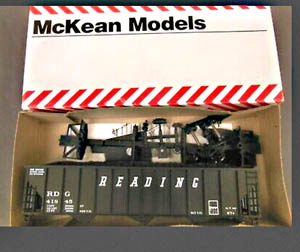
Company founded by Bill McKean, located in Sioux Falls S.D. - USA. She produced HO goods wagons.
This production was short -lived and the molds seem to be taken up by Con Cor.
Bill McKean seemed to have close links with Athearn. He died in 2013.
Meccano : "HO" et "O"
Marque anglaise, crée en 1908 par Frank Hornby (voir Hornby), lui-même créateur du système de construction Méccano en 1901,
La "Meccano Ltd" s'installe à Liverpool en 1914 et produit également des machines à vapeur (fixes) en 1915.
Trois usines se succéderont à Liverpool, la dernière, la plus grande, construite en 1914 ne fermera qu'en 1979.
C'est en 1920 que commence la production du matériel en "0" sous la marque Hornby.
Vers 1922 Meccano lance une nouvelle gamme de train "0" : Les trains Zulu, nettement moins cher que le Hornby, plus simple, bien que de
bonne qualité, (l'unique locomotive à ressort ne fonctionnait qu'en marche avant). Cette gamme a été abandonnée en 1925
En
1921 ouverture de l'usine Française de Bobigny (près de Paris) puis en
1959 l'usine de Calais, où sont toujours produites une
grande partie des boites de construction Meccano.
La production du matériel "0" a continué jusque dans les
années '60 (sous la marque Hornby).
En 1938 Meccano commence à fabriquer du 00 sous la marque Hornby Dublo
jusqu'en 1963, le matériel de production a été vendu à "G&R
Wrenn".
L'usine de Bobigny commence, en 1960, à produire le nouveau matériel
Hornby en HO sous l'appellation HOrnby acHO, et, au passage,
absorbe la marque Française SMCF.
En 1964 les difficultés de la maison mère en Grand Bretagne
font que le groupe "Lines Brother" (la marque concurrente Tri-Ang)
reprend la "Meccano Ltd" et ses filiales et la marque devient la "Meccano Triang Ltd
C'est le commencement du déclin de HOrnby acHO (au profit de Jouef) qui disparait en 1973
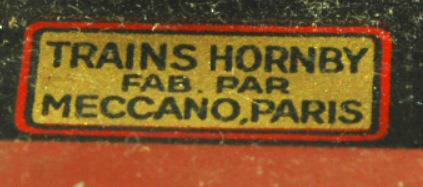
English brand, creates in 1908 by Frank Hornby (see Hornby) itself creative of the Meccano construction system in 1901,
Meccano Ltd settles in Liverpool in 1914 and produced also steam engines (fixed) in 1915.
It is in 1920 that the production of equipment in “0" starts” with the brand Hornby.
Around 1922, Meccano launched a new "O" gauge train range: the Zulu trains, significantly cheaper than the Hornby, simpler,
although of good quality (the single clockwork locomotive only worked forward). This range was discontinued in 1925.
In 1921, the French factory in
Bobigny (near Paris) opened, and in 1959 the Calais factory, where a
large part of the Meccano
boxes are still produced.
Production of "0" material continued into the 1960s (under the Hornby brand).
In 1938 Meccano starts to manufacture of the 00 under the brand Hornby Dublo until 1963, the equipment of production was sold to
G&R Wrenn
In 1960, the factory in Bobigny began to produce the new Hornby
material in HO under the name HOrnby acHO and, by the way,
absorbed the
French brand SMCF.
In
1964, the difficulties of the parent company in Great Britain resulted
in the acquisition of Meccano Ltd and its subsidiaries by the group
"Lines Brother" (the competing Tri-Ang brand) and became the "Meccano Triang Ltd". This
is the beginning of the decline of HOrnby
acHO (in favor of Jouef) which disappears in 1973
Mehanotehnika : "HO"
Société fondée en 1952/1953 en Yougoslavie, l'usine est toujours située à Izola en Slovénie et fabrique du matériel pour l'exportation.
Elle a produit du matériel pour le marché américain distribué par, entre autres, AHM, Model Power puis par Life Like.
En 1990 elle prend le nom de Mehano.
Bien qu'ayant déposé son bilan en 2009 Mehano existe toujours (2022) et sa production est délocalisée en Chine en 2010.
En 1964 et 1965 Mehanotehnika a utilisé la marque Tempo pour diffuser du HO, du matèriel en voie étroite HOe "MicrotrainS" et des voitures miniatures.
En Allemagne le matériel Tempo était diffusé par Haug :
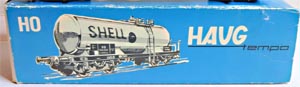
Quelques catalogues ont été publiés en anglais et en francais. Mais
devant le peu de ventes réalisées cette production a été arretée dès
1966.
She produced equipment for the American market distributed by AHM, Model Power then by Life Like.
In 1964 and 1965 Mehanotehnika used the Tempo brand to distribute HO, the "MicrotrainS" narrow gauge and miniature cars.
In Germany the tempo equipment was broadcast by Haug.
Some catalogs were published in English and French.
But faced with the few sales made this production was stopped in 1966.
In 1990 she takes the name of Mehano.
Although having filed its balance sheet in 2009 Mehano still exists (2022) and its production is relocated to China in 2010.
Marque américaine, (1933-1949) surtout spécialisée dans les kits
d'avions en bois, a proposé du matériel HO en association
avec Strombecker .
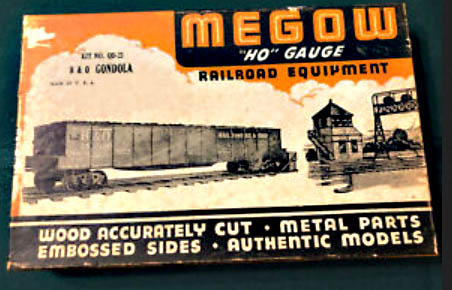
à une centaine d'exemplaires destinés à une promotion publicitaire.
seul type de
roue, tant pour les machines que pour les wagons.Le matériel était proposé dans des boîtes de carton sans marque.
Les wagons étaient peint de couleurs vives et également proposés brut de fonderie, sans peinture.
Company of cast aluminium, founded in Turin (Italy) in
1932 by Attilo Clement and Antonio Cravero, specialized in the
manufacturing carburettors for Fiat.
The production of moulded metal toys started in 1945 and the first
model was a futuristic car "the Aéro" produced to a hundred
specimens intended for an advertising promotion.
The brand is especially known for these road models, cars and trucks, but produced some railway models and planes.
The "Colibri"
train, a floor train of a size close to the "N", was produced around
1950/1952 and had the particularity of having only
one type of wheel,
both for the machines and for the wagons .
The equipment was offered in unmarked cardboard boxes.
The wagons were painted in lively colors and also offered rough cast, without painting.
Mercury quickly abandoned this production. Note that the locomotive and its tender were proposed, in 1952, in a scale close to the "Z"
called "Micromercury".
In 1978 Mercury was declared bankrupt and the brand disappeared.
Entreprise créée en 1933, en Angleterre à Northamton, par Phillip Ullman et Arthuer Katz, venus d'Allemagne (Ex "Tipp & Co") fuyant les
activités anti-juives.
Mettoy, contraction des mots anglais jouet et métal, produisait des jouets en fer blanc dont une gamme d'articles de chemin de fer en "0".
L'usine de Northamton a produit du matériel pour "Trix Twen" et "Basset Lowke".
Une importante usine est créée à Swansea, pour production d'objets moulés.
Vers 1950 il y a eu une production importante de bâtiments en tôle pour le modélisme ferroviaire sous la marque "Playtown",
le matériel roulant est abandonné peu à peu.
Mettoy
a abandonné le fer blanc pour le métal moulé et le plastique injecté
dès 1948 en produisant une vaste gamme
de véhicules routiers,
donnant naissance à la marque "Corgi" en 1956.
En 1953 Mettoy absorbe la "Playscraft Toys Ltd"
La marque Mettoy disparait en 1958 pour laisser place à la "Corgi Sales Ltd".
Hornby est maintenant le propriétaire de Corgi, marque toujours active en 2008.
Company created in 1933, in England in Northamton, by Phillip Ullman and Arthuer Katz, come from Germany (Ex Tipp & Co) fleeing
the anti-Jewish activities.
Mettoy, contraction of the English words toy and metal, produced tin toys of which a range of articles of railroad in “0”.
The factory of Northamton produced equipment for Trix Twen and Basset Lowke
An important factory is created in Swansea, for production of moulded objects.
Around 1950 there was an important production of sheet buildings for railway model making under the brand “Playtown”,
rolling stock is little by little abandoned.
Mettoy abondon tinplate for moulded metal and the plastic injected by 1948 by producing a vast range of road vehicles,
giving rise to the Corgi brand in 1956.
In 1953 Mettoy absorbs Playscraft Ltd Toys
The Mettoy brand disappears in 1958 to give place to Corgi Dirty Ltd.
Hornby is now the owner of Corgi, always active brand in 2008.
Société créée à Zurich - quartier de Seebach (Suisse) par Max
Maag en 1928, spécialisée dans le meulage de précision et la
micrométrie.
Vers 1940, le fils de Max Maag, Max Maag junior,
commence à fabriquer du matériel pour train miniature (une Ee
3/3 SBB) présentée
dans le célèbre magasin de jouets Zurichois de la rue Bahnhofstrasse et ouvre un atelier en 1945, sur leur site de Zurich-Oerlikon, où est
produit du matériel ferroviaire en HO, ce matériel
est limité à des voies équipées d'une caténaire et à deux
locomotives moulées en Zamac
Edwards : une C type Ae 3/3 et une 1C1 type 3/5 et à des transformateurs.
Cette production a pris fin au début des années 1950.
Le matériel
de fabication a été repris vers 1960 par la société Amiba qui commercialise des répliques de matériel ancien.
Ces machines étaient très robustes mais rustiques, surnommées par les utilisateurs "Réveils Russes".
Sous la marque "Junior" (1945/1949) des coffrets ont été
commercialisés. Ils comportaient des voitures et des wagons qui
n'étaient pas de
fabrication Micro-Maag mais construits par
Thommen à Trimbach (SO). Ce matériel était caractérisé par des
traverses de tamponnement
orientables (voitures et wagons) très remarquables, solidaires des bogies.
Une Ae 8/14 (réduite à 6/10) qui a été reprise par HAG
Une "Crocodile" qui a été laissée à la concurrence (Marklin).
Founded in Zurich - Seebach district (Switzerland) by Max Maag in 1928, specialized in precision grinding and micrometrics.
Around
1940, Max Maag's son, Max Maag Jr., began making miniature train
equipment (an Ee 3/3 SBB) in the famous Zurich toy shop
on
Bahnhofstrasse and opened, in 1945, a workshop on their site in Zurich-Oerlikon, where HO railway equipment is produced,
equipment limited to tracks equipped with an overhead line
and two engines moulded in Zamac: type C Ae 3/3 and a type
1C1 3/5 and
transformers.
This production ended in the early 1950s.
Fabrication equipment was taken over around 1960 by the company Amiba which markets replicas of old equipment.
These machines very robust but rustic, were called by the users “Russian clocks”.
Under the brand Micro Maag “Junior” (1945/1949) boxes were then marketed. They comprised wagons and coaches which were not
of Microphone-Maag manufacturing but built by Thommen in Trimbach (SO). This equipment was characterized by buffer beam
directional (cars and coaches) very remarkable, interdependent with the bogies.
It should be noted that Micro-Maag designed two prototypes of electric engine
one Ae 8/14 (reduced to 6/10) which was taken again by HAG
one “Crocodile” which was left with competition (Marklin).
Micro Trains Lines : N et Z
Cette entreprise américaine a été créée en 1990 issue de la division de l'entreprise Kadee , fondée en 1940 par Dale et Keith Edwards,
créateurs de l'accouplement HO "Magne-Matic" puis adapté au "N" en début des années 60.
A partir de 1972 ils ont commencé à produire du matériel roulant en "N" sous la marque "Micro-Train ®"
En 1990 les deux frères se brouillent et la Kadee Co à été divisée en deux, la nouvelle société "Micro
Trains Line Co"
créée par Keith gardant le N, Nn3 et le Z s'installe à Talent (Oregon), l'entreprise est toujours en activité (2016).
creators of the coupling HO "Magne-Matic" and then adapted to the "N" in the early 60's .
From 1972 onwards they began to produce rolling stock in "N" with the brand "Micro-Train ®"
In 1990 the two brothers got angry and Kadee Co was divided into two, the new company, Keith created, Micro Trains Line Co keeping N, Nn3 and Z.
located at Talent (Oregon), the firm is always in activity (2016).
Minitrix : "N"
Allemagne, créée en 1965 par Trix pour le N. Germany, created by Trix for N scale.
Entreprise Allemande qui possède un magasin de vente de modélisme
ferroviaire situé à Kamen (Rhénanie du Nord).
Depuis 2008 ce magasin propose sous sa propre marque "Modellbahn Union" du matériel fabriqué en Chine en HO, 00, TT et Z..
brand "Modellbahn Union" equipment made in China in HO, 00, TT and
Model Power : HO et N
USA –
Entreprise familiale fondée par Matthew Tager en 1970 suite à l'abandon d la marque ATT, elle commercialise du HO (plastique
et
métal) et du N.
Matériel fabriqué en Autriche, Yougoslavie ou à Hong-Kong.
A remarquer que les premières boîtes jaunes Model Power portaient la mème adresse que les anciens bureaux d'ATT : 200 Fifth Avenue, New York.
Puis Model Power a fusionné avec ATI (ex American Tortoise Inc) et s'est installé dans ses bureux à Farmingdale NY et est devenu
le distributeur américain de Minitrix.
L'entreprise a fermé en 2014 et la marque Model Power à été reprise par la MRC (Model Rectifier Corporation) (du groupe ATI)
qui continue de fournir du matériel en HO, N et G
(plastic and metal) and N.
Material manufactured in Austria, Yugoslavia or Hong Kong.
Note that the first yellow boxes Model Power wore the same address that the old ATT offices: 200 Fifth Avenue, New York
Then Model Power absorbs ATI (ex American Tortoise Inc) and settled in his offices at Farmingdale NY and became the US
Minitrix distributor.
The company closed in 2014 and the Model Power brand has been taken up by MRC (Model Rectify Corporation) (ATI group) which
continues to provide equipment in HO, N and G
Moldex :
MRC (Model Rectifier Corporation) : "N" -
Entreprise Américaine qui fabrique actuellement
du matériel électrique et électronique pour commande de circulation de trains
miniatures
(Alimentation, cde de locomotives ....) et des maquettes avions,
voitures, accessoires de décor pour réseaux.
Cette entreprise a été créée vers 1940 à Edison (NJ) USA et s'y trouve toujours.
A une certaine époque elle a commercialisé sous sa marque MRC du matériel en N
(Locos, voitures, wagons) fabriqué en Yougoslavie
(Par Méhano ?)
Depuis 2014 MRC a repris la licence de Model Power et commercialise les produits Model Power et Mantua.
En 2018 MRC a revendu ses licences HO à Lionel, et probablement
l'outillage correspondant, mais en 2021 l'accord aurait été dénoncé
par Lionel.
Model rectifier Corporation - American Company
which currently manufactures electrical and electronics equipment for
order of
circulation miniature trains
(Power, engines orders….) and models planes, cars, accessories
of decoration for networks.
This company was created around 1940 at Edison (NJ) USA and is there always.
At a certain time it marketed under its brand MRC equipment in N (Locos, cars, coaches) manufactured in Yugoslavia
(By Méhano?)
Since 2014 MRC has taken over the model of Model Power and markets Model Power and Mantua products.
In 2018 MRC sold its HO licenses in Lionel, and probably the corresponding tools, but in 2021 the agreement would have been
denounced by Lionel.
MTH : Standard - O
USA –
Créée vers 1980 par Mike Wolf, la " Mike's Train House" (M.T.H) Columbia Maryland, fabriquait pour Williams Electric Trains
des reproductions des trains de la Lionel Corporation.
D'abord fabriquées aux USA, ces reproductions sont fabriquées en Corée du Sud.
En 1987 MTH passe un accord avec Lionel et devient sons sous-traitant ce qui permet à MTH d'utiliser le nom de Lionel
pour ces reproductions.
En 2009 un nouvel accord permet à MTH d'utiliser les graphismes de Lionel (alors Lionel LLC) pour ses modèles et leurs boites.
Cet accord a pris fin en 2019.
MTH proposait 5 lignes de produits :
MTH HO
RailKing ®, la production de base,
RailKing One Gauge (échelle 1) produit du matériel au 1/32 pouvant être utilisé à
l'extérieur,
Premier réalise des modèles super détaillés copiant les wagons réels,
Tinplate
qui reproduit les anciennes séries en tôle comme du Lionel et du Yves
d'avant-guerre, à l'aide du matériel de production
racheté à Williams.
En juin 2020 Mike Wolf a annoncé la fermeture de l'entreprise pour 2021
et la publication des derniers catalogues de la marque.....
Les productions en HO et S auraitent été reprises par Scale Trains.com ???
"Williams Electric Trains"
reproductions of trains from the Lionel Corporation. First manufactured in the USA, these reproductions were manufactured in
South Korea.
In 1987 MTH made an agreement with Lionel and became subcontracting sounds which allows MTH to use the name of Lionel for
these reproductions.
In 2009 a new agreement allows MTH to use Lionel's graphics (then Lionel LLC) for its models and their boxes. This agreement ended in 2019.
MTH offered 5 lines of products:
RailKing ®, basic production,
RailKing One Gauge (scale 1) produced equipment at the 1/32 which can be used outside,
Premier carries out detailed super models copying the real coaches,
Tinplate which reproduces the old series sheet as Lionel or Yves of pre-war period, using the equipment of production repurchased
from Williams .
In June 2020 Mike Wolf announced the closure of the company for 2021 and the publication of the latest catalogs of the brand.....
HO production and have been taken up by Scale Trains.com ???
OSM - 0 Scale Models :
La société allemande O-Scale-Models Handelsgesellschaft mbH à été créée à Seevetal (Basse Saxe) par M. Wolfgang Dora en 1994 etproposait du matériel roulant en "0", fabriqué ne Chine, jusqu'en 2011 (dépot de bilan).
and offered rolling stock in "0", manufactured ne China, until 2011 (bankruptcy).
Do not comply with the "O Scale" toy store.
OZfreight : "HO"
Société Australienne dans la région d'Adélaide , (à Bridgewater ?), qui commercialisait sous cette marque du
matériel roulant de type Australien frabriqué en Chine.
A noter qu'aujourd'hui (2024) un important magasin de jouets situé à Parafield également près d'Adélaide
"OzRail Model Trains" fait aussi fabriquer du matériel roulant en Chine,.Je ne sais pas s'il y a (avait) un rapport
entre eux.
Australian company in the Adelaide region, (in Bridgewater?), which marketed under this brand Australian type
rolling stock mase in China.
Note that today (2024) an important toy store located in Parafield also near Adelaide "Ozrail Model Trains" also
makes rolling stock in China. I don't know if there was (had) a report between them.
Parkway Industries : "N"
Parkway Industries Co. (10101 Woodland Avenue, Cleveland, Ohio USA). Cette société créée en 1968 importait du matériel
HO et N, du matériel Bachmann, des locomotives diesel Mehano ou des wagons Roco, pour le reconditionner et le commercialiser
sous ce nom jusque vers 1974.
Parkway possèdait deux magasins "Hobby House" à Cleveland
Bachmann material, diesel Mehano locomotives and Roco freight cars, which reconditioning and marketing with this brand them until
around 1974.
Parkway owned two Hobby House stores in Cleveland
Paya Hermanos (Juguetes) : "O"
Marque
Espagnole créée par Rafael Paya à Ibi (Alicante) en 1902. La première usine a commencé sa production en 1906 en fabriquant des
trains de bazar puis de très beaux modèles en "0" dans les années 1930.
La
guerre civile Espagnole puis la 2ème guerre mondiale a stoppé la
production qui a repris en 1946 en récupérant les machines-outils
d'origine.
Une production de "OO" en voie de 18 mm puis 16,5 mm fit son apparition en 1950.
En 1984 la famille Paya éprouve de grosses difficultés tant financières qu'internes et les ouvriers fondent la Paya Juguetes (société
coopérative) qui reprend les modèles Paya en édition limitée, pour les collectionneurs.
La production Paya a définitivement cessé en 2009.
trains of bazaar then of very beautiful models in “0” in the years 1930.
The Spanish civil war then the 2nd world war stopped the production which began again in 1946 by recovering the machine tools of origin.
A production of “OO” in the process of 18 mm then 16.5 mm made its appearance in 1950.
In 1984 the family Paid has large difficulty so much financial which internal and the blue-collar workers found Paya Juguetes
(cooperative society) which takes again the models Paid in limited edition, for the collectors.
The production Paya definitively ceased in 2009.
Peco
:
HO et N
Créée
en 1946 à Beer dans le South Devon (UK) cette entreprise Peco est la marque enregistrée pour "Pritchard Patent
Product Co. Ltd
and Peco Publications and Publicity Ltd" qui se consacrent au
hobby de chemins de fer modèles réduits.
Toute l'activité est concentrée à Beer (UK). Elle produit du matériel de voie
pour toutes les échelles du 1 au Z.
Le matériel roulant est fabriqué en Z, N et
des kits HO - Toujours en activité (2024)
Created in 1946 based at Beer in South Devon, (UK) this Peco company is the brand recorded for "Pritchard Patent Product Co. Ltd
and Peco Publications and Publicity Ltd" who devote themselves to the hobby of railroads scale models.
All the activity is concentrated in Beer (the U.K.). It produces equipment of track for all the scales from 1 to Z.
Rolling stock is manufactured in Z, N and HO kits - Still in activity (2024)
En
1948, avant la création de la RDA, les soviétiques décident de produire
un chemin de fer miniature. L'entreprise PIKO a été créée
à Chemnitz sur un ancien site Siemens.
C'est en 1949 que les premiers trains HO "Pico
Express" ont été présentés à la foire de Leipzig
Par la suite, après la création de la RDA et les nationalisations qui suivirent, "Piko" (PIonier
KOnstruktion) a dominé le marché Est
Allemand en devenant la marque de distribution du modélisme ferroviaire de RDA au travers de VEB
Prefo Dresden via le conglomérat
VEB Modellbahn Oybin qui avait absorbé, entre autres, les marques Ehlcke, Schicht.
En 1952 la production est transférée à Sonneberg.
Dans les années 63/64 Piko se lance dans du "N" pour abandonner cette échelle vers 1984.
En 1992 (1990 réunification des deux Allemagnes) Piko devient "Piko
Spielwaren Gmbh".
En 2005 premier trains à l'échelle "TT".
En 2006 Piko se lance dans les train de jardin avec le Taurus en "G".
En 2010 réapparition du "N".
En 2018 toute la production en HO, N et TT (pas le G qui reste à Sonneberg) est principalement fabriquée à Chashan (Chine).
Toujours en production.
 Boite Pico Express de 1949
The Piko company was created in Chemnitz on an old Siemens site.
It was in 1949 that the first HO "Pico Express" trains were presented at the Leipzig Fair
Subsequently, after the creation of the GDR and the nationalizations that followed, "Piko" (Pionier Konstruktion) dominated the market
East German by becoming the distribution mark of RDA railway modeling through VEB Prefo Dresden via the Conglomerate Veb
Modelbahn Oybin who had absorbed, among others, the brands Ehlcke, Schicht.
In 1952 production was transferred to Sonneberg.
In the years 63/64 Piko embarked on "N" to abandon this scale around 1984.
In 1992 (1990 reunification of the two Germany) Piko became "Piko Spielwaren GmbH".
In 2005 first trains on a "TT" scale.
In 2006 Piko embarked on the garden train with the "Taurus" in "G".
In 2010 Reappearance of "N".
In 2018 all production in HO, N and TT (not the G which remains at Sonneberg) is mainly manufactured in Chashan (China).
Still in production.
Pioner Expressen : "O"
Société Danoise crée en 1948 par Knud Petersen à Amager (sud de Copenhague) qui a commercialisé du matériel
roulant en O et quelques modèles en HO jusqu'en 1965.
Tout commence en 1947 année où Knud Petersen commence la production de trains jouets en O. Matériel vendu tout d'abord
sous la marque "Knud P" puis sous la marque "Pioner Expressen".
L'entreprise s'agrandit et déménage à Birkerod au nord de Copenhague.
C'est sous ce nom que l'entreprise est devenue l'une des plus grosses productions de trains jouets Danois, comportant une gamme
complète de matériel roulant, rails et appareils de voies, ponts et bâtiments..
Les
premières locomotives, en 1948 étaient habillées avec des
éléments en bois, le fer blanc étant contingenté est réservé
à la fabrication des rails.
Dans les années 1952/1953 lancement d'une gamme en HO. En 1954 électrification du matériel moteur et production de transformateurs
Vers 1960 passage au plastique.
La production de trains jouets cesse en 1965 et tout le matériel est revendu.
Danish Company creates in 1948 by Knud Petersen in Amager (southern of Copenhagen) which marketed rolling equipment
O and some models HO until 1965.
All begins in 1947 year when Knud Petersen begins the production of trains toys O. Material first of all sold
under the brand Knud P. then under the brand “Pioner Expressen”.
The company increases and moves in Birkerod, north of Copenhagen.
It is under this name that the company became one of the largest productions of Danish trains toys, comprising a full range
of rolling stock, rails and trackside equipment, bridges and buildings.
The first engines, in 1948 were equipped with wooden elements , tinplate being fixed quotas is booked
to the manufacturing of the rails.
In the years 1952/1953 launching a HO range. In 1954 electrification of driving equipment and production of transformers
Around 1960 passage to the plastic.
The production of trains toys ceases in 1965 and all equipment is resold.
Plarail : Voir Takara Tomy
Playart : "HO"
Made in Hong Kong – Cette firme fabriquait des jouets de basse qualité pour des chaînes américaines comme Woolworth ou Sears,
dans les années 1970/1980.
Made in Hong Kong – This firm manufactured basic quality toys for American chains like Woolworth or Sears, in years 1970/1980.
Playcraft : "HO"
Distributeur
anglais pour le matériel Jouef de 1961 à
1969. Ce matériel était fabriqué en France et marqué "Made in France Jouef for
Playcraft" et sur les boîtes : "Manufactured in France exclusively for Playcraft Ltd London".
Playcraft
était une firme anglaise établie au Pays de Galles, faisant partie du
groupe Mettoy (autos Corgi Toys) et qui produisait du matériel
de bas de gamme en "OO" .
La marque a disparu en 1970.
English distributor for Jouef equipment of 1961 to 1969. This equipment manufactured in France and was marked “Made in France Jouef
for Playcraft” and on the boxes: “Manufactured in France exclusively for Playcraft Ltd London”.
Playcraft was an English firm established in Wales, being part of the group Mettoy (cars Corgi Toys) and which produced poor quality
equipment in “OO”.
The brand disappeared in 1970.
Playmobil : "O"
Allemagne
- Sous marque de Geobra Brandstätter, elle est créée en 1970 par H. Berch.
La société se lance dans le jouet en 1974 et commercialise des trains électriques en "G", fabriqués par LGB, de 1980 à 1996.
En 1997 la distribution prend le nom Playmobil "RCtrain".
La production de trains Playmobil s'arrrète en 2015 (le dernier set est le 5258)
Germany - Under the name "Geobra Brandstätter", the company is created in 1970 by H. Berch.
The firm launched out in toys in 1974 and markets electrical trains in "G", manufactured by LGB, from 1980 to 1996
Pocher : "HO"
Italie
– La firme Pocher, crée en 1952 à Turin par Arnaldo Pocher, se lance dans le train HO
A fait
faillite en 1965 la marque été reprise par Rivarossi
pour disparaître en 1968, du moins en ce qui concerne
le modélisme ferroviaire.
Le dernier catalogue Pocher (voitures miniatures) est publié en 1998, puis avec la reprise de Rivarossi par Hornby
disparait complètement.
Italy – the Pocher firm, creates in 1952 in Turin by
Arnaldo Pocher, launches out in the train HO
With fact bankruptcy in 1965 the brand taken again by Rivarossi to disappear in 1968, at least with regard to
railway model making.
The last Pocher catalogue (miniature cars) is published in 1998, then with the resumption of Rivarossi by Hornby
disappears completely.
Prefo : "HO"
Cette
entreprise Allemande, créée à Dresde en 1928, fabriquait de l'outillage et des
moules.
Après la guerre, elle a été nationalisée et devient la VEB Prefo Dresden qui
regroupait la production HO en Allemagne de l'Est, et en
particulier la VEB Modellbahn Oybin (ex entreprises Schicht, Ehlcke et Stärz&Co Oybin) avec comme marque de diffusion Piko.
A la réunification de 1990 la VEB Modellbahn Oybin est reprivatisée et devient la SachsenModels Gmbh et la marque Prefo disparait,
pour réapparaitre en
2003 à Beinstein, entreprise spécialisée dans la production d'accessoires pour le modélisme et qui existe toujours (2020)
This German company, created in Dresden in 1928, manufactured tools and mussels.
After
the war, it was nationalized and became the Veb Prefo Dresden which
brought together HO production in East Germany, and in
particular the VEB Modelbahn Oybin (ex Schicht, Ehlcke and Stärz & Co Oybin) with Piko marketing mark.
At the reunification of 1990 the VEB Modellbahn Oybin is again privatized and becomes the Sachsenmodels Gmbh and the Prefo brand
disappears, to reappear in 2003 in Beinstein, a company specializing in the
production of accessories for modelism and which still exists (2020)
Premiere Edition : "N"
Marque utilisée par la boutique de modèle réduit "The Freight
Yard" située à Anaheim, Californie USA.
Cette société personnalise la décoration de matériel roulant d'autres fabricants
(par exemple Micro Train) et le commercialise sous
sa propre marque "Premiere
Editions"
Premiere Editions
Brand used by "The Freight Yard" model shop located in Anaheim, California USA.
This company customizes the decoration of rolling stock from other
manufacturers (e.g. Micro Train) and markets it under
its own brand
"Premiere Editions"
Primex : "HO"
Name for a spécial model train programe offered by Märklin f,or the spermarkets between 1969 and 1992
boutiques Françaises spécialistes des trains jouets.
Cette boutique
existe toujours (2020).
Outre la diffusion des grandes et petites marques de jouets, il avait lancé
une petite production interne de matériels en HO.
Ce matériel était vendu sous la marque "Pullman".
Quelques catalogues et plaquettes concernant cette production ont été édités
entre 1955 et 1970.
Toy store opened in 1946. J.R. Allard opened in Paris, at 70 rue d'Amsterdam,one of the first French shops specializing in toy trains.
This shop always exists (2020).
In addition to the diffusion of large and small brands of toys, it had launched a small internal production of HO equipment.
This equipment was sold under the brand “Pullman”.
Some catalogues and plates concerning this production were published between 1955 and 1970.
Pullman (ESU - Allemagne) : "HO"
Société Allemande à Ulm, créée en 1996 ESU Electronic produit des modules électronique pour sonoriser des modèles réduits de bateaux et
de voitures à partir de sons réels.
En 2006 elle propose des télécommandes pour les modèles réduits, en particulier pour trains (locomotives et appareils de voie).
En 2012 ESU se lance dans le matériel roulant et propose un locotracteur allemand V60.
En 2015 création d'une gamme en G et I, puis en HO, sous la marque Pullman.
German company in Ulm, created in 1996 ESU Electronic produces electronic modules to sound models of boats and
of cars from real sounds.
In 2006, it offers remote controls for model cars, in particular for trains (locomotives and switches).
In 2012 ESU launches rolling stock and proposes a German locomotive V60. In 2015 creation of a range in G and I, then in HO,
under the brand Pullman.
Rail Route :
"Rail Route Jouets",
société Française, fondée à Villeurbanne (près de Lyon) en en
1961 par Emile Véron , qui fut, en 1946 avec son
frère Joseph,
le
fondateur de Norev (Véron en verlan…), pour produire des petits trains de parquet à l'échelle 1/143.
Les
activités de Norev et de Rail Route étaient totalement séparées
(brouille entre les deux frères), sauf pour la vente et avaient des
ateliers indépendants, bien que tous deux situés à Villeurbanne.
La production des trains pris fin en 1966. et Rail Route devient la société Majorette.
his brother.
Joseph, the founder of Norev (Véron ...word reverse), to produce small trains of parquet floor on scale 1/143.
The activities of Norev and Rail Route were completely separate (estrangement between the two brothers), except for the sale and had
independent workshops, although both located at Villeurbanne.
Train production ended in 1966, and Rail Route became the Majorette company.
Ready Made Toys / Ready Made Trains :
Petite entreprise de fabrication de trains jouets en "O", par Walter M. Matuch, située dans le New Jersy (USA), crée en 2003 en tant que
"Ready Made Toys".
C'est en 2006 que la marque devient "Ready Made Trains".
En 2016 Walter se retire et la production s'arrête, son épouse continuera la vente jusqu'à ce que les réserves soient entièrement vidées.
Red Caboose : "HO"
Petite entreprise créée en 1992 à Mead, Colorado, USA par Leon Fairbanks, qui produisait des kits à construire en HO, N et quelques
pièces en 0.
En 2016 la production en HO a été vendue à "Intermontain Railways Co" (entreprise située à Longmont proche de Mead) et la
production N vendue à "Fox Valley Models" à Des Plaines, Illinois, USA.
Small company created in 1992 in Mead, Colorado, USA, by Leon Fairbanks which produced kits to be built in HO, N and some parts
into 0.
In 2016 the HO production was sold to Intermontain Railways Co (loicated in Longmont, near Mead) and the production N sold to
Fox Valley Models (in Des Plaines, Illinois, USA).
REE modeles : "HO"
"Rails
Europ Express" - Société Française créée en 2008 à Annecy le Vieux
(Haute Savoie) qui étudie et commercialise du matériel roulant
en HO et N - Matériel fabriqué en Chine.
out of HO and N - Equipment made in China.
Replica Railways
: "HO"
Société
Anglaise fondée par Godfrey Hayes au début des années 1980 à Lambon qui produisait des transferts, soit à sec soit par
glissement à l'eau, de décoration de matériel ferroviaire.
En 1984 suite à un accord avec Kader, Replica Railways a commercialisé, dans des boites Replica, le matériel HO de
l'ex gamme
"Mainline", matériel fabriqué à Hong-Kong par Kader.
En 1990, Kader a repris la commercialisation à son compte dans le groupe Bachmann Europe
En 1997 (H-K redevient chinois) le matériel de fabrication est rapatrié en Grande Bretagne et Réplica Railways déménage pour
s'installer à son emplacement actuel à Swindon.
English
company founded by Godfrey Hayes in the early 1980s in Lambon, which
produced transfers either dry or water slipping
for rail models
decoration.
In 1984 following an agreement with Kader, Replica Railways marketed, in Replica boxes, the HO equipment of the ex "Mainline"
range, a material manufactured in Hong-Kong by Kader
In 1990, Kader took again yhe marketing
on its account in the group Bachmann Europe - In 1997 (HK becomes again
Chinese)
the equipment of manufacturing is repatriated in the United Kingdom and Replica Railways moves to settle in its current
location in Swindon.
Rivarossi : N , HO
et O
A l'origine, en 1945, reprise d'un atelier d'interrupteurs
électriques situé près de Côme (Italie) par Alessandro Rossi et Antonio Riva.
Le premier modèle réduit de train, en OO, une automotrice "AE 2002",
est lancé en 1946 année où Antonio Rossi quitte l'entreprise
au moment de la
publication du premier catalogue RIVAROSSI (alors écrit en lettre bâton) et de
la mise sur le marché de l'autorail
"Littorina" fabriqué en bakélite.
1947 inauguration de l'usine de "Monte Olimpino".
1959 l'écriture du nom "Rivarossi" passe en écriture italique : Rivarossi
1967 lancement de la production du "N" à la demande de l'américain Atlas et les deux premiers
catalogues, uniquement pour le N, (1968 et
1970) sont communs Atlas/Rivarossi, ensuite le N est présenté dans le catalogue général.
En 1969 production de modèles en "0".
En 1970 le logo RR (double R) est créé.
En 1981 l'entreprise est placée, sur sa demande, en redressement judiciaire et Allesandro
Rossi quitte la société qui devient la "Rivarossi Nuova Gestione".
En 1985 reprise de "AHM" qui avait fait faillite en 1981 - Etroitement lié à AHM
(jusqu'à 80% de la production Rivarossi partait aux USA)
Rivarossi est
fortement affaibli par cette faillite (l'affaire judiciaire ne se terminera que
dans les années 1990).
1988 fin de la production du matériel en "0"
En 1992 reprise de "Lima di Vicenza" (grande entreprise Italienne) puis
en 1995 de "Arnold" (l'inventeur Allemand du "N") et enfin
en 1996
prend le contrôle du Français Jouef (via sa filiale Lima).
En 2000 toute la production est recentrée sur le site de Lima à Isola avec la
fermeture de l'usine historique de Côme ainsi que les sites
de production de
Jouef et d'Arnold.
Puis les activités de Rivarossi déclinent et toutes les marques du groupe (Arnold,
Jouef, Lima, Pocher) sont rachetées par Hornby qui en
poursuit la production en
Chine.
The first model train, in OO, an "AE 2002" railcar, was launched in 1946, when Antonio Rossi left the company and when the
first RIVAROSSI (then written in baton lettering) catalog was published, and the placing on the market of the "Littorina" railcar
manufactured in Bakelite.
1947 inauguration of the "Monte Olimpino" factory.
1959 the writing of the name "Rivarossi" changes to italics: Rivarossi.
In 1964 partnership with the competitor Pocher (from Turin), which he completely absolved in 1974.
1967 launch of the production of the "N" at the request of the American Atlas and the first two catalogs, only for the N, (1968 and 1970)
are common Atlas / Rivarossi, then the N is presented in the general catalog.
In 1969 production of models in "0".
In 1970 the RR logo (double R) was created.
In 1981 the company was placed, at his request, in receivership and Allesandro Rossi left the company which became "Rivarossi
Nuova Gestione".
In 1985 takeover of "AHM" which had gone bankrupt in 1981 - Closely linked to AHM (up to 80% of the Rivarossi production went to
the USA)
Rivarossi is greatly weakened by this bankruptcy (the court case will only end in the 1990s).
1988 end of production in "0"
In 1992 takeover of "Lima di Vicenza" (large Italian company) then in 1995 of "Arnold" (the German inventor of the "N") and finally
in 1996 takes control of the French Jouef (via its subsidiary Lima).
In 2000, all production was refocused on the Lima site in Isola with the closure of the historic Como factory as well as the Jouef and
Arnold production sites.
Rivarossi's activities then declined and all of the group's brands (Arnold, Jouef, Lima, Pocher) were bought by Hornby, which
continued production in China.
Robilt : "O"
La "Robilt Products" a été
fondée à Armadale (Melbourne) par Ronald Titchener en 1946, ils ont produit des trains mécaniques puis
électriques,
matériel roulant et
accessoires en "0". Ce matériel était distribué par "Joy Toys," un fabriquant/distributeur Australien
installé depuis 1930.
Racheté
par la société "Rytime Company", autre société Australienne qui
appartenait à Jack Ryding (Horlogerie qui produisait les
engrenages pour Robilt), la production a été
transférée à l'usine de Rytime (Melbourne), en 1950 le matériel est
vendu sous
la marque
"Playtime Toys" puis, en 1954, sous le nom de "Robilt Products" Sandringham, Victoria.
En 1953 du matériel électrique a été produit, d'abord en 20 volts puis en 16 volts.
L'entreprise a fermé sa production de jouets à la fin des années
1960.
and accessories in "0". This material was distributed by Joy Toys, an Australian manufacturer / distributor installed since 1930.
Acquired by "Rytime Company", another Australian company owned by Jack Ryding (Watchmaker who produced the gears
for Robilt), the production was transferred to the factory in Rytime (Melbourne), in 1950 the material is sold under the "Playtime Toys"
brand and then,
in 1954, under the name of "Robilt Products".
In 1953 electrical equipment was produced, first in 20 volts and then in 16 volts.
The company closed its toy production in the late 1960s.
Roco
: HO
, Om et N
Autriche
- Firme fondée en 1960 à Bergheim, près de Salzbourg, elle devient "Roco International" en 1973, grâce
au rachat du matériel de
production de Röwa en faillite.
Roco a fabriqué, en coopération avec Liliput, du matériel distribué aux USA par AHM
Roco a frôlé la faillite en 2005.
Le 21 mars 2008 Roco rachète Fleischmann.
A produit également du
matériel en voie métrique Om sous la marque Roco Alpin
Line. (1994/2000)
Vers 1995 Roco a créé Hobby Line, matériel plus dépouillé, destiné aux enfants - Cette production a été arrêtée vers 2000/2001
Il existe actuellement quatre sites de production, en plus du siège social de Bergheim :
Le site autrichien de Gloggnitz, le site de Banská Bystrica (Slovaquie), le site de Arad (Roumanie) et le nouveau site (2016) de Ho Chi
Minh-Ville au VietNam.
Austria - Firm founded in 1960 in Bergheim, near Salzburg, it becomes Roco International in 1973, thanks to the repurchase of the
equipment of production of Röwa in bankruptcy.
Roco has manufactured, in cooperation with Liliput, material distributed in the US by AHM
Roco came very close to bankruptcy in 2005 - Always in production.
On March 21st, 2008 Roco rachète Fleischmann.
Products also equipment in metric gauge track Om under the brand Roco Alpin Line. (1994/2000)
Around 1995 Roco created Hobby Line, equipment more stripped, intended for the children - This production was stopped around
2000 /2001
There are currently four production sites, in addition to the Bergheim head office:
The Austrian site of Gloggnitz, the site of Banská Bystrica (Slovakia),
the site of Arad (Romania) and the new site (2016) of Ho Chi Minh
City
in VietNam.
Rokal : "TT"
La
marque à été fondée par Robert Kahmann à Lobberich (Allemagne) en 1947 - La
production était uniquement en TT, arrétée en 1969.
Rokal a travaillé pour des marques de RDA comme Zeuke
et Berliner Bahnen.
A partir de 1968 Rokal connait de grosses difficultés financières et cherche à vendre son matériel de production.
La marque n'est plus présente dans les grandes manifestations à partir de 1970.
Le matériel de production TT est vendu à Trix en 1972.
En 1974 Rokal fait faillite et la marque disparait. Elle entraine Röwa (elle en était le principal actionnaire) qui passe
sous le contrôle de Roco.
The brand founded by Robert Kahmann in Lobberich (Germany) in 1947 -
the production was only in All and continued until 1969.
Rokal worked for brands of GDR like Zeuke and Berliner Bahnen.
Starting from 1968 Rokal has large financial problems and seeks to sell its equipment of production.
The brand is not present any more starting from 1970 on great demonstrations.
The equipment of production TT is sold to Trix in 1972.
In 1974 Rokal goes bankrupt and the
brand disappears. It involves Röwa (it was the principal shareholder)
which passes under the control of Roco.
Roskopf
:
Allemagne
- Fondée en
1955 par Marcel Roskopf.
Cette marque produit des modèles réduits de matériel roulant routier très riche par sa diversité en HO ou N sera cédée
en
1970 à la marque Preiser.
Germany - Founded in 1955 by Marcel Roskopf, this very hight brand in its diversity in road roling stock HO or N gauge,
will be solded in 1970 to the Preiser bran.
Roundhouse MDC : "N"
La société "Américaine Model die Casting" (MDC) a été fondée en 1938 à Hawthorne Californie USA puis s'installe à Carson City (Névada)
en 1993.
Elle commercialisait du modélisme ferroviaire en HO, N (à partir de 1979) et G sous trois marques déposées : MDC , Roudhouse et MDC
"G" scale.
Le matériel roulant était de bonne qualité et surtout peu cher.
La société MDC, a été dissoute en juillet 1996 et reprise par "Horizon Hobbies" en juin 2004
The American Model Die Casting company (MDC) was founded in 1938 in Hawthorne California USA and relocated in 1993 to
Carson City, Nevada
It marketed model railways in HO, N (from 1979) and G under three registered trademarks: MDC, Roudhouse and MDC "G" scale.
The rolling stock was of good quality and mainly cheap.
The MDC company was dissolved in July 1996 and purchased by Horizon Hobbies in June of 2004
Rounhouse Electric Trains :
Magasin de vente de trains miniature, neuf ou d'occasion ouvert en 1983, situé à Louisville Kentuky USA.
En 2011 Kevin Cook a créé la Roundhouse Electric Trains Inc.
Model train sales store, new or used, opened in 1983, located in Louisville Kentuky USA.
In 2011 Kevin Cook created Roundhouse Electric Trains Inc.
RÖWA : "HO"
Société Allemande fondée en
1959 par Willy Ade. A commencé par fabriquer du matériel ferroviaire pour le
compte de Trix en HO et N.
En 1968, Röwa a commercialisé
sa production sous son propre nom : Röwa Gmbh.
Le principal actionnaire de
Röwa était la société Rokal qui, ayant fait faillite en
1974, a entraîné Röwa dans sa chute.
Dès 1972 le matériel de production en N (en fait celui de rokal) avait été revendu à Trix.
Après la faillite de 1974,
le matériel de production HO a été racheté par Roco.
Willy Ade a alors fondé une petite entreprise "Ade" spécialisée dans la production de voitures voyageurs très détaillées en HO
et strictement à l'échelle 1/87.
German company founded in 1959 by Willy Ade. With started by manufacturing railway equipment for the account of Trix HO and N.
In 1968, Röwa marketed its production under its own name : Röwa GMBH.
The principal shareholder of Röwa was the Rokal company which, having gone bankrupt in 1974, involved Röwa in its fall.
By 1972 the equipment of production in N (This equipment, actually that of Rokal) had been resold to Trix.
After the bankruptcy of 1974, the equipment of production HO was repurchased by Roco.
Willy Ade then founded a small company “Ade” specialized in the production of very detailed cars out of HO,
and strictly on the scale 1/87.
Sachsenmodelle: "HO"
Allemagne
– Après la réunification des deux Allemagnes, le VEB Modelbahn Oybin de la RDA a été reprivatisé
Sachsenmodelle GmbH Kiesewetter & Co.
Ce VEB, lui même subordoné au VEB Prefo Dresden, avait absorbé plusieurs
entreprises privées comme Ehlcke et Schicht,
pour créer
un ensemble gérant le modélisme HO d'Allemagne de l'est sous la marque Piko.
En 1999, en faillite, la Sachsen Modelle a été reprise par Tillig en 2001.
Germany - After the reunification of the two Germany, the VEB Modelbahn Oybin of the GDR was replied
Sachsenmodelle GmbH Kiesewetter & Co.
This VEB, itself subordinate to the VEB Prefo Dresden, had absorbed several private companies such as Ehlcke and Schicht,
to create a set managing the model Ho of Eastern Germany under the Piko brand.
In 1999, bankruptcy, the Sachsen Modelle was taken up by Tillig in 2001.
Elle offre quatre gammes de produits :
American company based in Benton Tennesse USA which manufactures rolling stock in HO and N.
It offers four product lines: Operator, Rivet Counter, Museum Quality and Kit Classics.
Schicht : "HO"
Société
créée en 1947 à Dresde (RDA) par Gerhard Layer ne produisait que des modèles de voitures et wagons en tôle
En 1950 les modèles ont été moulés en
plastique injecté et la peinture/décoration réalisée par la société
Stär z&Co d'Oybin,
société fondée en 1941 par Gustav Kiesewetter.
En 1958 Schicht est devenue la VEB Modellbahnwagen Dresden (voir VEB).
En 1970 reprise du matériel de fabrication de Ehlcke
En 1972 l'entreprise est nationalisée dans VEB
Modellbahn Oybin (ex Stärz&Co) dirigée par Gustav Kiesewetter et l'entreprise
Schicht disparait.
Cette VEB est entièrement subordonnée à VEB Prefo Dresden qui commercialise tout le modélisme ferrovière produit par la RDA sous le
nom de Piko
En 1990 la VEB Modellbahn Oybin (ex Schicht) devient la Sachsenmodelle GmbH Kiesewetter qui depose son bilan en 1999 et en 2001
est rachetée par Tillig
Company created in 1947 in Dresden (GDR) by Gerhard Layer produced only models of cars and wagons in sheet metal
In 1950 the models were molded in injected plastic and the
painting/decoration made by the compagny Stär Z & Co d'Oybin,
company founded in 1941 by Gustav Kiesewetter.
In 1958 Schicht became the VEB Modelbahnwagen Dresden (see VEB).
In 1970 recovery of Ehlcke manufacturing equipment
In 1972 the company was nationalized in VEB
Modelbahn Oybin (Ex Stärz & Co) directed by Gustav Kiesewetter, it's the end of Schicht.
This VEB is entirely subject to Veb Prefo Dresden which markets all the railway modeling produced by the GDR under the name of Piko
In 1990 the Veb Modellbahn Oybin (ex Schicht) became the Sachsenmodelle GmbH Kiesewetter which features its assessment in 1999 and
bought by Tillig in 2001
Schuhmann (AS) : "O"
Créée
en Allemagne par Adolf Schuhmann en 1907 à Nuremberg, cette petite entreprise a
commencé par des jouets moulés en étain
La production de trains jouets a débuté en 1920 en 1 et 0.
Le matériel était proposé en boîtes de train complet, quelques pièces ont été vendues
au détail.
En 1938/1939, suite aux lois antisémites, l'entreprise est fermée et le matériel
de production repris par Beckh, Grötsh et Distler.
The production of trains toys began in 1920 into 1 and 0.
Sold normally in boxes of complete train, some parts were sold with the detail.
In 1938 /1939, following the antisemitic laws, the company is closed and the equipment of production is taken again by Beckh, Grötsh
and Distler.
Entreprise Australienne située à Winston Hills, dans les Nouvelles Galles du Sud
Production de modèles très détaillés en HO
Australian company located in Winston Hills, New South Wales.
It produces very detailed models in HO
moulé
Silver Streak produisait aussi des kits en HO .
American brand of the company "Pacific Ho Company" (Los Angeles) producing kits to be built in molded
metal very good quality, on a scale O. in 1960/1970
Silver Streak produced also HO kits.
Towards the mid-1960s, the Pacific Ho became "Tru-Scale".
This company was bought by Walthers in the 1970s
Société anglaise, créée en 1972 à Matlock (Derbyshire), actuellement (2010) leader dans la production de kits de construction de wagons,
voitures et locomotives dans
diverses échelles.
English company, created in 1972 with Matlock
(Derbyshire), currently (2010) leader in the production of kits of
construction of wagons,
cars and engines in various scales
SMCF (Super Modèles de Chemin de Fer) : "HO"
Fondée à Montreuil les Bois, région parisienne, en 1948 par MM. Collard et Guerin.
La gamme en HO, de haut niveau (distribuée par Fulgurex et Rivarossi)
comporte du matériel en tôle et bronze puis en zamac jusqu'en 1958
ou
la production passe au plastique. La marque est mise en faillite en 1961.
A noter que M. Collard a fondé, en 1967, une nouvelle entreprise : "France Train".
SMCF = Super Modèles de Chemin de Fer - French brand founded in Montreuil les Bois, Paris region, in 1948 by MM. Collard
and Guerin.
The top-level HO range (distributed by Fulgurex and Rivarossi) includes sheet metal and bronze and then zamac material until 1958
where the production goes to plastic. The brand went bankrupt in 1961.
Redeemed, in 1961, by Hornby France who integrated the models into its AcHO range.
It should be noted that Mr. Collard founded, in 1967, a new company : France Train
Stelco :
Entreprise allemande crée en 1950 surtout connue pour une production de modèles réduits de voitures en plastique.
Vers 1970 en association avec Takara Tomy des boites de trains ont été diffusées sous l'appellation "Stelco Junior express" ref 4545 (rame
voyageurs) et 4570 (trains de marchandises). Ces boites étaient un mélange de produits japonais et allemands et il semble que Stelco
ait fabriqué en Allemagne une bonne une partie du matériel japonais "Plarail" à l'exception des locomotives fournies par Tomy (Japon)
Stelco semble avoir été absorbée par Tomy en 1979.
German company created in 1950 best known for the production of reduced plastic car models.
Around 1970 in association with Takara Tomy trains of trains were broadcast under the name "Stelco Junior Express" Ref 4545
(Rame travelers) and 4570 (freight trains).
These boxes were a mixture of Japanese and German products and it seems that Stelco made a good part of the Japanese equipment
in Germany with the exception of locomotives provided by Tomy (Japan)
Stelco seems to have been absorbed by Tomy in 1979.
StromBecKer : "HO"
Société créée à Molin dans Illinois (USA) par Strombeck-Becker, émigrants suédois, en 1868.
Cette société était spécialisée dans les jouets en bois. C'est en 1929
qu'ils ont commercialisé leur premier train en bois (à traîner) créé par
Andrew Bergstrand (autre Suédois) puis, en
1931, des kits de locomotives et de wagons, toujours en
bois prédécoupé avec du papier cartonné
coloré pré-imprimé.
En 1933, en association avec la société "Megow" (plus connue pour ses kits de maquettes d'avions), ils ont proposé du matériel roulant HO,
toujours en kit, jusqu'en 1949 année de la disparition de cette marque.
Les catalogues proposaient indifféremment la production des deux marques.
Après
la guerre, la production a repris avec les anciennes références et la
gamme HO a été fortement développée jusqu'en 1961 année où
la société est vendue à Dowst Manufacturing Company.
Le nom de Strombecker est utilisé par cette dernière jusqu'en 2004.
Company created in Molin in Illinois (USA) by Strombeck-Becker, Swedish emigrating in 1868.
This company was specialized in the wooden toys. It was in 1929 that they marketed their first wooden train (to be pulled)
created by Andrew Bergstrand (another Swedish) then, in 1931, kits of engines and coaches, always out of wood precut with pre-printed
coloured hard-bound paper.
In 1933, in partnership with the Megow company (more known for its kits of models of planes), they proposed rolling stock HO,
always in kit, until 1949 year of the disappearance of this brand.
The catalogues proposed indifferently the production of the two brands.
After the war, the production began again with the old references and the range HO was strongly developed until 1961 year when
the company is sold to Dowst Manufacturing Company.
The name of Strombecker is used by this latest company until 2004.
A l'origine la société Japonaise Tomiyama , à Tokyo, fabriquant des jouets en tôle a été créée en 1924 par Eiichiro Tomiyama.
Ce n'est qu'en 1953 qu'elle devient la Tomy Company Ltd. et commence à produire des jouets en plastique.
En
1970 la production de jouets s'installe à Hong Kong et s'implante aux
USA en 1973, Grande Bretagne en 1982 et en France en 1985.
En 1987 construction d'une usine en Thailande puis en 1992 en Chine à Shenzhen
En 2006 elle fusionne avec la société Takara, créée en 1955, pour former la Takara Tomy.
En
1959 une gamme de trains jouets, "Plarail", est lancée, d'abord des
trains à tirer à la main puis, en 1961, équipés de moteur électrique
à piles.
Ce matériel fonctionne sur des "rails" type route à empreintes moulées.
Vers 1970/1973 ce matériel a été diffusé en Allemagne sous la marque "Stelco".
1930  1959
1959  2006
2006 
It was not until 1953 that it became the Tomy Company Ltd. and starts producing plastic toys.
In 1970 the production of toys moved to Hong Kong and set up in the US in 1973, Great Britain in 1982 and France in 1985.
In 1987 construction of a factory in Thailand then in 1992 in China in Shenzhen
In 2006 it merged with the company Takara, created in 1955, to form the Takara Tomy.
In 1959 a range of toy trains, "Plarail", was launched, first of the hand drawn trains and then, in 1961, equipped with electric batteries.
This equipment works on "rails" type road with molded fingerprints.
Around 1970/1973 this equipment was broadcast in Germany under the brand "Stelco".
Tempo : "HO"
Marque utilisée par Mehanotehnika pour diffuser sa production HO et HOe en 1964 et 1965
Brand used by Mehanotehnika to distribute its HO and Hoe production in 1964 and 1965
TexNrails : "N"
Boutique de Miami, Floride (USA) spécialisée dans le modèle réduit en N
et Z. Elle distribue toutes les marques et commercialise sous
son nom des éditions spéciales de matériel roulant, avec ses références propres.
Shop in Miami, Florida ( USA) specialized in the scale model in N and Z. It distributes all brands and markets under
its name special editions of rolling stock, with its own references.
Tillig : TT - HO
Société
allemande, basée en Saxe à Sebnitz, a été créée en 1991 qui fabriquait des voies flexibles en HO puis en TT.
C'est en réalité la
société Berliner TT Bahnen en faillite qui a été rachetée par Jurgen Tillig en 1993 et qui en a transféré la production
à Sebnitz.
Berliner Bahnen était le nom
donnée à l'ancienne société Zeuke (fondée en 1945) qui avait été nationalisée par
l'état est allemand en 1972.
A repris la gamme HO de Sachsen Modelle en 2001.
Toujours en activité Tillig est considérée comme la plus importante société
productrice de matériel TT.
Elle produit également du matériel en HO et HOe.
German company, based in Saxony in Sebnitz, was created in 1991 which manufactured flexible tracks in HO and then in TT.
It is in reality the company Berliner TT Bahnen in bankruptcy which was bought by Jurgen Tillig in 1993 and who transferred
production to Sebnitz.
Berliner Bahnen was the name given to the former Zeuke company (founded in 1945) which was nationalized by the State was German
in 1972.
Has resumed the HO range from Sachsen Modelle in 2001.
Still in Tillig activity is considered to be the most important company producing TT equipment.
It also produces HO and HOE equipment.
.
Tri-Ang
: HO
et TT
La marque Tri-Ang Toys a été créée par la société "Lines Bros" en juillet 1927.
Le logo triangulaire vient des trois frères fondateurs de "Lines Bros"
: Les "Lines Brothers" Walter Lines, William Lines et Athur Lines
En 1951 "Lines Bros" rachète et incorpore à Tri-Ang une entreprise anglaise, la "Rovex
plastic Ltd", fondée en 1946 à Chelsa et developpe
l'offre des trains
miniatures fabriqués par Rovex (1er train présenté en 1950) jusqu'ici uniquement proposé sous
forme de boîtes contenant un
train complet, en fabriquant et vendant tout
le matériel (wagons, machines, bâtiments, rails ....) au détail dès
1952 (rachat de l'outillage du
fabricant des jouets "Pyramide").
Tout
ce matériel était vendu sous la marque "Tri-ang Railways" de la
société "Rovex Plastic Ltd" (qui devient en 1953 la "Rovex Ltd
Models")
Rapidement l'usine de Richmond devient trop petite pour faire
face à la demande, le groupe choisi de s'installer à Margate, sur la
côte Sud
de l'Angleterre, à une centaine de miles de Londres.
En 1946, Tri-Ang rachète le fabricant de jouets New Zélandais "Joy
Toys Ltd" à Auckland et produit sur place les jouets pour le marché
local, évitant
ainsi les droits de douane. Tri-Ang NZ a été repris par "Underwood Eng.co.Ltd" d'Inglewood, NZ en 1979.
A cette époque "Lines Bros" ouvre une usine au Canada : "Thistle" avec un chardon comme logo.
Toujours
pour éviter les taxes douanières des modèles Tri-Ang,
tous en OO, ont été fabriqués en Australie entre 1951 (année où Lines
Bros
rachète 50% de Cyclops Company, un fabriqaunt de jouets
Australien) et 1968 par Moldex (Victoria/Melbourne).
Moldex était une filiale de la Cyclops Company. Cette dernière est rachetée en totalité en 1956
par Lines Bros.
Après 1969 seule la production des voies est restée
en Australie puis l'usine a été revendue en 1976.
En 1957 création de l'échelle TTT de 12 mm (qui est en fait du TT : Table Top)
En 1960 Tri-ang rachète la marque Française VB. En 1965, après le rachat de Mecanno Ltd,
les productions de "Hornby Dublo" et
"Tri-ang Railways" fusionnent pour
donner la "Tri-ang Hornby Ltd".
L'outillage de Hornby Dublo a été repris par Wrenn, Tri-Ang modifiant ces propres machines pour adopter le profil des roues et rails Dublo
nettement plus fins que ceux de Tri-Ang.
En
1966 lancement d'une ligne en "0" sous le nom de "Big Big". Les
locomotives étaient alimentées par des batteries embarquées et non plus
par les rails.
En 1967 la société change à nouveau de nom pour devenir la "Rovex Industries Ltd" puis en 1970 la "Rovex Tri-ang Ltd".
En 1972 Lines Bros éclate, Rovex mis en vente est racheté
par un important fabricant de jouets anglais : la société "Dunbee Combex
Marx Ltd"
Tri-ang Hornby Ltd devient "Hornby Ltd", Rovex Tri-Ang Ltd devient "Rovex Ltd" et le nom de Tri-ang disparaît.
A noter que du matériel Tri-Ang a été
fabriqué en Nouvelle Zélande (à partir de 1954) et en Australie (en
1951) pour couvrir ces marchés
Des catalogues, dédiés à ces fabrications, ont été distribués vers la fin des années 60.
The Tri-Ang Toys brand was created by the company Lines Bros in July 1927.
The triangular logo comes from the
three founding brothers of "Lines Bros": the "Lines Brothers" Walter
Lines, William Lines and Athur Lines
In 1951 "Lines Bros" bought and incorporated an English company into
Tri-Ang, the "Rovex Plastic Ltd", founded in 1946 in Chelsa
and developed the offer of miniature trains manufactured by Rovex (1st train presented in 1950) so far only offered in the form of boxes
containing a complete train, by manufacturing and selling all the equipment (wagons, machines, buildings, rails, etc.) to retail in 1952
(acquisition of the tool manufacturer of "pyramid" toys).
All this material was sold under the brand "Tri-Ang Railways" of the
company "Rovex Plastic Ltd" (which in 1953 became the "Rovex Ltd
Models")
The
Richmond factory quickly became too small to deal with the demand, the
group chosen to settle in Margate, on the southern coast of
England, at around a hundred miles from London.
In
1946, Tri-Ang bought the New Zealand "Joy Toys Ltd" toy manufacturer in
Auckland and produced toys on the local market on site, thus
avoiding the rights of customs.
Tri-Ang NZ was taken up by "Underwood Eng.co.LTD" by Inglewood, NZ in 1979.
At that time Lines Bros opens a factory in Canada: Thistle with a thistle like logo.
Always
to avoid customs taxes from Tri-Ang models, all in OO, were made in
Australia between 1951 (year when Lines Bros bought 50%
of Cyclops Company, a fabric of Australian toys) and 1968 by Moldex (in Victoria/Melbourne ).
Moldex was a subsidiary of the Company Cyclops. The latter was bought in full in 1956 by Lines Bros.
After 1969 only the production of the tracks remained in Australia then the factory was sold in 1976
In 1957 creation of the scale TTT of 12 mm (which is in fact the TT: Table Top)
In 1960 Tri-ang repurchases the French brand VB . In 1965, after the repurchase of Mecanno Ltd, the productions of Hornby Dublo and
Tri-ang Railways are amalgamate to give Tri-ang Hornby Ltd.
The tools of Hornby Dublo were taken again by Wrenn, Tri-Ang modifying these proper machines to adopt the profile of the wheels and
Dublo rails distinctly finer than those of Tri-Ang.
In 1966 launching of a range in “0” under the name of “Big Big”. The engines were supplied by embarked batteries and not either
by the rails.
In 1967 the company again changes name to become Rovex Industries Ltd then in 1970 Rovex Tri-ang Ltd.
In 1972 Lines Bros bursts, Rovex put on sale is repurchased by an important manufacturer of English toys: the company Dunbee Combex Marx Ltd
Tri-ang Hornby Ltd becomes Hornby Ltd, Rovex Tri-Ang Ltd becomes Rovex Ltd and the name of Tri-ang disappears.
It should be noted that Tri-Ang equipment was manufactured in Zealand News (starting from 1954) and Australia (in 1951) to cover these markets
Catalogues, dedicated to this manufacturing, were distributed towards the end of the Sixties.
Trim Toy's : "HO"
Marque Allemande qui, dans les années 1970, diffusait du matériel que Jouef lui fournissait dans des boîtes spécifiques.
German brand which, in the 1970s, broadcast equipment that Jouef provided to it in specific boxes.
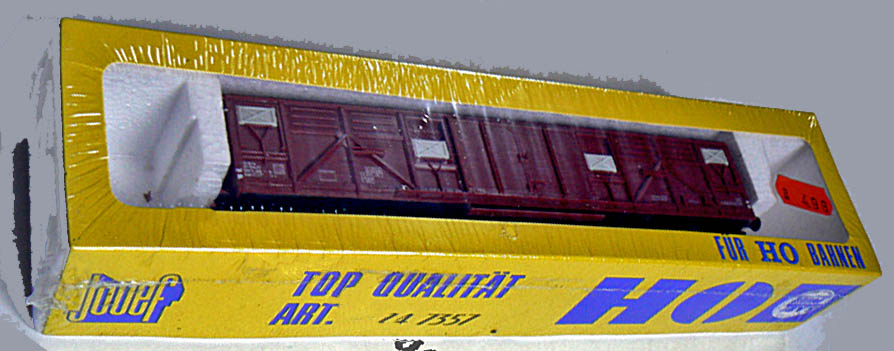
TRIX-Express "HO" et MiniTrix "N"
Trix est une entreprise de jouets allemande créée en 1838, à Nuremberg, par J. Haffner.
En 1928 Stephan Bing, concepteur du Bing OO, rejoint cette société qui se lance dans la production de trains joiets à traîner.
C'est
en 1935 que sont proposés les premiers trains miniature,à l'échelle OO
avec des locomotives en métal et des wagons en tôle avec
un nouveau système permettant de conduire deux trains sur la même voie à trois rails
sous 14 volts alternatifs. C'est la naissance de Trix-Express.
Stephan Bing, fuyant les Nazis, s'installe
en Angleterre et y lance une production en 00 en association avec "Bassett-Lowke"
: la
Trix Twin Railways.
Petit à petit les deux marques divergent et la marque Trix Express reste uniquement Allemande.
En 1967 le matériel anglais est repris par Trix Allemagne, puis ce même matériel est racheté pat Liliput Autriche en 1972.
Le troisième rail sera utilisé jusqu'en 2003.
Le matériel Trix Express est caractérisé
par des roues très épaisses, conçues en 1930, incompatibles avec le matériel
des autres constructeurs.
Ce n'est qu'en 1953 que
l'alternatif est abandonné pour le courant continu mais toujours avec une voie à 3 rails.
Ce n'est qu'en 1964 que la voie est proposée en système 2 rails sous le nom de "Trix Express International" puis "Trix HO".
Création en 1964 de la marque Minitrix Electric, un N mais à l'échelle 1:180 avant de passer au N classique 1:160
La voie était en 3 rails alimentée en courant continu permettant ainsi de commander deux locomotives sur le même circuit.
Certains wagons Minitrix sont marqués "Trix
Austria" : Ils ont été fabriqués par Roco pour le compte de Minitrix
En 1972, Trix rachète les moyens de
production en N de Röwa, alors en difficulté.
En 1994 Trix est absorbé
par Märklin.
Les moules anglais sont encore utilisés
par Bachmann.
In 1928 Stephan. Bing, designer of the Bing OO, joins this company which embarks on the production of joy trains to drag.
It was in 1935 that the first miniature trains were offered, on an OO scale with metal locomotives and sheet metal wagons with a new system
allowing to drive two trains on the same track to three rails under 14 alternative volts. It is the birth of Trix-express.
Stefan Bing, fleeing the Nazis, settled in England and launched a production in 00 in association with Bassett-Lowke: the Trix Twin
Railways.
An English division of Trix was created in 1938: The Trix Limited.
Gradually the two brands diverge and the brand Trix Express remains only German.
In 1967 English material is taken over by Trix Germany, then this same material is bought back by Liliput Austria in 1972
The third rail will be used until 2003.
The Trix Express is characterized by very thick wheels, designed in 1930, incompatible with the equipment of other manufacturers.
It was not until 1953 that the alternative was abandoned for continuous current but still with a 3 rails route.
It was not until 1964 that the way was offered in a 2 rails system under the name of "Trix Express International" then "Trix Ho".
Creation in 1964 of the Minitrix Electric brand, an N but on a 1: 180 scale before going to the classic N: 160
The track was in 3 rails supplied in direct current, thus allowing two locomotives to be ordered on the same circuit.
Some Minitrix wagons are marked "Trix Austria": They were manufactured by Roco for the Minitrix account
In 1972, Trix bought the means of production of Röwa N, then in difficulty.
In 1994 Trix is absorbed by Märklin.
English molds are still used by Bachmann.
Sous marque de Zeuke (DDR) de 1959 à 1972.
Secondary brand of Zeuke (GDR) from 1959 to 1972.
TTR (Trix Twin Railway) : "HO"
Ce nom a été imposé par l'importateur anglais, M. Basset-Lowke qui importait d'Allemagne du matériel Trix Express dès décembre 1935,
avant l'établissement d'usines Trix en Angleterre.
Le
créateur Allemand de Trix Express, Stefan Bing, quitte l'Allemagne pour
fuir le
nazisme et commence à produire du matériel 00 au
Royaume Uni en
association avec W.L. Bassett-Lowke sous la marque Trix Twin Railway
(TTR)
La
production des mécanismes TTR est réalisée en Allemagne et les
carrosseries anglaises fabriquées en Angleterre par Winteringham Ltd.
Les trains sous le nom de Trix Express sont produits la fois en Allemagne et en Angleterre. Voie
de 16,5 mm en 14 volts alternatifs
Une division anglaise de Trix est créée en 1938 : Trix Limited.
Petit à petit les deux marques divergent et la marque Trix Express reste uniquement Allemande.
Trix Twin Railway : Conduisez deux trains sur la même ligne : l'idée fut
d'alimenter, en 14 volts alternatifs, deux locomotives sur la même
voie chacune
des locomotives utilisant l'un des deux rails extérieurs et le rail central.
Une publicité de Bassett-Lowke de 1939 proclamait :
"Echelle
00 (16 m/m) - Nous étions les premiers dans cette échelle de modélisme
très connue, nous l'avons présentée dès 1922 comme un
jouet peu
couteux.
A présent nous le proposons avec la célèbre fonction "Deux trains une seule voie" capable de faire manœuvrer
deux trains sur la même voie,
comme dans la réalité (sens de
marche et sa signalisation en couleur, accrochage/décrochage) mieux que
n'importe quel autre système 00 du
marché."
Stefan
et B.L. se livraient une guerre commerciale, chacun voulant inclure TTR
dans sa production : Le catalogue de 1937 montre à chaque
page le logo
TTR mais sa couverture indique : "The Basset-Lowke Twin Train Table Railway" ....du TTTR !!
Certains modèles semblent avoir été peints au nom de Trix puis repeints en version TTTR de B.L. .....
De
son côté Stefan s'arrangeait pour que la production du TTR soit
dispersée sur plusieurs sites de production pour éviter la
prépondérance
de l'usine de Northampton, une usine B.L.
L'Angleterre resta fidèle au moteur 14 v ~ jusqu'en 1956 alors que Trix Allemagne
était passé au courant continu beaucoup plus simple et
fiable dès 1950,
mais c'est seulement en 1967 que le 3ème rail disparu.
Après-guerre la concurrence très importante du Hornby Dublo et surtout des trains Triang, bien moins chers et mieux détaillés, met en
difficulté le TTR.
En
1964 Trix Ltd passe au deux rails et normalise ses voies et ses roues
pour rendre son matériel compatible avec ceux fabriqués sur le
continent, puis propose dans son catalogue du matériel Trix Express et Liliput (adapté aux normes Trix).
En 1967 la Trix Ltd est reprise par la marque Allemande Trix Express, jusqu'en 1973 où Trix est absorbé par Rovex.
Les moules anglais sont encore utilisés par Bachmann.Du matériel TTR a été vendu sur le marché américain de 1949 à 1960.
This name was imposed by the English importer, Mr. W.L. Basset-Lowke,
who imported from Germany Trix Express equipment as early as
December 1935, before the
establishmen of Trix plants in England.
The German creator of Trix Express, Stefan Bing, leaves Germany to flee
the
Nazism and begins to produce material 00 in the United
Kingdom in
association with W.L. Bassett-Lowke under the trademark Trix Twin
Railway (TTR)
The production of the TTR mechanisms is carried out in Germany and the engines manufactured in England by Winteringham Ltd.
Trains under the name Trix Express are produced in both Germany and England. Track of 16.5 mm, three rails, in 14 volts alternating
An English division of Trix was created in 1938: The Trix Limited.
Gradually the two brands diverge and the brand Trix Express remains only German.
Trix Twin Railway: Drive two trains on the same line: the idea was to power two locomotives on the same track
each of the locomotives using one of the two outer rails and the central rail.
A Bassett-Lowke advertisement of 1939 proclaimed:
"Scale 00 (16 m / m) -
We were the pioneers
of this amazingly popular size in railways, and first introduced it in 1922 as
an inexpensive toy. Now it has been
revived in the form of the famous Twin Trains,
which are capable of more model railway manoeuvres (shunting, auto-coupling an
uncoupling, colour light signalling, two trains on one track) than any other
gauge "00" railway on the market. "
Stefan and W.L were engaged in a commercial war, each wishing to
include TTR in its production: The 1937 catalog shows on each page
the
TTR logo but
its cover says: "The Basset-Lowke Twin Train Table Railway" .... do TTTR !!
Some models seem to have been painted in Trix version then repainted in version TTTR of B.L. .....
For his part, Stefan arranged that the production of the TTR be
dispersed on several production sites to avoid the preponderance of the
factory of Northampton, a factoty B.L.
England remained faithful to the engine 14 v ~ until 1956 when Trix Germany had switched to DC much simpler and reliable,
as early as 1950, but it was only in 1967 that the third rail disappeared.
After the war the very important competition of the Hornby Dublo and especially of the trains Triang, much cheaper and better detailed,
puts in difficult the TTR.
In 1964 Trix Ltd switched to two rails and normalized its tracks and
wheels to make its equipment compatible with those made on the
mainland,
Then offers in its catalog the Trix Express and Liliput equipment (adapted to Trix standards).
In 1967 Trix Ltd was taken over by the German brand Trix Express, until 1973 when Trix was absorbed by Rovex.
English molds are still used by Bachmann.
TTR equipment was sold on the US market from 1949 to 1960.
Tyco : "HO"
Marque
Américaine "Tyler Manufacturing Compagny", est créée en 1952
par le fils de John Tyler créateur de "Mantua", Norman Tyler.
Suite à la croissance de la demande de matériel "prêt à rouler", la famille Tyler décide de créer cette filiale pour
produire du matériel en HO
puis des modèles complets vendus en boites bleues.
Très fortement liée à la société Mantua elle en a suivi le destin.
Dans les années 1960 la reproduction de matériel ferroviaire devient importante
et les boites sont de couleur rouge.
Racheté par "Consolidated Food" vers 1970, la fabrication est
délocalisée du New Jersey à Hong Kong, les boites sont devenues brunes.
En 1980 apparaît la "Tyco Industrie". Le dernier catalogue Tyco parait en 1993.
American brand Tyler Manufacturing Compagny, is created in 1952 by the son of John Tyler creative of Mantua, Norman Tyler.
Following the growth of the demand for equipment “ready to roll”, the family Tyler decides to create this subsidiary to produce HO
equipment then sold complete models in blue boxes.
Very strongly related to the Mantua company it followed destiny from there.
In the years 1960 the railway reproduction of equipment becomes important and limp them are of red.
Repurchased by Consolidated Food around 1970 and manufacturing was shifted from New Jersey to Hong Kong, boxes them became
brown.
In 1980 Tyco Industry appears. The last Tyco catalogue appears in 1993.
UTZ : "Om"
Société Suisse aujourd'hui disparue. Elle fabriquait du matériel en Om, principalement pour la voie à crémaillère.
UTZ avait repris une partie du catalogue Fama, autre marque Suisse de modèles réduits de haute qualité, fermée en 1984.
UTZ à arrèté sa production en 1988 qui est reprise par Framos GmbH jusqu'en 1992
En 1992 la production est reprise par "Les trains miniatures Kiss" et en 1994 Roco continué la fabrication sous la marque "Roco Alpin Line".
En 2004 et jusqu'en 2016 cette production, qui était réalisée en très petite quantité, à été reprise par la société Suisse Alpin Line
surtout spécialisée dans les modèles réduits d'automobiles
Swiss company now disappeared. It manufactured equipment in Om, mainly for the rack track.
UTZ had taken over part of the Fama catalog, another Swiss brand of high quality models, closed in 1984.
UTZ stopped its production in 1998, taken over by Framos GmbH until 1992.
In 1992 production was taken up by "Les trains miniatures Kiss" and in 1994 Roco continued manufacturing under the brand
"Roco Alpine line".
In 2004 to 2016 this production, which was produced in very modest amount, taken back again by the Swiss company Alpin Line
especially specialized in model cars
Varney : "HO"
Entreprise créée en 1936, à Chicago USA, par Gordon Varney.
Spécialisée dans la production de matériel HO à construire de haute qualité, en carton et bois avec des pièces en laiton et en
zamac pour les locomotives.
En 1939 les wagons étaient proposés avec un chassis en bois et une caisse en feuille d'aluminium ou de laiton.
La
production de wagon plastique injecté (Tenite) commence dès 1940 mais
ce n'est qu'en 1950 que l'ensemble de la production
est proposée en plastique avec un chassis en métal moulé.
Vers 1952 Varney possèdait deux atliers de production, l'un à Coral Gables (Floride), l'autre à Porto Rico.
En 1955 Varney, alors basé à Miami (Floride) produit du matériel pour Gilbert HO.
L'entreprise fait faillite en 1960 et est vendue à Life Like qui délocalise l'usine à Baltimore. La marque a définitivement
disparue en 1970
Company creates in 1936, in Chicago USA, by Gordon Varney.
Specialized in the production of HO equipment to be built of high quality, in cardboard and wood with brass and
Zamac
for locomotives.
In 1939 the wagons were offered with a wooden chassis and a case in aluminum or brass sheet.
The production of injected plastic wagon (tenite) began in 1940 but it was not until 1950 that the whole production
is offered
in plastic with a molded metal chassis.
Around 1952 Varney had two production workshops, one in Coral Gables (Florida), the other in Puerto Rico.
In 1955 Varney, then based in Miami (Florida) produced equipment for Gilbert Ho.
T
he company went bankrupt in 1960 and was sold to Life Like which relocates the factory to Baltimore. The brand definitively
disappeared in 1970
VB : "HO"
Marque
française, créée en 1946 par J.A. Vollon et A. Brun, fabriquant du
matériel (des wagons puis des voies en 1945),
vendu à l'unité dans des
magasins spécialisés comme "La Maison des Trains" à Paris.
En 1955 production de la motrice BB 9001 et apparition de boites complètes marchandises.
Vers 1958 apparition d'une voiture inox "Mistral" et d'un fourgon générateur.
A cette même date lancement de "Boites à construire" : wagons, voiture inox et une rame banlieue Budd.
La
production pouvait se diviser en deux séries : La série "Maquette" dont
le matériel était fabriqué à la main et,
à partir de 1956, la série "Industrielle" moulée en zamac ou en plastique.
La firme est reprise par Triang
en 1960 mais les stocks, rachetés par D. Lejeune, ont été diffusés jusqu'en 1972.
En 1971, au rachat de Triang par Hornby, la marque VB disparaît.
sold individually in stores specialized like "La Maison des Trains" in Paris.
In 1955 production of the motor BB 9001 and appearance of complete boxes of goods.
Around 1958, the appearance of a "Mistral" stainless steel car and a generator van.
On the same date, the launch of "Boxes to build": wagons, stainless steel car and a Budd suburban train.
The production could be divided into two series: The "Maquette" series whose material was made by hand and, from 1956,
the "Industrial" series molded in zamak or plastic.
The firm was bought by Triang in 1960 but the stocks, bought by D. Lejeune, were distributed until 1972.
In 1971, when Triang was bought out by Hornby, the VB brand disappeared.
VEB (Volkseigene Betrieb = Entreprise publique) : "HO"
Forme juridique des entreprises industrielles et de services Allemandes dans la zone
d'occupation soviétique et plus tard de la RDA.
En 1979 le VEB Kombinat, ou VEB, intègre les
différentes marques (usines et entreprises) déja regroupées sous
l'appellation de "Kombinat"
(groupe) au détriment des marques individuelles (Ehlcke - Schicht)
L'organisation de toutes les entreprises étaient de la responsabilité de la "Commission Nationale de Planification".
Les VEB Kombinat de Sonneberg regroupaient les entreprises de jouets et
le VEB Piko Sonneberg est devenu le "Erzeugnisgruppenleitrieb"
pour le modélisme ferroviaire : Site de production Modélisme ferroviaire Prefo Dresde Usine II.
La plupart de la production du modélisme ferroviaire de la RDA a été
commercialisée sous le nom générique de "Piko" et non sous le nom de
chacun des fabricants.
Legal form of the Germany industrial companies and services in the Soviet zone occupation and later in GDR.
In 1979 the VEB Kombinat, or VEB, integrates the various brands (factories and companies) already gathered under the name of “Kombinat” (groups)
to the detriment of the individual brands (Ehlcke - Schicht)
The organization of all the companies were responsibility of the “National Commission of Planning”.
The VEB Kombinat in Sonneberg gathered the companies of toys and the VEB Piko Sonneberg became the “Erzeugnisgruppenleitrieb” for
railway model making: Model making railway production site Prefo Dresden Usine II.
Most the production of the railway model making of GDR was marketed under the generic name of “Piko” and not under the name of each manufacturer.
Walthers : "HO"
La firme "Wm. K. Walthers Inc". a été créée en 1932 à Milwaukee (USA) pour produire du train jouet en 0.
En 1937 création d’une ligne HO qui, après une interruption pendant la guerre, remplace petit à petit le "0".
Dès 1994 Walthers ouvre son site internet Walthers.com qui participe fortement à l'expension de l'entreprise.
Elle a absorbé Life Like en 2005 et conserve la ligne Proto 1000 et Proto 2000.
En 2016 Walthers abandonne la marque Life Like.
Walthers produit toujours (2020) trois lignes principales de matériel
HO : Walthers Proto, Walthers MainLine et Walthers TrainLine
et commercialise l'ensemble des produits pour les modèles réduits de chemin de fer..
The firm created in 1932 in Milwaukee (USA) to produce train toy into 0.
In 1937 creation of a line HO which, after an interruption during the war, replaces gradually the ”0".
From 1994 Walthers opened its Walthers.com website which strongly participated in the expansion of the company.
It absorbed Life Like in 2005 and retained the Proto 1000 and Proto 2000 line.
In 2016 Walthers abandoned the Life Like brand. Walthers still produces (2020)
three main lines of HO equipment: Walthers Proto, Walthers Mainline and Walthers Trainlin and markets all the products for
reduced railway models.
Wells Brimtoy : "O"
La Wells and Co, entreprise de jouets a été créée au nord de Londres, à Walthamstow, (Angleterre) en 1919
par A.W.J. Wells,
la marque bien connue "Wells O 'London" a été lancée en 1924.
En 1932 Wells fusionne avec l'entreprise de jouets Brimtoy Ltd qui fabrique principalement des trains.
Wells était le partenaire dominant et les deux usines ont été déplacées à Walthamstow, vers 1938.Suite à l'absorption de Brimtoy par Wells, la société a continué à utiliser les noms "Wells" et "Brimtoys", ainsi que "Wells Brimtoy"
ce qui n'aide pas à l'identification ou à sa datation.
En 1943 la société "Wells Brimtoy Distributor" est créée.
Wells Brimtoy a continué à opérer de Walthamstow puis a déménagé à Anglesey au Pays de Galles pour fermer en 1965
When Brimtoy Ltd was acquired by Wells in 1932, Wells was the dominant partner and the factories were merged in Walthamstow, around 1938.
Following the absorbtion of Brimtoy by Wells, the company continued to
use both the Wells and Brimtoys names, as well as Wells Brimtoy,
which does not help with identification or dating.
In 1943 the "Wells Brimtoy Distributor" created.
Wells Brimtoy continued to operate from Walthamstow then moving to Anglesey in Wales, finally closing in 1965
Wesa : "13mm"
Entreprise familiale Suisse à Inkwil (canton de Berne), a commencé de produire des wagons en 1946 :
Les premiers wagons avaient une caisse en bois recouverte d'un papier coloré à l'échelle 1/110 avec un écartement de 13mm.
Puis vers 1947 ils ont été fabriqués en plastique injecté.
A noter que les wagons citerne à bogies avaient des
citernes en tôle
façonnées par Gebrüder Hoffmann AG à Thun.
Les locomotives électriques
fonctionnaient sous courant alternatif.
En 1951 passage à l'échelle de 1/100, toujours sur voies de 13mm, mais alimentation en courant continu.et production de wagons
à deux
essieux.
Vers 1960 une production en "N" est lancée.
Le dernier catalogue Wesa est sorti en 1966/1967.
Depuis le matériel de production a été repris par des pationnés.
A noter que l'entreprise Wesa AG, moulage par injection de plastique, est
toujours en activité à Inkwil (2023) fabrique des pièces
pour l'industrie mais des modèles réduits Wesa sont toujours en vente (2025), voir les site wesa-bahn.ch ou wesabahn.ch
(Swiss family business in Inkwil (canton of Bern), began producing wagons in 1946.
The first wagons had a wooden box recovest with a colored paper on a 1/110 scale with a 13mm spacing.
Then around 1947 they were made with injected plastic.
Note that the Bogies cistern wagons had sheet metal tanks shaped by Gebrüder Hoffmann AG in Thun.
Electric locomotives operated on alternating current.
In 1951 the scale became 1/100, still on tracks of 13mm, but direct power supply and production of wagons with two axles.
Around 1960 a "N" production was launched.
The latest Wesa catalog released in 1966/1967.
Since the production equipment has been taken up by pationized. Note that the Wesa AG company, plastic injection molding, is still active
in Inkwil (2023) manufactures parts For the industry but reduced Wesa models are still on sale (2025), see the site wesa-bahn.ch or
wesabahn.ch
Williams : "O"
Société Américaine, fondée en 1971 par Jerry Williams à Columbia (Maryland USA).
Spécialisée dans la reproduction du matériel Lionel et Ives, Williams avait racheté leur matériel de production en fer blanc, ainsi que,
en 1980, celui du petit fabriquant peu connu Kusan (concurrent de Lionel dans les années 1950).
Tout ce matériel a finalement été revendu à MTH.
En 2007, La société Williams a été rachetée par Bachmann Industries qui en a conservé la marque (Williams by Bachmann) pour
diffuser du matériel en "0", produit en Chine
Williams Bachmann produit deux lignes de matériel, l'une classique l'autre spécialisée dans la reproduction de modèles anciens la
US company, founded in 1971 by Jerry Williams in Columbia (Maryland the USA).
Specialized in the reproduction of equipment Lionel and Ives, Williams had repurchased their equipment of tin production, and also,
in 1980, that of small manufacturing little known Kusan (competitor of Lionel in the years 1950).
All this equipment was finally resold to MTH.
In 2007, the company Williams was repurchased by Bachmann Industries which preserved the brand (Williams by Bachmann)
to diffuse equipment in “0”, produced in China
Williams Bachmann produces two lines of equipment, one classical the other specialized in the reproduction of old models
the “Golden Memories Series”.
Wimmer Heinrich - Voir HWN
Wrenn : "HO"
Fondée
en 1950 par les frères Georges et Richard Wrenn à Lee Green (SE de Londres) en Grande Bretagne, la "G&R
Wrenn" a commencé
à fabriquer des voies pour le 00 en 2 et 3 rails, puis des voies en TT.
En 1955 l'entreprise s'installe à Basildon (Essex) et y reste jusqu'en 1992.
En 1957
l’entreprise devient la société : "G&R Wrenn limited".
En 1966 "Lines Bros Ltd" prend une participation majoritaire dans l’entreprise, y
apportant les moules de "Hornby Dublo".
Un lien apparaît entre Wrenn et Tri-Ang
(appartenant également à Lines Bros) entre 1969 et 1972 et du matériel est commercialisé
sous l'appellation "Tri-ang Wrenn", mais Lines Bros connaît de graves difficultés en 1972 et Wrenn redevient une marque indépendante
sous le nom de "Wrenn Railways".
En 1992 Wrenn est mis en vente et cesse son activité. Dapol, en 1993 reprend le stock et le matériel.
La majorité du
matériel d'origine est détruit dans un gigantesque incendie à l’usine de Winsford, en
1994
Une
partie de la production ayant été transférée à Llangollen (Pays de Galles), la vente du matériel
Wrenn, dans des boites Wrenn, continue
jusqu’en 1997
En
novembre 2001, trois collectionneurs passionnés, rachètent la "G&R Wrenn
Ltd" à Dapol (matériel, moules, pièces détachées).
En 2015 fermeture du "Wrenn Collectors Club" et fin des activités de G1R Wrenn Ltd.
Founded in 1950 by brothers Georges and Richard Wrenn in Lee Green (SE of London) Great Britain, G & R Wrenn began
manufacturing tracks for the 00 in 2 and 3 rails, then tracks in TT.
In 1955 the compagy moved in Basildon (Essex) where it remained until 1992.
In 1957 the company becomes a limited company: the G&R Wrenn limited.
In 1966 Lines Bros Ltd takes a majority holding in the company, bringing the moulds of Hornby Dublo there.
A link appears between Wrenn and Tri-Ang (also belonging to Lines Bros) between 1969 and 1972 and equipment is marketed
under name tri-ang Wrenn, but Lines Bros has serious problems in 1972 and Wrenn becomes again an independent brand
under the name of Wrenn Railways.
In 1992 Wrenn went on sale and ceased trading. Dapol, in 1993 takes back the stock and the material.
The majority of equipment is destroyed in a gigantic fire in the factory of Winsford, in 1994.
Part of the production having been transferred to Llangollen (Wales), the sale of Wrenn equipment, in boxes Wrenn continues until 1997
In November 2001, three collectors, enthusiast, repurchase the G&R Wrenn Ltd in Dapol (material, moulds, spare parts).
2015 - The Wrenn Colletors Club losed and G&R Wrenn Ltd will close.
L'un des plus grands fabricants de jouets d'après-guerre du Japon,
c'est aussi l'un des grands acteurs du marché de la télécommande
radio
A produit des trains en fer blanc jusqu'en 1960. Ce matériel était distribué aux USA par
Japanese company, creates in Tokyo in 1951. (Known as "Yone" or simply "Y")
One of Japan's largest and most prodigious post-war toy
manufacturers and an early participant in the growing radio control
market.
With product of the tin trains until 1960. This equipment was distributed to the USA by Cragstan .
Yonezawa's toy division was transferred to Segatoys in May 1994.
Zerba : "TT"
C'est
le nom d'un magasin de Prague (République tchèque) qui commercialise du matériel sous son propre nom
:
A noter qu'il existe (2025) des magasins de jouets du nom de Zerba :
Zerba sro, náměstí Přátelství 1518/4, 102 00 Praha, Hostivař (centre commercial Černá Růže )
Ben-Zerba s.r.o. Manârrska 335-261 01, Pfibram IV (www.ben-zerba.cz)
Même origine ??
It is the name of a store in Praha (Czech Republic) which markets equipment under its own name:
It should be noted that there exists now (2025) toys shop :
Ben-Zerba s.r.o. Manârrska 335-261 01, Pfibram IV (www.ben-zerba.cz)
Same origin ??
Zeuke : "TT"
Fondée par Werner Zeuke en 1945 à Berlin Est, l'entreprise commence à fabriquer des trains en "0" dès 1946 à la demande des
autorités soviétiques qui veulent relancer l'industrie du jouet. Elle utilise le procédé 3 rails isolés qui permet facilement l'inversion de marche
à distance en courant alternatif
(18/20V).
La firme prend le nom de "Zeuke und Wegwertrh KG" en 1949.
En 1957 présentation du premier matériel en TT.
Zeuke commercialise le matériel TT sous le nom de TTHobby.
A partir de 1960 devant le succès du TT la production en "0" est diminuée pour être abandonnée quelques années plus tard.
Zeuke est nationalisée en 1972 sous le nom de VRB Berliner TT Bahnen.
A la réunification de l'Allemagne, elle reprend le nom de Zeuke mais fait rapidement faillite. En 1993 Hans-Jürgen Tillig reprend
"BTTB Zeuke GmbH" et lance sa nouvelle société "Berliner TT Bahnen Pilz GmbH & Co. KG", toujours installée à Berlin.
À la fin de 1993 ce nom devient Tillig
Modellbahnen Gmbh & Co.KG et la société est transférée à Sebnitz en
Saxe.
Founded by Werner Zeuke in 1945 in East Berlin , the company starts to manufacture trains in “0” by 1946 at the request of
Soviet authorities which want to start again toy industry. It uses the process 3 rails isolated which allows the reversing easily
remotely in alternative voltage (18/20V).
The firm takes the name of Zeuke und Wegwertrh KG in 1949.
In 1957 presentation of the first equipment in TT. .
Zeuke markets equipment TT under the name of TTHobby.
From 1960 in the face of the success of TT production in "0" was decreased to be abandoned a few years later.
Zeuke is nationalized in 1972 under the name of VRB Berliner TT Bahnen .
With the reunification of Germany, it takes again the name of Zeuke but quickly gone bankrupt. In 1993 Hans-Jürgen Tillig retakes
BTTB Zeuke GMBH and launches its new company Berliner TT Bahnen Pilz GMBH & Co. KG, always installed in Berlin.
At the end of 1993 this name becomes Tillig Modellbahnen GMBH & Co.KG and the company is transferred to Sebnitz in Saxony.
Zamac ou
Zamak :
Cet
alliage (95% de zinc, 4% d’aluminium, le 1% restant étant du cuivre et des
traces de magnésium) est particulièrement facile
à mouler et à injecter.
Malheureusement la moindre impureté dans le zinc conduisait
à la « maladie du Zamac » qui, au fil du temps, a détruit ou
déformé de
nombreux objets moulés.
This alloy (95% zinc, 4% aluminum, the remaining 1% being copper and
traces of magnesium) is particularly easy to mold and
to inject.
Unfortunately the smaler foulness in zinc led to "Zamac disease",
which, with time, destroyed or deformed many molded objects.